

Compressed-air System > Clutch Booster
Pick your vehicle
clutch booster: complete repair guide
Driving a vehicle with a manual transmission is a daily routine for many drivers and professional operators. To ensure a smooth and safe driving experience, it is critical that the driver’s physical input – pressing the clutch pedal – is effectively and accurately transferred to the vehicle’s powertrain. In the case of light passenger cars, a standard hydraulic system (master cylinder and slave cylinder) or even a simple mechanical cable is sufficient. But the heavier the vehicle, the more powerful its engine and the greater the torque, the more massive and stronger the clutch basket is required. A stronger clutch basket, however, means many times stronger diaphragm springs. If such a system had to be operated solely by the driver’s foot, pressing the pedal would be physically exhausting or even impossible. This is where an ingenious mechanical assistant comes into play – the clutch booster or clutch servo . 
In this extremely comprehensive and technical guide, we dive deep into the world of clutch boosters. We examine in detail their construction, different types, operating principles, wear anatomy and signs of malfunction. We also provide an overview of which most common vehicle models these devices are found on, how to properly diagnose and maintain them, and which world-renowned spare parts manufacturers to prefer when the time comes to replace this vital component.
What is a clutch booster and what purpose does it serve?
A clutch booster is a complex electromechanical, pneumatic or vacuum-powered device that is integrated into a vehicle's clutch hydraulic system. Its primary and only function is to multiply the mechanical force from the driver's foot, thereby drastically reducing the effort required to depress and hold the clutch pedal. If you've ever sat behind the wheel of an old truck without power steering, you know that depressing the clutch pedal felt more like a weightlifting workout. In modern power steering systems, however, depressing the pedal is effortless, more like the feel of a regular passenger car pedal.
Physically speaking, the problem is torque. In order for a large diesel engine (such as that found in a truck or large SUV) to prevent the clutch disc from slipping under acceleration, the clutch pressure plate in the clutch basket must press the disc against the flywheel with enormous force. This enormous force must be overcome when the pedal is depressed. The clutch servo uses an external energy source (either vacuum produced by the engine or compressed air produced by a compressor) to push the piston in the clutch slave cylinder in parallel with the driver's foot force, doing most of the hard work for the driver.
types of clutch boosters and their detailed working principle
Depending on the size, construction, and purpose of the vehicle, two types of clutch boosters are mainly used in the automotive industry: vacuum boosters and pneumatic or compressed air boosters.
1. vacuum clutch boosters
Vacuum boosters are mostly found in lighter commercial vehicles, large SUVs and certain specific passenger cars. Their operating principle is very similar to a regular brake booster.
How does it work? The booster consists of a large metal or plastic box, which is divided into two chambers by a rubber diaphragm on the inside. One chamber is connected to the vehicle's intake manifold (on gasoline engines) or to a separate vacuum pump (on diesel engines). When the clutch pedal is in the rest position, a vacuum (rareness) prevails in both chambers and the diaphragm is balanced. When the driver presses the clutch pedal, a small valve inside the booster opens, allowing atmospheric pressure to enter the chamber on the pedal side. The pressure difference (vacuum on one side, normal air pressure on the other) forces the diaphragm to move in the direction of the vacuum. This diaphragm is directly connected to a push rod, which compresses a hydraulic piston and helps to disengage the clutch. When the pedal is released, the vacuum valve closes, the vacuum is restored in both chambers and a strong return spring pushes the diaphragm back to its original position.
2. pneumatic / air clutch servos
This is the absolute standard for heavy equipment, trucks, buses and heavy tractors. Since these vehicles already have a powerful compressed air system and compressor for the air brakes, it makes sense to use the same energy to operate the clutch.
How does it work? A pneumatic clutch booster (often simply called a clutch servo) is more compact in design but more complex than a vacuum booster. It is a combined device that contains both a hydraulic working cylinder and a pneumatic cylinder. When the driver presses the clutch pedal, hydraulic fluid moves from the clutch master cylinder through pipes into the clutch booster. The hydraulic pressure acts on a small control piston inside the booster. This control piston opens a special pneumatic valve that lets compressed air (usually 8-10 bar) from the vehicle's air tank into the large air chamber of the booster. The compressed air pushes a large air piston with enormous force, which in turn directly pushes the clutch fork or clutch release mechanism. The entire system is proportional: the harder the driver presses the pedal, the more hydraulic pressure is generated, the more the air valve opens and the more compressed air pushes the clutch. When the pedal is released, the air valve closes, the pressure in the air chamber is released to the atmosphere through the exhaust port, and the springs push the system back to its original position.
What vehicles and car models are equipped with clutch boosters?
A clutch booster is not a part you'd find in a small city car or a regular family station wagon. These are specific components for vehicles designed for heavy duty work, hauling heavy loads or operating in extreme conditions.
heavy trucks and buses (pneumatic servo systems)
In this category, a clutch booster is an inevitable standard. The clutches of heavy-duty vehicles with manual or semi-automatic transmissions are so massive that it is practically impossible to disengage them manually without the help of compressed air.
- Volvo Trucks: Models such as the legendary Volvo FH, FM and FMX series use highly advanced pneumatic clutch servos, often integrated with i-Shift electronic control systems.
- Scania: Scania R-series, P-series and G-series trucks are known for their exceptionally reliable hydraulic-pneumatic clutch boosters. On models with the Opticruise system, the booster is often controlled fully electrically.
- Mercedes-Benz: Actros, Arocs and Atego series. These trucks place great emphasis on clutch smoothness, which is why their clutch servos are very precisely calibrated.
- MAN and DAF: The MAN TGX/TGS series and the DAF XF/CF series use similar pneumatic solutions manufactured by WABCO or Knorr-Bremse.
commercial vehicles and light trucks
Smaller distribution trucks and heavier vans use either vacuum or compressed air boosters, depending on the level of equipment.
- Isuzu N-Series (NQR, NPR)
- mitsubishi fuso canter
- iveco daily (heavier versions)
large and heavy SUVs (mostly vacuum boosters)
True frame-based SUVs of the 1990s and 2000s often had turbodiesel engines with huge torque that required very strong clutches. A vacuum clutch booster is a very common feature on these cars.
- Nissan Patrol: especially the legendary Y60 and Y61 body Patrols (with 2.8 TD and 4.2 TD engines), which are widely used in extreme off-roading . Their clutch booster is often located right behind the master cylinder, near the pedal.
- Toyota Land Cruiser: J70, 80 series and 100 series (especially with 4.2 liter diesel engines 1HD-T and 1HZ). These are perpetual motion machines where the clutch booster makes maneuvering in the forest and towing heavy trailers significantly more comfortable.
- Mitsubishi Pajero / Shogun: The stronger diesel versions of older generations also used clutch vacuum boosters to increase driver comfort.
specific and sporty passenger cars
Although rare, there have been sports cars in automotive history with factory clutches so stiff (to handle the enormous torque) that the manufacturer found it necessary to install a clutch booster. A good example is the 90s supercar Nissan Skyline GT-R (R32, R33, R34) , which used a hydraulic clutch booster (often powered by the power steering pump) to make everyday driving with a sporty clutch bearable.
Main symptoms: how to recognize a faulty clutch booster?
Since the clutch booster is a critical safety and comfort component, its failure gives the driver a very clear indication. Early recognition of the symptoms will save you from unexpected delays and higher repair bills, as driving with a defective booster can quickly damage the clutch disc, flywheel and gearbox synchronizers.
1. exceptionally heavy clutch pedal ("rock-hard pedal")
This is by far the most common symptom. When the clutch booster stops working, the force multiplier effect is lost from the system. You suddenly have to overcome the entire resistance of the clutch basket springs using only your own thigh muscle. In heavy trucks, this can mean that it is almost impossible to press the pedal all the way to the floor. In SUVs with a vacuum booster, you will feel that the pedal is many times heavier than usual, quickly making driving in city traffic tiring.
2. Air leaks and hissing sound
For pneumatic clutch servos, this is a very specific and dangerous sign. If you press the clutch (especially with the engine stopped, but if there is still air in the system) and hear a loud, continuous hissing sound from the booster or air spontaneously escaping through the muffler (outlet), the booster's internal air seals, diaphragms or O-rings have broken. You may also notice that the vehicle's air pressure gauge in the dash drops abnormally quickly with each clutch press.
3. Hydraulic fluid leaks
Because the power steering is where hydraulics and pneumatics/vacuum come together, the internal seals are critical. When the hydraulic cylinder seals wear out, clutch fluid (dot 4) will begin to leak. You may notice a drip under the vehicle right next to the transmission (where the servo is mounted) or, in the case of SUVs, the fluid may leak directly into the cabin, onto the driver's floor mat. If the clutch fluid reservoir is emptying inexplicably, checking the power steering for leaks is one of the first steps.
4. vague clutch feel and "dragging"
If the internal mechanism of the booster gets stuck due to corrosion or dirt, the pedal movement may no longer be in sync with the actual clutch disengagement. You press the pedal all the way down, but the booster does not respond with enough force, resulting in the clutch not fully disengaged. Engine torque is still transmitted gently to the transmission. This causes difficult gear changes (especially 1st gear and reverse) and the transmission gears to rattle during shifts. In the long run, this will destroy the transmission.
5. Pedal return delay (pedal remains on the floor)
Sometimes the booster is defective in such a way that the clutch is depressed, but the exhaust valve is clogged or the return spring is broken. In this case, you release your foot from the pedal, but the pedal rises very slowly or remains completely stuck to the floor, leaving the car in neutral and making it impossible to drive forward.
What causes internal clutch servo failures?
These components are designed to withstand hundreds of thousands of hours of operation and millions of pedal strokes. Yet they wear out. Why?
- Condensation and moisture (enemy number 1 of pneumatic systems): The air in a heavy-duty compressed air system must be completely dry. If the vehicle’s air dryer filter is old or the compressor is worn out, moisture can enter the system with the compressed air. This moisture accumulates in the aluminum or cast iron housing of the clutch booster. Water causes severe internal corrosion (rust). However, the rust particles act like sandpaper, destroying the booster’s internal rubber o-rings and seals with every pedal stroke, leading to an inevitable air leak.
- Old and contaminated hydraulic fluid: The brake fluid used in the clutch system is hygroscopic – it absorbs moisture from the air. Over time, the fluid deteriorates, becoming dark and acidic. This acid breaks down the rubber seals in the hydraulic cylinder from the inside. Therefore, changing the clutch fluid regularly every 2 years is also vital to extend the life of the clutch servo.
- Abrasive dirt from the environment: Clutch boosters, especially those located on the transmission in the outdoor environment, are constantly bombarded with salt water, sand, and mud from the road. Although they have rubber dust boots, these rubber boots age, crack, and tear. If the boot is broken, abrasive dust can get directly onto the pushrod of the booster. The dust will scratch the rod, which will soon break the seals.
- Natural material fatigue: the large rubber membrane inside the vacuum amplifiers is in constant flexing. After a few decades, the rubber simply becomes brittle and tears under the force of the vacuum. The metal springs inside the system also fatigue and break.
Clutch booster replacement and maintenance: step-by-step overview
Warning: The following is an informative overview. Repairing pneumatic and hydraulic systems requires specific knowledge and tools. Compressed air systems operate under dangerously high pressure. It is recommended that heavy equipment repairs be left to qualified professionals.
preparation and safety requirements
It all starts with safety. When replacing a pneumatic clutch servo on a heavy-duty vehicle, the first thing to do is to make sure that the vehicle’s wheels are blocked with chocks, as the work can cause air pressure to be lost, which can affect other systems. The next critical step is to depressurize the system . All compressed air must be released from the vehicle’s air tanks through the appropriate valves. When working with the hydraulic system, wear safety glasses and gloves, as brake fluid is a very aggressive chemical that can damage skin and corrode the vehicle’s paintwork in an instant.
removal process
First, the pneumatic air pipes are disconnected. Special quick-release couplings (voss fittings) are often used there, and the correct technique for disassembling them is required in order not to damage the plastic pipes. Then the hydraulic pipe is removed. It is a good idea to have a drip tray handy, as brake fluid will flow out of the pipe. Finally, the clutch booster pushrod is separated from the clutch fork. It is usually secured with a cotter pin and a cylindrical pin. Once the pushrod is free, the retaining bolts that hold the booster to the gearbox housing are unscrewed and the booster is removed.
installation and calibration of a new amplifier
The new unit is installed in the reverse order. Cleanliness is critical. All hydraulic hose ends and fittings must be thoroughly cleaned before connection. Adjusting the length of the push rod is also very important. On many models, the push rod is threaded. The rod must be adjusted to the exact length specified by the factory to ensure correct free play and complete disengagement of the clutch. If the rod is adjusted too long, the clutch will be under constant gentle pressure, which will lead to rapid clutch disc slippage and wear.
bleeding the system – the most difficult phase of the repair
After installing a new clutch booster, there is air in the hydraulic system. The air is compressible and does not transfer force - resulting in a "soft" or bottoming pedal that does not disengage the clutch. The system must be bled.
Bleeding heavy-duty and complex clutch boosters is significantly more difficult than bleeding passenger car brakes. Often, long pipes run from the cab (master cylinder) down to the transmission, creating height differences where air bubbles tend to get trapped. The traditional "pump and hold" two-man method may not work here.
Professional workshops use special pressure bleeders . Fresh hydraulic fluid is forced from the reservoir into the system under pressure while opening the bleed nipple on the clutch booster. This forces air bubbles out forcefully. Another and very effective method for heavy equipment is reverse bleeding . In this method, fresh fluid is pumped in with a special syringe from the lower bleed nipple on the clutch booster, forcing the fluid (and air bubbles) upwards towards the master cylinder reservoir. Since air naturally wants to rise upwards anyway, this is a very logical and quick method for bleeding stubborn systems.
repair kits vs. replacing the entire assembly
Since an original clutch booster can cost hundreds or even thousands of euros for a heavy-duty vehicle, car owners are often tempted to use repair kits. A repair kit usually includes all the internal rubber O-rings, cuffs, valves and dust caps.
When is a repair kit useful? If the amplifier has only recently started to leak air slightly or the dust cover has broken, but the inner aluminum or cast iron cylinder wall is mirror-smooth, without scratches and without any corrosion. In this case, a skilled mechanic can disassemble the amplifier, clean it in an ultrasonic cleaner, assemble new seals with special pneumatic grease and the device will work again for years.
When should the entire unit be replaced? In nine out of ten cases, the fault is discovered too late. If the amplifier has been running for a long time with a faulty air dryer, the water has managed to corrode the cylinder walls. Even a tiny rust pore or longitudinal scratch on the cylinder wall means that the new rubber seal will wear out again within a few weeks if it moves against it and the leak will return. Also, the housings of old amplifiers are often oxidized on the outside and the bolts break when they are disassembled. In such cases, the only rational solution, both financially and in terms of reliability, is to buy a new, factory-assembled and tested spare part.
How to choose the right spare part and which brands to trust?
The clutch booster is a critical safety component. Using a cheap, unknown Asian copy on a heavy-duty truck carrying 40 tons of cargo is irresponsible and a life-threatening risk. A poor-quality booster shell bursting under pressure or an unexpected seal failure could leave the driver unable to shift gears or engage the clutch on a dangerous descent.
To ensure the best durability and absolute compatibility, you should always prefer products from companies that supply these same parts to car manufacturers' factory conveyors (OEM - original equipment manufacturer).
top-class brands in the world of pneumatics and hydraulics:
- wabco: the absolute global leader in electronic, pneumatic and brake systems for heavy-duty vehicles. wabco clutch servos are synonymous with uncompromising quality and durability. they are used as original equipment (oe) in most european trucks.
- knorr-bremse: another german industrial giant, wabco's biggest competitor. their pneumatic clutch servos are technologically extremely advanced and extremely resistant to corrosion. well-known oe supplier for scania, man and volvo systems.
- Kongsberg Automotive: a Norwegian company known globally for its specialized powertrain control systems, including clutch servos. A highly regarded product found in many Volvo and Scania vehicles.
- FTE Automotive (Valeo Group): A German company that specializes in vehicle hydraulic systems. Their clutch cylinders and servo systems are of first-class build quality and perfect dimensional accuracy.
- Sachs and LUK: Both brands (part of the ZF and Schaeffler groups respectively) are the world's largest manufacturers of clutch systems. Although they mainly produce clutch discs and flywheels, they often offer complete solutions, including state-of-the-art clutch hydraulics and boosters. Choosing them is always a safe decision.
- AISIN and TRW: AISIN is an indispensable brand when looking for original quality spare parts for Japanese SUVs (such as the Toyota Land Cruiser). TRW (also part of the ZF Group) offers a strong range of hydraulic and vacuum systems for European machines.
frequently asked questions (FAQ)
Can I continue driving with a broken clutch booster?
In the case of passenger cars and SUVs (with vacuum booster), driving is physically difficult, but exceptionally possible for short distances, provided that the clutch still fully disengages. In the case of pneumatic servos in heavy-duty vehicles, the answer is a categorical no. In most cases, you will not be able to depress the clutch enough anyway. If the booster leaks air, it will empty the vehicle's air system, which will compromise the operation of the brakes and trigger the spring accumulators. The faulty vehicle must be towed immediately or repaired on site.
Why doesn't my new clutch booster work after installation?
In nine out of ten cases, the cause is improper venting. A small air bubble trapped in pneumatic and hydropneumatic systems will nullify all hydraulic pressure. Another common cause is incorrect pushrod length calibration, which prevents the system from functioning properly or valves from opening in a timely manner.
How to extend the life of the clutch booster?
The most effective measures are simple: change the clutch system brake fluid strictly every two years, and in the case of heavy-duty vehicles, systematically replace the air dryer cartridges and maintain the compressor. Clean and dry working fluids (both air and oil) keep the internal seals healthy for decades.
summary
The clutch booster is a brilliant engineering feat that works behind the scenes, making driving heavy, powerful and gigantic vehicles humanly possible and comfortable. Representing a complex synergistic node where human physical strength, hydraulic pressure and pneumatic compressed air (or vacuum) come together, this device requires attention, regular maintenance and proper diagnostics. By recognizing the first air leaks, changed pedal feel or wet rubber boots, you can react before a total failure occurs. However, when the time comes to replace it, do not compromise – choose a spare part from recognized OE manufacturers such as WABCO, KNORR-BREMSE or FTE. A properly installed and calibrated high-quality clutch booster will ensure thousands of hours of effortless and precise gear shifting, saving both the driver’s nerves and the vehicle’s expensive powertrain components.
Why do wiper blades spoil quickly? Causes and effective solutions with deep cleaning
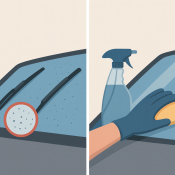 Rapid wear of wiper blades is a problem that can occur even on brand new cars. If new wiper blades start to streak, leave spots on the glass or start to skip after just a few weeks or months, the fault is usually not with the product itself. Most often, the cause is invisible dirt accumulated on the surface of the windshield or the wipers are working at the wrong angle.
Below is an overview of the main causes and solutions.
... More...
Rapid wear of wiper blades is a problem that can occur even on brand new cars. If new wiper blades start to streak, leave spots on the glass or start to skip after just a few weeks or months, the fault is usually not with the product itself. Most often, the cause is invisible dirt accumulated on the surface of the windshield or the wipers are working at the wrong angle.
Below is an overview of the main causes and solutions.
... More...
 The data shown here, especially the complete database of car spare parts, may not be copied. It is strictly prohibited to duplicate the data and database and distribute the same, and/or instruct third parties to engage in such activities, without prior consent from TecAlliance. Any use of content in a manner not expressly authorized constitutes copyright infringement and violators will be prosecuted.