

Axle Drive > Differential
Pick your vehicle
car differential: one of the most important components of the engine system
In this category you will find differential parts such as oil change bolt / cap, differential intermediate shaft, intermediate shaft seals, etc.

Fig. Construction of a car differential.
1. bevel gears
2. drive pinion
3. cardan joint
4. differential stub shaft
5. bevel gears
6. ring gear
The powertrain of any vehicle is a complex and finely tuned mechanism, one of the most important components of which is the differential. The main function of the differential is to distribute the engine torque between the drive wheels so that they can rotate at different speeds when cornering. Although the differential itself is built to withstand enormous loads, its long life directly depends on several smaller but vital components. In this article, we will focus on three important parts: the differential oil change bolt (cap), the intermediate shaft, and the intermediate shaft seals.
differential oil change bolt/cap: a small but critical detail
The differential requires special transmission oil to operate smoothly and prevent wear on metal parts. Just like engine oil, differential oil needs to be changed regularly to remove metal debris and maintain the oil's optimal lubricating properties. This is where the oil change bolt or cap comes into play.
The differential usually has two plugs: one for filling (upper) and one for draining (lower). The lower oil change bolt is often equipped with a strong magnet. The magnet's job is to catch the fine metal shavings that form during the natural wear of the gears. This simple but ingenious solution prevents abrasive metal shavings from getting between the bearings and gears, preventing premature wear of the expensive assembly.
Every time the differential oil is changed, it is extremely important to check the condition of the plug. A new plug sealing washer (usually copper or aluminum) should always be installed to prevent future oil leaks. Always tighten the plug to the torque specified by the car manufacturer - overtightening can damage the threads of the aluminum or cast iron differential housing, leading to a very expensive and time-consuming repair.
stub shaft: the secret to smooth power transmission
Especially on front-wheel drive and transverse-engined four-wheel drive cars, the differential is not exactly centered in relation to the vehicle's longitudinal axis. If the wheels were connected to the differential directly by two driveshafts of different lengths, the car would start to pull to one side on its own under heavy acceleration (known as torque steer ).

To solve this physical and driving comfort problem, the differential intermediate shaft is used. It is a strong metal shaft that connects directly to the differential splines at one end and rests on a special support bearing at the other end, which is attached to the engine block. The function of the intermediate shaft is to extend the differential output so that both actual drive shafts, which go to the wheels and move with the suspension, can be exactly the same length.
Intermediate shaft failures are not common, but on vehicles with higher mileage, the intermediate shaft splines may wear out over time or the support bearing supporting it may break down. Worn splines or a faulty support bearing often indicate a strong vibration when accelerating, a characteristic rumbling under the car, or a whining sound at certain speeds.
intermediate shaft seals (simmer rings): protection against leaks and dirt
Because the intermediate shaft goes into the differential housing and rotates there at high speed, this connection must be airtight and absolutely leak-proof. Inside the differential is oil that must not be allowed to escape, and outside is water, sand and road salt that must not get in. This critical boundary is guarded by intermediate shaft seals, which in technical and popular language are also called shaft seals or simmer rings.
These O-rings are made of a durable rubber compound that must withstand high temperatures, constant mechanical friction and chemically aggressive transmission oil. Over the years and kilometers traveled, the rubber inevitably loses its elasticity, becomes brittle, cracks and eventually begins to leak oil.
A leaking intermediate shaft seal is dangerous for two main reasons. First, an unnoticed drop in the oil level in the differential leads to overheating and rapid destruction of the gears and bearings. Second, leaking oil can get on nearby rubber bushings, damaging their structure, or on the hot exhaust pipe. If a leak is detected, the seal must be replaced with a new one as soon as possible, having previously carefully cleaned the contact surfaces of the shaft and housing to prevent dirt from getting between the new seal.
well-known and reliable spare parts brands
When it's time to replace differential seals, intermediate shaft parts or oil plugs, the quality of the new part is crucial. A cheap and poor-quality rubber seal can start leaking again after just a few months, which means another big and expensive trip to the mechanic.
Professional car mechanics often prefer top-quality aftermarket brands to original parts, which are more affordable but offer identical reliability. In the world of seals and seals, Corteco and Elring are the absolute leaders, offering leak resistance equivalent to the factory and are often original equipment suppliers to car manufacturers themselves. When it comes to intermediate shafts, drive shafts and their support bearings , SKF , Spidan (GKN), Löbro and Febi Bilstein are very strong and reliable choices. Parts from these manufacturers ensure a precise fit and a long life even in the toughest Nordic driving conditions. For oil plugs, bolts and smaller fasteners, brands such as Topran or Swag are often a good and reliable choice.
summary
Although the differential is one of the strongest and most massive components under the car, its flawless operation depends on such seemingly small things as a tight oil change bolt and high-quality intermediate shaft seals. Regular visual inspection under the car – for example, during tire changes or routine maintenance – will help you notice any oil leaks early on, before they cause major damage. By investing in durable spare parts from well-known brands and changing the transmission oil on time, you will ensure a long, smooth and trouble-free life for your vehicle’s powertrain.
The differential is one of the most important components of a car's mechanisms, playing an important role in the vehicle's ability to move. This system allows the wheels to rotate at different speeds and smoothly transmit power, especially in curves where the inner and outer wheels are moving at different speeds. We most often find a differential in the rear or front suspension systems of a vehicle, and it is especially important for vehicles that move with all wheels. In this article, we will look at what a car differential is, how it works, what its functions are, and how to maintain and check it.
What is a car differential?
A differential is a mechanism that connects the engine's power to the wheels, allowing them to rotate at different speeds. This mechanism is found on most cars, whether they are rear-wheel drive, front-wheel drive, or all-wheel drive. The differential is usually located on the vehicle's drive shaft and its job is to distribute the torque produced by the engine evenly to the different wheels so that they can rotate at different speeds while maintaining stability and control.
How does a differential work?
The function of the differential is to allow the vehicle to turn smoothly and safely, especially when cornering. When the car is moving straight, all wheels move at the same speed. However, when the vehicle turns, the inside and outside wheels must move at different speeds because the outside wheel has to travel a longer distance than the inside wheel.
The differential ensures that each wheel has sufficient freedom of movement. When the vehicle turns left, the outer right wheel moves faster than the inner left wheel. The internal gears of the differential distribute the force to each wheel according to how much movement each wheel needs. If the vehicle were not equipped with a differential, turning would become much more difficult, as both wheels would have to turn at the same speed, which would create a lot of friction and reduce maneuverability.
types of differentials
Different types of differentials exist to meet the needs of different vehicles. Here are some of the most common types of differentials:
1. open differential
An open differential is the most common and simplest type of differential found on most modern vehicles. It distributes power equally between both wheels, but if one wheel loses traction, such as on a slippery road, power is directed to the wheel with less traction. This can lead to a situation where the car is stuck on slippery surfaces because one wheel is spinning rapidly while the other is not moving at all.
2. limited slip differential (LSD)
The precision differential is an advanced solution that provides better traction and power distribution. This mechanism prevents one wheel from moving faster than the other, thereby providing better power distribution and preventing slippage. It is especially useful in sports cars, SUVs and vehicles that have to withstand different road conditions. The principle of operation of the precision differential is based on preventing slippage, while the power is rationally distributed between both wheels.
3. precision differential with locking (locking differential)
A locking differential provides even more efficient power transfer because it allows both wheels to move at the same speed, even if one wheel loses traction. A locking differential activates a mechanism that connects both wheels so that they move at the same speed. This type of differential is especially useful when driving off-road and in extreme road conditions.
4. electric and hydraulic differential
Some high-tech vehicles, including high-end sports cars and luxury SUVs, are equipped with electric or hydraulic differentials. These differentials provide even more precise power distribution using a variety of mechanical and electronic components. Electrical systems can automatically adjust the power distribution depending on the vehicle's needs.
differential maintenance and inspection
Regular maintenance of differentials is essential to ensure the smooth and safe operation of your vehicle. Since the differential contains many precision-machined gears among its moving parts, excessive wear can be caused by a lack of lubricant or outdated lubricating oil.
1. Checking and changing the oil
The differential contains a special oil that lubricates and cools the parts in the mechanism. Changing the oil is important to prevent overheating and ensure smooth operation. The oil change depends on the car manufacturer, but it should be done regularly, usually every 30,000–60,000 km. If the oil is not clean enough or there is too little of it, the differential can start to work inefficiently, which can lead to greater breakdowns and faster wear.
2. Maintenance signs
If the differential is damaged or working inefficiently, the following symptoms may appear:
- Noise: If you hear a strange sound (such as a constant squeaking or rustling), it could indicate damaged gears or a lack of lubricant.
- Vibrations: If the vehicle starts to vibrate while driving or excessive movement is felt, it may mean that the differential is not working properly.
- Unusual wear: If you are having problems with vehicle stability or traction, the differential may be damaged, causing erratic wheel movement.
3. regular check-ups and specialist check-ups
To ensure the reliability of differentials, it is important to perform regular maintenance and have the mechanism checked by a professional. If you are not sure whether the differential needs maintenance, it is always recommended to take the car to a specialist who can check its condition and carry out repairs or maintenance if necessary.
summary
A car's differential is an important mechanism that ensures that your vehicle can move smoothly and stably, even in difficult road conditions. Its function is to distribute the engine's power to the wheels, allowing them to turn at different speeds, especially when cornering. Regular maintenance and oil changes help keep the differential working reliably and prevent major causes of failure. Monitoring the condition of the differential and timely maintenance is an important part of overall vehicle maintenance, helping to prevent major problems and ensuring a safe and smooth driving experience.

Powertrain and what is a differential and where is it located on the car?
 Car Differential, Driveshaft, and Gearbox: Overview and Working Principles
... More...
Car Differential, Driveshaft, and Gearbox: Overview and Working Principles
... More...
Why do wiper blades spoil quickly? Causes and effective solutions with deep cleaning
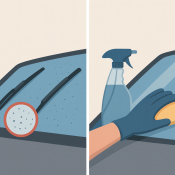 Rapid wear of wiper blades is a problem that can occur even on brand new cars. If new wiper blades start to streak, leave spots on the glass or start to skip after just a few weeks or months, the fault is usually not with the product itself. Most often, the cause is invisible dirt accumulated on the surface of the windshield or the wipers are working at the wrong angle.
Below is an overview of the main causes and solutions.
... More...
Rapid wear of wiper blades is a problem that can occur even on brand new cars. If new wiper blades start to streak, leave spots on the glass or start to skip after just a few weeks or months, the fault is usually not with the product itself. Most often, the cause is invisible dirt accumulated on the surface of the windshield or the wipers are working at the wrong angle.
Below is an overview of the main causes and solutions.
... More...
 The data shown here, especially the complete database of car spare parts, may not be copied. It is strictly prohibited to duplicate the data and database and distribute the same, and/or instruct third parties to engage in such activities, without prior consent from TecAlliance. Any use of content in a manner not expressly authorized constitutes copyright infringement and violators will be prosecuted.