

Lighting > Direction Indicator
Pick your vehicle
Car turn signals: traffic rules, common mistakes and repairs
Traffic is a social activity based on communication. Because drivers are separated from each other by glass and metal, we have only a limited number of means of communicating with others: the position of the car on the road, the brake lights and, most importantly, the direction indicators . This simple yellow flashing light is the only way to let other road users know your intentions , not just what is already happening.
Yet turn signals (or indicators ) are often the components that are only noticed when they stop working or when the green arrow on the dashboard starts to blink rapidly in panic. In this in-depth technical review, we look under the hood and examine how the turn signal system has evolved over the decades from a simple thermal relay to a complex digital matrix system. We analyze common car model faults and give advice on how to choose the right spare parts so that communication with other road users is always clear.

1. The evolution of turn signals: how did the "click" come about?
To understand modern malfunctions, you need to know the history of the system. Many older drivers remember the characteristic rhythmic "click-click" sound that a turn signal makes. Did you know that in modern cars, this sound is often faked?
thermal relay era
In older cars, current ran through a relay with a bimetallic strip. The current heated the metal, it bent and broke the connection (the light went out). As the metal cooled, it straightened and reconnected the circuit (the light came on). This physical snapping was what made the sound.
peculiarity: the flashing speed depended on the load. If one bulb burned out, the current decreased, the metal did not heat up enough and the turn signal either did not flash at all or flashed very slowly/fast.
electronic relay
In the 90s, electronic relays (with a capacitor and a transistor) were introduced. They were more stable, but retained the safety feature: if a bulb burns out, the relay doubles the flashing speed to warn the driver.
digital control (can-bus and bcm)
Most modern cars (from around 2005) do not have a physical turn signal relay. The signal travels from the turn signal lever to the body control module (BCM). The computer uses a transistor to turn the light on.
Where does the sound come from? Since there is no relay, a "click" sound is played through the dashboard speaker (or a small buzzer) to prevent the driver from forgetting the direction in.
2. Bulb types: from incandescent to dynamic LED
The light sources of the turn signals have undergone a major change, which directly affects repair options and price.
a. light bulbs (py21w, p21w, wy5w)
the most common and cheapest solution.
- py21w: a bulb with amber (yellow) glass and offset pins in the socket (the letter y indicates yellow and offset pins). It cannot be accidentally pushed into a white socket.
- wy5w / w5w: small glass-enclosed bulbs used in sidelights (on the wing).
- diadem / silver vision: special designer bulbs that are silver when turned off (does not create a "browning" effect when lit), but burn yellow.
b. LED technology
The LEDs light up in milliseconds (an incandescent bulb takes 0.2 seconds). At highway speeds, this gives the driver behind about 5 meters of additional braking distance.
Static LED: simply a blinking LED block.
Dynamic (sequential) LED: A "running" turn signal popularized by Audi. Here, the LED segments light up sequentially from the inside out. This requires complex control and if one segment dies, the entire light usually has to be replaced.
3. Why is the turn signal flashing quickly? (hyperflashing)
This is the number one question related to turn signals.
Cause: The car's control module or relay is constantly measuring the resistance of the circuit. A standard 21-watt bulb creates a fixed load.
1. Burnt out bulb: If one bulb (e.g. the front one) burns out, the load on the circuit is drastically reduced. The system goes into "warning mode" and causes the entire side to flash rapidly (hyper-flashing).
2. LED installation: If you replace a regular bulb with an LED, the LED's power consumption is so low (e.g. 2W vs 21W) that the car "thinks" the bulb is broken. The result is rapid flashing and an error message in the instrument cluster.
Solution for LEDs: use LEDs with CAN-BUS support or install additional resistors (load resistors) that simulate the load of a regular bulb. NB! Resistors get very hot when working and must be installed on a metal surface, away from plastic.
4. typical faults by car model
Although the system is simple, engineers have managed to create model-based weaknesses.
BMW (3 Series E46, E90, F30)
- Taillight ground failure (e46): one of the most famous faults. The ground terminal (brown wire) of the taillight connector is too thin. It overheats and melts the plastic around the connector.
Symptom: The dashboard displays a burnt-out bulb error, even though the bulb is intact. The turn signal may glow dimly. - FRM module (E90/E70): If the turn signal is shorted for a long time or you change the bulbs with the ignition on, the footwell module can go into short circuit protection mode and permanently turn off the output. In the worst case, the module will "reorder" in software.
- Side LED directions: The LED strips inside the front fender get moisture and stop working or flash irregularly.
volkswagen and audi (passat b6/b7, golf, a4, a6)
- Mirror directions (inside the side mirror): a very common problem. The seals in the side mirror housing get tired, water gets into the LED strip.
Symptom: The inside of the mirror turn signal is "sweaty" or green (algae) and glows dimly. Since it is a closed module, the entire turn signal strip must be replaced (often together with the lower mirror housing). - Dynamic taillights (Audi): On newer models where the turn signal "runs", a situation may arise where the "run" is interrupted. This usually indicates moisture damage in the light control unit.
mercedes-benz (c-class w204, e-class w212)
- Mirror wiring: If you have power folding mirrors, the mirrors move together every time you lock the car. Years of movement will break down the insulation in the wiring inside the mirror.
Symptom: Mirror direction stops working when the mirror is in a certain position, or short-circuits with puddle lighting. - Taillight circuit board: Similar to BMW, Mercedes taillight connectors melt due to overload, causing a "disco effect" in the turn signals and brake lights.
Peugeot and Citroen (com2000 block)
- turn signal lever (switch): the weak point of French cars is the steering column switch block (com2000).
Symptom: the turn signal turns off by itself (the lever is "loose") or vice versa - after making a turn and turning the steering wheel straight, the lever flips over and starts flashing in the other direction. The turn signal can also start flashing by itself when driving through potholes. The solution is usually to replace the entire lever module.
Volvo (V70, XC90)
- Socket oxidation: Volvos are strong, but the turn signal sockets (the plastic socket that goes into the light) in their headlights tend to oxidize. The contacts turn green and the bulb won't make contact. A simple cleaning will help temporarily, but replacing the socket is more secure.
5. Spare parts selection: cheap vs. original
When it comes to turn signals – especially when it comes to mirror indicators or complete lights – the price differences are huge. Is it worth buying a cheap B-part?
mirror directions and side directions
Asian manufacturers dominate here (e.g. tyc , depo , abakus ).
Rating: They are generally of acceptable quality, but they have one big drawback – their tightness. Cheap mirror lenses tend to fog up after just a few months.
Recommendation: Before installing a cheap mirror, it is worth sealing its joints (between glass and plastic) with transparent silicone.
headlights and taillights
If the turn signal is integrated into the main beam (especially with LED), the risk is greater.
- Hella / Valeo / Marelli: These are original manufacturers (OEM). The quality is top notch, the beam is correct and the plastic does not fade in the sun.
- Depo / Tyc: offer affordable alternatives. Their biggest problem is often "fitment". The light can leave larger gaps between body parts. The LED color may also differ from the original (e.g. one light flashes more yellow than the other).
pears
As mentioned, always prefer well-known brands such as Osram , Philips or Narva .
Why? On cheap "gas station bulbs" the yellow paint peels off the glass. The result is a white flashing turn signal, which is prohibited in traffic and will result in a repeat inspection.
6. "comfort blinker"
One feature that many drivers use but whose faults are misdiagnosed is convenience turn signal . This means that with just a brief touch of the lever, the turn signal will automatically flash 3 times (programmable 1-5 times on some cars).
Problem: Sometimes drivers complain that the turn signal only flashes 1 time, even though it should flash 3 times.
Reason: Often the cause is dirty contacts in the turn signal lever. The lever does not give a clean enough signal to the brain. Another common cause is a short-term loss of connection to the battery - many cars "forget" the convenience function setting and it has to be reactivated in the menu.
7. Review and legislation
The turn signal is one of the most stringent inspection items during the technical inspection.
- Color: must be amber. Red turn signals from US cars are generally prohibited in Europe (with exceptions). The bulb must also not be so worn that it flashes white.
- Flashing frequency: standard is 90 ± 30 times per minute. Too fast (hyperflashing) or too slow will not pass the light.
- Integrity: the mirror directions must work. If the mirror body is broken and white light shines backwards, this is a fault. In the case of LED lights, at least 2/3 of the diodes must be lit (depends on the exact regulation, but noticeable dimming is a fault).
summary
A turn signal is not just a light bulb – it is your voice in traffic. Driving a "dumb" car creates stress for others and dangerous situations for yourself. Fortunately, turn signal repairs are usually within the reach of every car owner, whether it is a simple bulb change or a mirror replacement.
If you notice that the turn signal is flashing unusually quickly or there is an error message in the instrument panel, do not postpone the repair. First check the bulbs, then the sockets and contacts. When choosing spare parts, make sure that yellow is still yellow and prefer manufacturers whose quality can withstand both our winter and summer heat waves.
Safe driving and clear communication on the road!

Why do wiper blades spoil quickly? Causes and effective solutions with deep cleaning
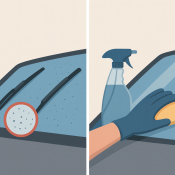 Rapid wear of wiper blades is a problem that can occur even on brand new cars. If new wiper blades start to streak, leave spots on the glass or start to skip after just a few weeks or months, the fault is usually not with the product itself. Most often, the cause is invisible dirt accumulated on the surface of the windshield or the wipers are working at the wrong angle.
Below is an overview of the main causes and solutions.
... More...
Rapid wear of wiper blades is a problem that can occur even on brand new cars. If new wiper blades start to streak, leave spots on the glass or start to skip after just a few weeks or months, the fault is usually not with the product itself. Most often, the cause is invisible dirt accumulated on the surface of the windshield or the wipers are working at the wrong angle.
Below is an overview of the main causes and solutions.
... More...
 The data shown here, especially the complete database of car spare parts, may not be copied. It is strictly prohibited to duplicate the data and database and distribute the same, and/or instruct third parties to engage in such activities, without prior consent from TecAlliance. Any use of content in a manner not expressly authorized constitutes copyright infringement and violators will be prosecuted.