

Body > Wheelhouse / Panelling mudguard
Pick your vehicle
car fender liner – the invisible hero in your car's wheel well
Every time you get in your car and drive through rain, slush or gravel, a real battle is taking place around the wheels of your vehicle. Your tires throw up water, rocks, sand, salt and dirt at breakneck speed. If all this abrasive and wet mass flew directly into your car's metal body panels, engine compartment components or the backs of your headlights, your car's lifespan would be extremely short. Fortunately, engineers have created a seemingly simple but absolutely critical protective shield – the car's fender liner (in English, a fender liner , wheel arch liner or splash guard ).

A mud flap is a flexible plastic or special fabric covering that lines the inside of the wheel arch. Although it is a completely invisible detail for most car owners, which is only thought of when it breaks and starts to rub against the tire, it plays a huge role in ensuring the longevity, aerodynamics and driving comfort of the vehicle. In this extremely comprehensive guide, we will dive deep into the world of car mud flaps. We will examine in detail what their functions are, what materials they are made of, why they break, how to recognize damage and provide a step-by-step overview of how to replace and maintain a mud flap yourself in your home garage.
Why are logs vital to a car? Key features
Cars produced decades ago lacked plastic inner fenders. Their wheel arches were simply extensions of the bodywork, covered in a thick layer of anti-corrosion mastic. The result? These cars rusted through within a few years, as rocks eroded the mastic and moisture did its job. Today, fenders are standard equipment on every car. However, their function is much broader than just preventing rust.
1. engine compartment and electronics protection
The most important function of the idler pulley is to act as a physical barrier between the rotating wheel and the delicate internal components of the car. Behind the front wheel arches (especially on front-wheel drive and transversely mounted engines) there are a huge number of critical parts. The alternator and air conditioning compressor accessory belts (ribbed belts) run there, there are fog light bulb sockets, horn sockets, ABS sensor wiring, windshield washer fluid reservoir and often the engine's computer (ECU) or fuse boxes. If the idler pulley breaks or is missing, water and dirt will fly right in between the belts. The result is whistling belts, rapidly wearing roller bearings, shorted lights and oxidized connectors. In the worst case scenario, a sharp stone flying from under the wheel can crack the windshield washer fluid reservoir or break an expensive sensor.
2. protecting the body from corrosion and mechanical damage
Every stone flying from under the wheel acts like a small hammer. If these stones were to hit the inner metal sheet of the wheel arch, they would instantly chip off the paint and zinc layer, exposing the bare metal to the elements. The logar takes all these blows. The plastic or textile absorbs the kinetic energy of the stone. In addition, the logar prevents salty slush and mud from accumulating on the upper edges of the wheel arch and on the insides of the wing, where it would otherwise remain moist for months and cause aggressive rusting.
3. Optimization of aerodynamics and fuel consumption
Modern spoilers are not just any plastic bowls. Their shape has been tested in wind tunnels for hundreds of hours. A spinning wheel creates enormous aerodynamic turbulence. A properly designed spoiler directs the airflow in the wheel wells in a way that creates as little drag as possible. Some spoilers have special fins or openings (louvers) that help direct cooling air to the brake discs or intercoolers, then smoothly direct the hot air under the car. A broken or missing spoiler disrupts the car's aerodynamics, which increases fuel consumption and wind noise at highway speeds.
4. ride comfort and sound insulation
Have you ever driven on a gravel road and heard the sound of rocks hitting the bottom of your car with a loud clatter? One of the functions of the rocker arms is to reduce this noise. The rear rockers in particular are critical in dampening cabin noise, as the rear wheel arches are often located directly under the passenger seats or trunk, acting as a sound box. Modern textile rockers are specifically designed to absorb tire noise, making highway driving many times quieter.
anatomy of materials: plastic vs. textile
Car manufacturers mainly use two types of materials to make their logs, each with its own pros and cons. Often, one material is used for the front and another for the rear of the same car.
high-density polyethylene or plastic (hdpe/abs)
The most traditional logarithm material is a strong but flexible plastic. It is molded exactly to the shape of the wheel arch.
- Advantages: extremely resistant to physical impacts. It is very easy to clean with a pressure washer – dirt and snow do not stick to it. The plastic log does not absorb water and does not become heavy.
- Disadvantages: plastic is an acoustically hard material. When a stone hits plastic, a clear click is heard in the cabin. Also, with a plastic logarithm, the rolling noise of the tire (water noise in the rain) is more audible in the cabin. In cold weather, plastic becomes brittle and can break (crack) more easily upon impact.
needle-punched textile (non-woven pet / "felt logar")
Over the past 15 years, the automotive industry (especially German premium brands) has massively switched from textile or felt material to logarithms, especially in the rear wheel arches.
- Advantages: Excellent sound insulation. Felt absorbs sound waves, making the cabin drastically quieter. A stone or water flying against the textile makes almost no sound.
- Disadvantages: they are a nightmare to maintain. felt absorbs water and dirt. In winter, this water- and slush-soaked log freezes into a heavy lump of ice, which can sink under its own weight and rub against the tire. They are extremely difficult to clean, as pressure washers often push dirt even deeper into the fibers of the material or even break the textile structure. They can also "sink" over time and lose their original shape.
How and why do car logs break?
Although the bearings are designed to last, they have a limited lifespan. They operate in the harshest environments in a car. Failures and breakages are most often caused by the following factors:
1. winter conditions and ice accumulation
This is the number one killer of logarithms in the Nordic countries. When driving in snow and slush, the snow sticks to the logarithm in the wheel wells. When it freezes, it turns into a thick and heavy lump of ice. This ice is literally millimeters away from the rotating tire. When the car's suspension moves over an unevenness, the tire rubs against this lump of ice with great force, which in turn tears the logarithm from its mountings or breaks the plastic. Often, drivers try to remove the ice by kicking the logarithm, thus breaking the frozen and brittle plastic.
2. parking curbs and low ground clearance
The very bottom edge of the first logs is often connected to the lower lip of the bar. If you drive too deep into a parking space, the bar will slide over the curb. If you now start to reverse, the bottom edge of the bar and the log connected to it will catch behind the curb. The result is a rattle, during which the front part of the log is torn out of its mounts. This piece of the log will often hang against the front wheel.
3. missing or broken retaining clips
Logs are attached to the body with special plastic dowels, expansion clips or metal clips. These attachments age, become brittle and fall out due to vibration. Also, mechanics often forget to put all the clips back in after changing belts or changing light bulbs (where the log must be partially removed). If even one or two clips are missing, the log will start flapping in the wind at high speeds. The flapping will fatigue the plastic, which will eventually break, or the wind will push the log directly into the spinning wheel, which will melt and eat a huge hole in the log in a split second.
4. incorrect tire sizes or lowering springs
If tires that are wider or taller than the factory recommended size are installed on the car, or if alloy wheels with the wrong offset are installed, the wheel may no longer fit in the hole. When the steering wheel is turned all the way out or when driving through a hole, the outer edge of the tire will rub against the logarithm, quickly wearing out the hole. The same thing happens with aggressive suspension lowering if the car is not adjusted correctly.
Signs and symptoms: how to tell if a log is damaged?
Since the strut is hidden in the wheel arch, the crack may not be immediately noticeable. However, the car will give you several signs of a faulty strut:
- Scary flapping or sawing sound on the highway: When the flap is open, the air flow pushes it against the tire. This creates a terrible sawing or scraping sound that gets louder as you go faster. Many drivers mistake this for a wheel bearing or transmission failure. After stopping, you may see a clear, melted hole in the flap with melted edges where the tire has rubbed into it.
- Visible cracks or missing pieces: Visual inspection is easiest. Turn the front wheels completely out and look inside. If you see cracks in the plastic, large holes, or if the fender flares no longer fit snugly against the fender edge, it's time to take action.
- The engine compartment is abnormally dirty: if you open the hood and notice that, for example, the area around the belt or behind the headlights is covered in thick fresh dirt or leaves, it is very likely that the front part of the mudguard has broken or is completely missing, allowing dirt from under the wheel to freely fly into the engine compartment.
- Electrical anomalies: If your fog lights stop working, the ABS light comes on in the dash in rainy weather, or the horn is making a strange noise, it's worth checking the ignition switch first. A broken ignition switch will cause these electrical components to overheat.
common car models and their logarithmic specifics
Different car manufacturers solve logarithmic engineering differently. Let's look at the typical problems of the most common car models on our roads.
BMW 3 Series (E46, E90, F30) and 5 Series (E39, E60, F10)
BMWs are technically complex, and their first logars often consist of two or three separate parts (the first part, the middle part and the rear flap). The first part of the BMW first logar very often contains the outside air temperature sensor (often in the driver's side compartment). If you drive over a high curb and crush the front corner of the logar, this sensor is often torn off as well. The instrument panel immediately shows a temperature of -40 degrees and the air conditioning stops working normally. BMW logars are very precise, which is why installing the B-part is often challenging, as the mounting holes may not line up perfectly.
volkswagen golf, passat, škoda octavia and audi a4/a6 (vag group)
VAG Group vehicles are known for their extensive use of textile logs, especially at the rear, but also at the front on newer models. Passat B6 and B7, as well as many Audis, suffer from the fact that the felt log soaks up slush in winter, becomes tens of kilos heavy and sinks below the mountings. The metal studs on the body, to which the plastic nuts of the log are attached, often rot through. The first plastic logs on VAG cars hide behind them, exactly under the door hinges, the infamous "compost pile" - leaf litter and soil accumulate there over the years, which retains moisture and causes the lower corner of the front wing and the end of the side box to rust mercilessly.
toyota corolla, avensis, rav4
Japanese car manufacturers have long preferred classic and very thin plastic struts. Toyota struts are mechanically quite durable, but their Achilles heel is the retaining clips. Toyota uses a large number of plastic push-pins, which harden over the years and lose their holding power. Due to vibration, the pins fall out and the strut starts to flutter slightly. When replacing the strut, it is absolutely mandatory for Toyotas to buy a handful of new, fresh retaining clips, because it is almost impossible to get the old ones intact.
honda civic, accord, cr-v
Like Toyota, Hondas have thin plastic mudguards. In the case of the Civic and Accord (which have fairly low clearance from the factory), it is very common for the first lower lip of the mudguard, which attaches to the underbody as an aerodynamic deflector, to simply tear apart in winter ruts or snowdrifts. Honda mudguards directly protect the air conditioning pump and alternator, so a broken mudguard on a Honda is a direct threat to the life of expensive auxiliary equipment.
original spare part (oem) vs. part b (aftermarket): which one to choose?
When you are faced with replacing a logar, the first question is: should you buy an original part from the car factory dealership or choose an aftermarket B-part (from brands like Blic, Prasco, Klokkerholm, Van Wezel, etc.)?
Original part (OEM): the advantage is a 100% perfect fit. All bolt holes match to the millimeter, the flexibility and strength of the plastic meet the factory requirements exactly, and the material withstands cold well. The disadvantage is the price – a logar purchased from a dealership can cost 80 to 250 euros, depending on the car brand.
B-part (aftermarket): A high-quality B-part logar (such as the aforementioned BLIC or similar) often costs a fraction of the price of the original, remaining in the price range of 15 to 45 euros. This makes them very attractive. However, when installing a B-part, certain specifics must be taken into account:
The plastic of the B-parts can be a little stiffer or a little thinner than the original. This means that installation may require more patience from the mechanic. Sometimes not all the mounting holes line up perfectly. A professional mechanic knows that in such cases, it is often helpful to gently heat the logar with a heat gun to make the plastic more flexible and stretch it into the correct position. In rare cases, a new hole must be drilled in the plastic to fix it to the body with a dowel. Despite these minor installation difficulties, the B-part logar fulfills its protective function perfectly and offers excellent value for money for older and middle-aged cars.
Step-by-step guide: how to change the car log yourself?
Replacing a front sway bar is within the reach of any do-it-yourselfer with a jack, some basic tools, and a little time. It's a great way to save on repair costs. Here's a step-by-step guide to replacing a front sway bar (the rear process is similar).
necessary tools:
- safe jack and axle stand.
- Phillips wrench or impact wrench to remove the wheel.
- trim removal tool or wide-head flathead screwdriver.
- a set of socket wrenches (usually 8mm and 10mm sockets) or torx wrenches (t20, t25, t30 – common on vag and german cars).
- rust remover and anti-corrosion wax (optional but highly recommended).
- New retaining clips: Don't even start unless you have new dowels on hand. The old ones almost always break when you take them apart.
process:
Step 1: Safety and wheel removal. Park the car on a level surface, apply the handbrake. Loosen the bolts on the front wheel on the side to be replaced. Jack up the car and place a jack stand securely under the car. Remove the wheel completely to ensure free access to the entire wheel arch.
Step 2: Remove the old log. Locate all the screws and plastic clips holding the log in place. The log is often attached to the bottom edge of the strut (often with 8mm sockets or T25 Torx screws), the inside edge of the wing arch, and the side wall of the engine bay. Remove the screws. To remove the plastic clips, use a wide flathead screwdriver or clip tool to push up (or push in, depending on the type) on the center of the dowel head and pull the dowel out. If the clips break, don't worry, this is normal.
Step 3: Pry the log out. Once all the fasteners have been removed, the log needs to be bent out of the hole. Start at the bottom ends of the log, carefully pulling them out from behind the bars and side box. Then, tilt the entire log over the wheel hub and remove it completely.
Step 4: Cleaning and rust removal (the most important step!). Now that the cave is bare, you’ll see a picture you don’t often see. The rainwater drainage channels under the windshield run directly behind the fender. Especially where the front door hinge meets the side box, you’ll probably see a thick layer of damp leaf soil. Clean it all off! Wash the cave clean with a pressure washer or brush and dry it. If you notice any surface rust, remove it with a wire brush, apply a rust converter, and then coat the cave with an anti-corrosion wax or mastic. This simple step will extend the life of your car’s body by years.
Step 5: Install the new glider. If you are using part B, compare it to the old one first to make sure the shape is similar. Slide the new glider into place, starting by bending it behind the wing edge and then pushing the inside into place. The bottom edges of the glider must go under or behind the strut, exactly as the factory intended, or the wind will rip it right off.
Step 6: Fixing. Do not tighten any screws yet! First, place all new dowels and screws loosely in their holes. If the holes do not line up perfectly (special feature of part b), press or stretch the plastic a little. Once all the holes have been found and the bolts are in the slots, tighten them completely. Make sure that the logar sits tightly and evenly around the entire wing arch, and does not bulge out anywhere towards the wheel.
Step 7: Finishing. Reinstall the front wheel. Jack up the car and tighten the wheel bolts with a torque wrench. Turn the steering wheel from end to end in situ and visually check that the tire does not rub against the new lug in any position.
Tips: improving sound insulation and ride comfort
If you have your car jacked up and the bumper removed anyway, this is the perfect time to drastically improve the car's acoustic comfort. Many car owners, especially those of Asian cars (where the factory soundproofing is often poor), modify the new plastic bumpers before installing them.
Here's how it works: buy a roll of self-adhesive aluminum-coated butyl mat (pitch mat) and a sheet of closed-cell sound-absorbing foam. Cut pieces of the butyl mat and glue them to the inside of the new plastic log (the side facing the body). Don't cover the entire log to avoid excessive weight gain, covering about 50-60% of the surface on wider and flatter areas is enough. The pitch mat adds weight to the plastic and completely dampens the "drum effect" caused by rainwater and stones. You can then stick a layer of water-repellent foam on top. This homemade modification makes the plastic log a better sound absorber than the factory felt log, while maintaining the advantages of plastic - easy washability and durability on the wheel side.
How to take care of logarithms on a daily basis?
Loggers do not require constant attention, but some habits can help prevent them from being replaced prematurely:
- Be careful with the pressure washer! When washing a car, never direct the jet of a powerful pressure washer closer than 30 centimeters to the log. Especially with textile logs, high pressure coming too close can break the fibers of the material. With plastic logs, you can break old and brittle fastening clips with high pressure.
- Spring cleaning: After the winter season, when you change your winter tires to summer tires and the wheels are off anyway, take a hose and wash the wheel arches thoroughly. Wash off all the accumulated salt and dirt that has stuck to the edges of the log.
- Don't kick the ice: when large lumps of ice have accumulated on the logs in winter, it's tempting to kick them with the toe of your boot. Cold plastic is fragile and breaks easily. A better solution is to lightly tap the tire with a rubber mallet (the vibration will loosen the ice) or let the car thaw in a warm underground parking lot or garage.
summary
Your car's struts may be a hidden detail that you don't notice until you have a problem, but it's impossible to underestimate their importance. They're not just a piece of plastic or molded fabric; they're your vehicle's first line of defense against the elements. A properly installed and healthy strut protects alternators from short circuits, belts from breaking, and, most importantly, keeps out that silent and destructive enemy—rust. By being aware of the strut's role, noticing the symptoms of loose fasteners or cracks in time, and knowing how to select and install a new replacement part (whether it's a perfectly fitting OEM part or a budget-friendly B-part that needs a little tweaking), you can significantly extend the life of your vehicle and save yourself from unexpected repair bills in the future. Keep your wheel arches clean and your struts healthy, and your car will thank you with years of trouble-free service.
Car body parts and body details
 Car bodywork (body parts), structural parts and subframes – important components and their role
The underbody and structural parts of a car form the basis of the vehicle's strength and safety. These parts are responsible for the rigidity of the vehicle's structure, the absorption of impact energy and the durability of the body. The correct condition of the car's supporting and supporting framework is important for ensuring safety, aerodynamics and driving comfort. Car body parts and body parts can be made of various materials: sheet metal (so-called body panels), plastic, metal and other materials.
Car Body and Frame
✅ Passenger cars are constructed with a monocoque or unibody).This means that the car body is structurally a load-bearing structure and there is no separate frame underneath. This is a lighter and easier-to-manufacture solution.
✅ SUVs, trucks, and buses are mostly body-on-frame vehicles. If you remove the cab, all that remains is a drivable chassis with engine.
Clarifications and exceptions:
Not all SUVs are frame-based anymore. Many of today's crossover SUVs (e.g. Toyota RAV4, Honda CR-V, BMW X5) have a unibody design because it is lighter and more fuel efficient. However, true off-road SUVs like the Toyota Land Cruiser, Jeep Wrangler, and Mercedes G-Class have a frame design.
Some passenger cars and sports cars use a semi-frame or specially constructed body. For example, some sports cars and exclusive models (e.g. Lamborghini Aventador, Tesla Cybertruck) may use hybrid solutions where a tubular frame or half-frame is combined with a supporting body.
Buses have different types of construction. Some smaller city buses have a frame body, while most large buses and trucks use a traditional frame construction.
... More...
Car bodywork (body parts), structural parts and subframes – important components and their role
The underbody and structural parts of a car form the basis of the vehicle's strength and safety. These parts are responsible for the rigidity of the vehicle's structure, the absorption of impact energy and the durability of the body. The correct condition of the car's supporting and supporting framework is important for ensuring safety, aerodynamics and driving comfort. Car body parts and body parts can be made of various materials: sheet metal (so-called body panels), plastic, metal and other materials.
Car Body and Frame
✅ Passenger cars are constructed with a monocoque or unibody).This means that the car body is structurally a load-bearing structure and there is no separate frame underneath. This is a lighter and easier-to-manufacture solution.
✅ SUVs, trucks, and buses are mostly body-on-frame vehicles. If you remove the cab, all that remains is a drivable chassis with engine.
Clarifications and exceptions:
Not all SUVs are frame-based anymore. Many of today's crossover SUVs (e.g. Toyota RAV4, Honda CR-V, BMW X5) have a unibody design because it is lighter and more fuel efficient. However, true off-road SUVs like the Toyota Land Cruiser, Jeep Wrangler, and Mercedes G-Class have a frame design.
Some passenger cars and sports cars use a semi-frame or specially constructed body. For example, some sports cars and exclusive models (e.g. Lamborghini Aventador, Tesla Cybertruck) may use hybrid solutions where a tubular frame or half-frame is combined with a supporting body.
Buses have different types of construction. Some smaller city buses have a frame body, while most large buses and trucks use a traditional frame construction.
... More...
Why do wiper blades spoil quickly? Causes and effective solutions with deep cleaning
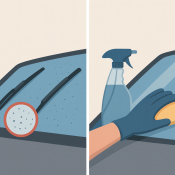 Rapid wear of wiper blades is a problem that can occur even on brand new cars. If new wiper blades start to streak, leave spots on the glass or start to skip after just a few weeks or months, the fault is usually not with the product itself. Most often, the cause is invisible dirt accumulated on the surface of the windshield or the wipers are working at the wrong angle.
Below is an overview of the main causes and solutions.
... More...
Rapid wear of wiper blades is a problem that can occur even on brand new cars. If new wiper blades start to streak, leave spots on the glass or start to skip after just a few weeks or months, the fault is usually not with the product itself. Most often, the cause is invisible dirt accumulated on the surface of the windshield or the wipers are working at the wrong angle.
Below is an overview of the main causes and solutions.
... More...
 The data shown here, especially the complete database of car spare parts, may not be copied. It is strictly prohibited to duplicate the data and database and distribute the same, and/or instruct third parties to engage in such activities, without prior consent from TecAlliance. Any use of content in a manner not expressly authorized constitutes copyright infringement and violators will be prosecuted.