

How to choose a battery charger?
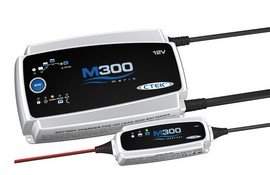 1. First, make it clear which battery or batteries you want to charge, whether regular lead-acid batteries (in most cars), gel batteries, AGM batteries (used on many motorcycles) or calcium batteries.
2. What is the capacity (how many Ah) of your battery? The capacity of the battery depends on the car's electricity consumption, the more electrical devices the more powerful the battery should be. The charging current in amperes (A) is shown on the battery chargers or on the box, as well as the maximum battery capacity that the given charger is capable of charging. A typical battery is 50Ah, and a 10A charger will charge a completely empty battery in about 6 hours. To calculate the charging time, use the formula battery Ah divided by charger A plus 10%. All battery chargers sold in our store are suitable for charging lead-acid batteries.
3. How many volts of battery do you have, is it 6V (motorcycles, lawn tractors, scooters, etc.), 12V (car, motorcycle batteries - most common), 24V battery (trucks).
Battery chargers are divided into:
- Manual battery chargers (standard chargers): Suitable for charging lead-acid batteries only. The charger charges constantly and when the battery is full, the charger must be manually switched off to prevent overcharging the battery.
- Automatic battery chargers (standard chargers): Suitable for charging lead-acid and gel batteries. As a rule, you can choose between fast and slow charging modes. When the battery is fully charged, the charger switches to maintenance mode, thanks to which the battery can be left connected to the charger for a short time.
- Smart chargers (Smart Chargers) - microprocessor-controlled (many different smart chargers available in our online store, see here): Suitable for charging lead-acid, gel, AGM and calcium batteries. You can choose between several different charging modes. Smart chargers charge the battery up to 2 times faster than manual and automatic chargers. When the battery is full and the charger is connected to the battery, charging only occurs when the battery voltage drops, so the charger can be connected to the battery indefinitely (for example, all winter). Smart chargers also have a battery maintenance function that improves battery performance and extends battery life.
Possible Functions of Smart Car Battery Chargers
1. Battery Reconditioning Function (Recond / Recondition)
The battery reconditioning function (often called Recond or Recondition) is designed to restore deeply discharged or sulfated lead-acid batteries, including VRLA, AGM, GEL, and conventional flooded lead-acid batteries.
What it does
The reconditioning mode adds pulses or a higher charging voltage (usually up to 15.8 V) during the charging process. This helps to:
-
Dissolve sulfate crystals that form on the lead plates when a battery remains discharged for a long time.
-
Restore battery capacity and extend battery life.
-
Balance the voltage between battery cells.
When to use it
-
When the battery has been unused or discharged for a long period of time.
-
When the battery no longer holds charge properly.
-
When a charger such as CTEK detects an unusual voltage or internal resistance pattern and recommends reconditioning.
Important to know
-
This function should not be used during every charging cycle, but only occasionally when the battery has weakened.
-
For AGM and GEL batteries, the reconditioning mode should be used with caution (always check the charger manual to ensure compatibility).
-
Conventional flooded lead-acid batteries usually tolerate this process well.
2. Alternator Test (Charging System Test)
The Alternator Test (also called Charging Test) is a function that checks whether the vehicle’s alternator is operating correctly and charging the battery properly.
Purpose
The test measures the voltage produced by the alternator while the engine is running. Based on this measurement, it can determine whether:
-
the alternator is charging the battery sufficiently,
-
the voltage regulator is working correctly,
-
or there is a problem in the charging system (for example, voltage that is too low or too high).
How the test works (general principle)
-
Connect the charger clamps to the vehicle battery, just as you would for normal charging.
-
Start the engine.
-
Activate the alternator test from the charger menu.
The charger measures and displays the alternator output voltage, usually via LEDs or a display.
Interpretation of Results
- Good: voltage typically 13.8–14.7 V
- Too low voltage: the alternator is not charging properly (this may indicate a problem with the drive belt, brushes, or voltage regulator).
- Too high voltage: the voltage regulator may be faulty, which can damage the battery and vehicle electronics.
Benefit
This test provides a quick overview of whether a weak battery is actually caused by a faulty alternator rather than the battery itself.
3. Battery Charger Jump Start Function
The Jump Start or Engine Start function means that the charger can deliver a very high current for a short period of time, helping to start the engine when the battery is too weak to crank the engine on its own.
What it does
The jump start mode delivers a large current (often hundreds of amps) for a short time, usually a few seconds to about a minute.
- This allows the vehicle engine to be started without fully charging the battery first.
- In practice, the function works similarly to a booster pack or jump starter.
When to use it
- When the battery is too discharged for the starter motor to turn the engine.
- When the vehicle must be started quickly and there is no time to fully recharge the battery.
Important to know
- Jump start does not replace proper charging. After the engine starts, the battery should still be charged normally. When using this function, safety precautions must be followed, because high current can cause sparks or damage vehicle electronics if connections are poor.
Difference from normal charging
- Normal charging: Low current (typically 5–25 A). Slow and safe process
-
Jump start: Very high current (100–120 A or more). Short duration. Designed only for engine starting
4. ESB Mode (Extra Second Battery)
ESB mode (short for Extra Second Battery) means that the charger has a special output or function for charging or maintaining a secondary battery.
What the ESB function includes
- The charger’s main output is designed for the primary battery (usually the starter battery).
- The ESB function allows the charger to charge or maintain a second battery, such as: an auxiliary battery in a vehicle, a leisure battery in a camper, boat, or service vehicle
- The specific output is usually marked in the manual as “ESB output” or “ESB control”.
What it means for the user
If your vehicle or boat has two batteries (for example one for starting and another for accessories), the charger can:
-
prioritize charging the starter battery first
-
then charge or maintain the second battery
-
make it easier to manage a dual battery system
What to pay attention to
-
The ESB output usually has a lower current than the main output (for example 13.8 V / 2 A). Autokaubad24+1
- The system must be installed correctly, including proper wiring, battery separation, and protection.
- The ESB function does not automatically mean that any two batteries can be charged simultaneously without preparation. Battery types (AGM, GEL, lithium, etc.) and charging requirements must always be considered.
 The data shown here, especially the complete database of car spare parts, may not be copied. It is strictly prohibited to duplicate the data and database and distribute the same, and/or instruct third parties to engage in such activities, without prior consent from TecAlliance. Any use of content in a manner not expressly authorized constitutes copyright infringement and violators will be prosecuted.