

Steering rack – what is it and why does a car need it?
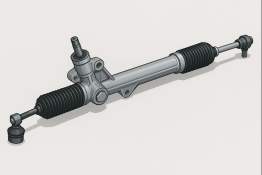 The steering rack, often called the steering rack , is the central part of a car's steering system.
it connects the steering wheel to the front wheels so that the car moves exactly where the driver turns.
simply put:
The steering rack is a long mechanism that converts the movement of the steering wheel into the rotation of the wheels.
This detail is present in all cars – Audi, Volkswagen (VW), Volvo, BMW, Mercedes, Toyota, Škoda and many other models use different types of steering gears, but the principle of operation is the same for all.

How does the steering rack work?
The steering rack consists of several parts:
-
rack – a long straight bar,
-
pinion – a wheel on the steering shaft that moves the rod,
-
ends and hinges – connect the bar to the wheel arch guide rods,
-
hydraulic or electric power steering , which makes steering easier.
The work is done like this:
you turn the steering wheel.The gear wheel makes the rack move left or right.
the rod moves the steering tips.
the wheels turn exactly in the desired direction.
Electric Power Steering (EPS), used in many newer VW, Audi, Volvo models, works similarly but uses an electric motor.
main types of steering rods
-
mechanical steering rack – older models, without power steering.
-
Hydraulic power steering rack (HPS) – a very common system on Audi, VW and Volvo models.
-
Electric Power Steering (EPS) – newer cars, such as VW Golf 7, Audi A3 8V, Volvo V40.
common problems with the steering gear
Over time, the steering rack wears out and the following errors begin to occur:
-
oil leak on the steering rack (on hydraulic models),
-
game or a slouch at the wheel ,
-
creaking, rattling or rattling when turning ,
-
difficult steering ,
-
uneven turning sensation ,
-
the center position "floats", meaning the car does not stay straight ,
-
EPS error codes and warning lights (on electrical bars).
examples:
-
The steering rack of the VW Passat B6 often experiences leaks and looseness.
-
Audi A6 C6 models are known to have leaks in the power steering hydraulic system.
-
Volvo XC90 in earlier years has internal wear and cracking in the steering rack.
signs that the steering rack needs checking or replacement
-
the steering wheel becomes heavy ,
-
the steering wheel does not return to the center position on its own,
-
there are knocks or clicks in the steering wheel,
-
the car "floats" or sinks to one side,
-
oil stains on the bottom of the car (on the slats with a hydraulic system),
-
There is an electrical humming sound near the steering wheel switch (eps characteristic).
How to maintain the steering rack?
-
Keep the power steering oil level correct (HPS systems).
-
Replace steering knuckles and joints on time.
-
Do not keep the wheels fully turned out for a long time.
-
Use high-quality power steering fluid that is suitable for your specific car.
-
Check the steering rack during every maintenance, especially if the mileage is high.
When should the steering rack be replaced?
usually when:
-
the leaks are large,
-
Internal wear causes rattling and noise,
-
the steering wheel becomes heavy,
-
the electric steering servo gives permanent errors,
-
Repair is no longer economically viable.
A new or rebuilt steering rack restores your car's precise steering feel, safety, and driving comfort .
short summary
-
The steering rack connects the steering wheel to the front wheels.
-
This ensures precise and safe handling in all situations.
-
Common problems: leaks, looseness, knocking, difficult steering.
- Regular maintenance helps avoid expensive repairs in the long run.
Steering rack and its typical faults: why does the steering wheel rattle and which cars are at risk?
The steering system of a car is one of the most important safety elements, ensuring direct contact between the driver's hands and the road surface. At the heart of this system is the steering rack . Although it is an extremely durable component designed to last hundreds of thousands of kilometers, the roughness of our roads, moisture and natural wear and tear are some of the biggest enemies of the steering rack.
Steering rack failure usually doesn't show itself overnight. It creeps up on you quietly – at first with a slight wobble or a barely noticeable rattle that gets worse over time. In this article, we'll look at how to recognize steering rack failures, the difference between hydraulic and electrical systems, and what are the typical problems in common car models.
How do you know if the steering rack is worn out?
Regardless of the make of car, the symptoms of steering rack wear are quite similar. The most common signs that indicate the need to visit a service center are:
- front axle rattle: especially noticeable on cobblestone roads or when driving over a railway crossing. It's a sharp, metallic clank that often travels to the steering wheel.
- play in the steering wheel: the steering wheel has a "dead zone" - you have to turn the steering wheel more than usual to turn the wheels, and the car "floats" on the road.
- Heavy steering wheel: the power steering is not working properly, the steering wheel is stuck in places or "shakes" when turning.
- Oil leak (on hydraulic struts): a red or greenish puddle appears under the car and the fluid level in the power steering tank drops.
- Creaking or whistling: Especially with electric battens, you may hear strange sounds when turning the steering wheel on the spot.
Hydraulic vs. Electric Steering Rack: Different Concerns
Older cars have hydraulic steering racks that operate using oil pressure. Their main enemy is corrosion. If the steering rack dust cover (rubber bellows) breaks, water and sand can get onto the working surface of the rod. This causes rust, which in turn damages the seals (simmerings), causing oil leaks.
Newer cars (mostly from 2005-2010) use electric power steering (EPS) . There is no oil or pump here, the work is done by an electric motor. Their weakness is electronics and moisture. If water gets into the housing, it can short-circuit the control unit or damage the belt drive. Another problem is mechanical wear in the plastic bushings, which causes an annoying rattling sound.
typical defects by car model
BMW (E60, E90, F-Series)
BMW is known for its precise handling, but this places high demands on the steering system. The so-called active steering rods are particularly complex.
- Problem: The steering column in the middle position has a play due to wear, which is felt when driving on the road. Hydraulic variants often have leaks at the connections of the pipes. On electric rods (F-series), the bolts connecting the motor and the rod often break or the belt drive wears out, causing a rattling sound.
volkswagen, audi and škoda (vag group)
VAG Group cars have had problems with steering racks over the years, but the reasons have changed.
- Older models (Passat B5, Audi A4/A6 C5): A typical fault is a hydraulic leak directly into the dust covers. Nothing may be visible from the outside, but the tank is emptying.
- Newer models (golf 6/7, passat b6/b7): electromechanical struts are used (e.g. zf or apa-bs). A typical fault is a rattle at the right end, which is caused by wear of the support bushing. Water damage is also a problem - if the dust cover is broken, all the electronics "die" and the red steering light in the dashboard lights up.
Ford and Volvo
Since the Ford Focus, Mondeo and Volvo S40/V50/V70 shared platforms at a certain period, their concerns are also similar.
- Problem: It is common for hydraulic rods to wear out the teflon seals inside the steering rod housing. This creates a situation where the power steering disappears momentarily when turning quickly. It is also common for fords to have the steering rod end caps (plastic) break, allowing moisture into the system.
Toyota and Honda
Japanese cars are generally durable, but the steering racks are their Achilles heel, especially on our roads.
- Problem: Electric steering racks (e.g. Honda Civic, Toyota Avensis/Corolla) start to rattle on gravel roads. The cause is the wear of the plastic or Teflon slider inside the rack. This is not dangerous, but extremely annoying. Often just replacing the bushing is enough, but many dealerships only offer to replace the entire rack.
Mercedes-Benz
Mercedes steering systems are generally very durable (especially on older C and E-classes, which used a worm gear system). Newer rack and pinion steering models (W204, W211) have hydraulic leaks from the control valve (solenoid) that adjusts the weight of the steering wheel according to speed.
What to do if the steering rack needs replacing?
Repairing or replacing a steering rack is an expensive job, so it's worth choosing a spare part carefully. A cheap "no-name" steering rack can start to leak or rattle after just six months.
Reliable aftermarket brands that experts recommend include TRW and Bosch (often original manufacturers), as well as high-quality remanufacturers such as General Ricambi , Elstock or Era . A remanufactured steering rack is an environmentally friendly and more budget-friendly alternative to a new original part, provided that the remanufacturing is done industrially and all consumable parts are replaced.
A final tip: the cheapest way to save your steering rack is to regularly check the condition of the steering rack dust covers (e.g. during oil changes). A small crack in a 10-euro rubber cover can result in a 500-euro repair bill if water and salt can damage the expensive mechanism.
 The data shown here, especially the complete database of car spare parts, may not be copied. It is strictly prohibited to duplicate the data and database and distribute the same, and/or instruct third parties to engage in such activities, without prior consent from TecAlliance. Any use of content in a manner not expressly authorized constitutes copyright infringement and violators will be prosecuted.