

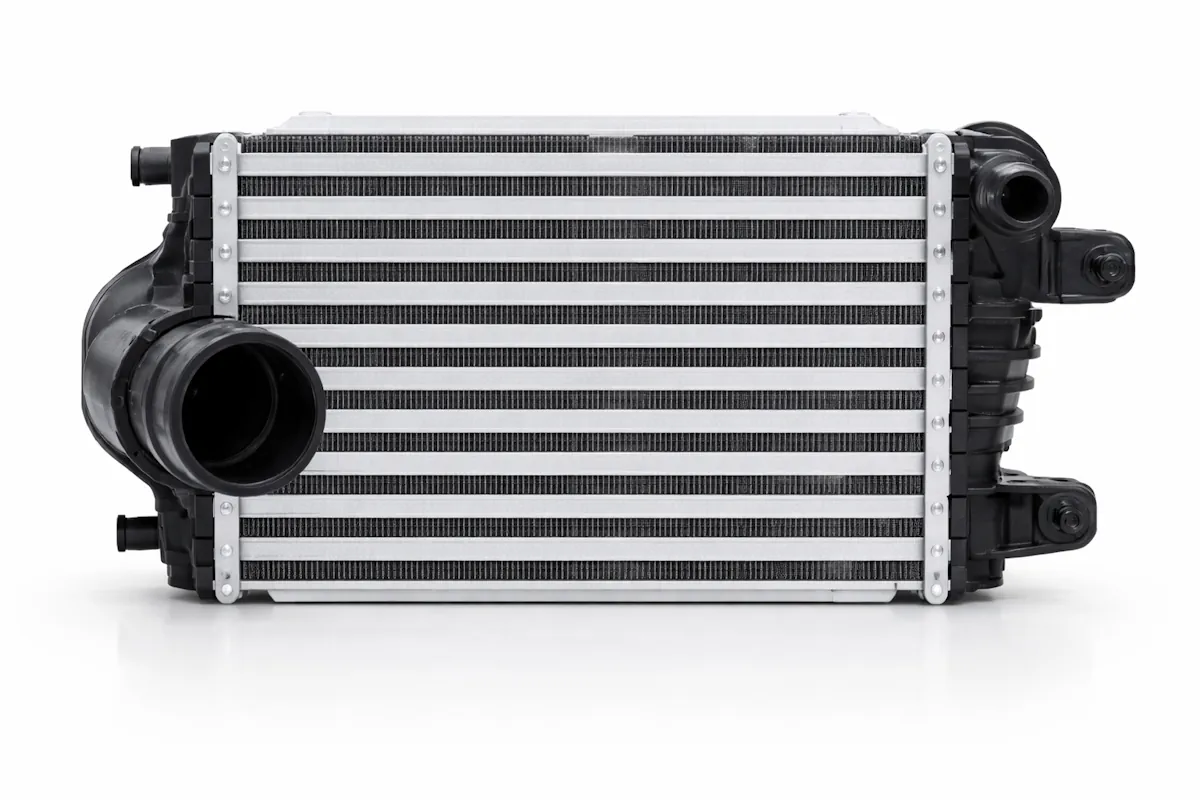
Turbo radiator or intercooler
 Turbo Radiator, also known as an intercooler (often referred to as a "charge air cooler"), is a crucial component of a turbocharged car's powertrain system. Its primary function is to cool the compressed air from the turbocharger or supercharger before it enters the engine cylinders. Cooling the air helps improve engine efficiency, performance, and durability.
TURBO SYSTEM AND COMPONENTS:
1. Compressor air intake
2. Compressed air movement
3. Cooling radiator (intercooler)
4. Intake valve
5. Exhaust valve
6. Turbine inlet
7. Air exiting the turbine
How the Turbo Radiator (Intercooler) Works
-
Air heats up in the turbocharger:
- The turbocharger compresses air to allow more oxygen into the engine, enabling more fuel to be burned.
- However, the compression process significantly increases the air temperature.
-
Air cools down in the intercooler:
- Hot compressed air is directed through the intercooler, which functions as a heat exchanger.
- The intercooler uses either:
- Air (air-to-air intercooler), where the compressed air is cooled using ambient airflow, or
- Liquid (air-to-liquid intercooler), where a coolant absorbs the heat and is then cooled by a separate radiator.
-
Cooled air enters the engine’s combustion chamber:- Cooled air is denser and contains more oxygen, enhancing combustion efficiency, increasing engine power, and improving fuel efficiency.
Benefits of a Turbo Radiator
-
Increases engine power:
- Cooled air is denser and contains more oxygen, allowing the engine to generate more energy from combustion.
-
Improves fuel efficiency:
- More efficient combustion leads to lower fuel consumption.
-
Reduces engine wear:
- Cooled air helps maintain lower engine temperatures, reducing overheating risks and mechanical stress.
-
Enables higher boost pressure:
- Without an intercooler, hot compressed air would limit the amount of boost pressure that can be safely used, as excessive heat may cause detonation (premature fuel combustion).
Types of Intercoolers
-
Air-to-Air Intercooler:
- Compressed air moves through the intercooler, where it is cooled by external airflow passing through cooling fins.
- Common in everyday vehicles due to its simplicity and reliability.
-
Air-to-Liquid Intercooler:
- Compressed air is cooled using a liquid (such as coolant), which is then cooled in a separate radiator.
- More commonly used in sports and racing cars, as it is more compact and effective under high loads.
Common Issues and Maintenance
- Air Leaks:
- If the intercooler or its piping leaks, engine power may decrease, and fuel consumption may increase.
- Contamination and Blockages:
- Dust, oil, or other contaminants can accumulate inside the intercooler, reducing its efficiency. Regular cleaning can help prevent this.
- Physical Damage:
- The intercooler is often located at the front of the car, making it vulnerable to damage from road debris and rocks.
Where is the Intercooler Located?
- Typical location:
- The intercooler is usually positioned in front of the engine, ahead of or below the radiator, to receive maximum airflow. Some sports cars may have it mounted on the sides or under the hood (with an air duct).
Automotive Turbo Intercooler: Common Model-Specific Failures and Their Symptoms
In today’s automotive industry, turbocharging has become the rule rather than the exception. This applies to both diesel and gasoline engines, where the goal is to achieve maximum power and fuel efficiency from a relatively small engine displacement. One of the most critical—yet often overlooked—components in this system is the intercooler, also known as the charge air cooler.
Although the intercooler is structurally a relatively simple radiator, its failure can cause serious engine performance issues, ranging from noticeable power loss to costly damage to the turbocharger or the diesel particulate filter (DPF). In this article, we take an in-depth look at the function of the intercooler, the most common failures found in popular vehicle models, and which brands are worth choosing.
How to recognize an intercooler failure?
Before diving into model-specific issues, it is important to recognize the general symptoms that indicate a leaking or clogged intercooler (charge air cooler):
Noticeable loss of power: The car feels sluggish during acceleration, especially when overtaking. The engine no longer responds to the accelerator as sharply as before.
Hissing or whistling noise: During acceleration, a loud air hiss or whistling sound can be heard. This usually indicates that pressurized air is escaping through a crack or a loose connection.
Black smoke (diesel engines): Because the engine receives less air than the engine control unit expects, the air–fuel mixture becomes too rich. Unburned diesel fuel exits the exhaust as black soot.
Increased fuel consumption: The engine has to work harder to maintain the same driving speed.
Engine warning light (Check Engine): Modern vehicles can detect boost pressure leaks and may switch the engine into limp or emergency mode.
Common model-specific failures
Although intercoolers are generally universal components, certain car manufacturers and models have developed specific weak points over time.
Volkswagen Group (Volkswagen, Audi, Škoda, SEAT)
Vehicles from the VAG group—especially popular models equipped with 1.9 TDI and 2.0 TDI engines (such as the VW Passat, Golf, Audi A4 and A6)—are well known for issues related to intercooler connections.
- Problem: These models often use quick couplers, where the charge air hose is secured to the intercooler with a retaining clip. Over time, the seals (O-rings) wear out, and the metal locking clips can weaken or corrode.
- Consequence: The connection becomes no longer airtight, and oil—inevitably carried into the intake system via crankcase ventilation—begins to seep out at the joint. This results in boost pressure loss and an oil-contaminated engine bay.
- Solution: In many cases, replacing the seals and retaining clips is sufficient. However, if the intercooler’s mounting collars themselves are worn or damaged, replacement of the entire intercooler is required.

Figure. Oil seeping from the joint of a turbocharger intercooler hose.
BMW (3 Series and 5 Series)
On BMW diesel engines (such as the E60, E90 and F10 series), intercooler design characteristics are a common source of problems.
- Problem: BMW original intercoolers use an aluminum core with plastic end tanks, joined together with crimped clamps. Due to age, vibration, and temperature fluctuations (hot charge air versus cold ambient air), the plastic end tanks tend to crack or the joints begin to fail.
- Consequence: Under high boost pressure, the intercooler can “expand,” leading to microcracks that are difficult to detect visually but allow air to escape under load.
- Solution: The only long-term solution is to replace the intercooler with a new, high-quality aftermarket or OE-equivalent unit.
Ford and Volvo
Ford (Focus, Mondeo) and Volvo (V50, V70) share many engine platforms, especially diesel engines.
- Problem: On these vehicles, the intercooler is often mounted very low, behind the lower edge of the front bumper. This makes it highly vulnerable to road debris, curbs, and winter ice.
- Consequence: Physical damage to the cooling core is common. Even a small stone can create a hole large enough to cause boost pressure loss. Another frequent issue involves the lower charge air hoses, which can rub against body panels or other components until a hole forms.
- Solution: Regular visual inspection is essential. If oily residue is visible on the intercooler core, it usually indicates a leak (oil attracts dust and dirt).
Opel and Saab
Opel Insignia, Astra, and older Saab models suffer from issues similar to BMW vehicles—fatigue at the joints between plastic end tanks and the aluminum core. In addition, certain models are prone to intercooler clogging caused by a mixture of oil and soot from the crankcase ventilation system, significantly reducing cooling efficiency.
 Figure. Old turbo radiator, also known as an intercooler (charge air cooler), requiring replacement.
Why choose well-known brands?
When replacing an intercooler becomes unavoidable, car owners face a choice: purchase a cheap, “no-name” part or invest in a product from a reputable manufacturer. While the price difference may be noticeable, the difference in quality is often even greater.
Well-established manufacturers such as Nissens, Mahle, Valeo, Hella, and NRF have decades of experience in the automotive industry.
Material quality: Low-cost intercoolers are often made from thinner aluminum and more brittle plastics, which are less resistant to high boost pressure and temperature fluctuations. Reputable brands use reinforced, higher-grade materials designed to withstand demanding operating conditions.
Cooling efficiency: Intercooler performance depends heavily on its internal design (fin density and geometry). Premium manufacturers test their products in wind tunnels to ensure cooling performance equal to—or even better than—original equipment (OE). A cheap unit may look similar externally but can cool the charge air 20–30% less effectively, effectively defeating the purpose of replacement.
Fitment: Few things are more frustrating than discovering during installation that mounting holes are misaligned or that a pipe diameter is off by just a millimeter. Nissens and Mahle are particularly well known for their strict “Perfect Fit” standards.
The hidden dangers of a faulty intercooler
Many car owners postpone replacing a faulty intercooler, assuming that a slight hissing noise or somewhat sluggish performance is not a serious issue. This, however, is a dangerous misconception.
- Turbocharger failure: When there is a leak in the system, the turbocharger has to work twice as hard to achieve the required boost pressure. This places extreme stress on the turbo, leading to overheating and premature failure. Replacing a turbocharger is many times more expensive than replacing an intercooler.
- Death of the diesel particulate filter (DPF): As mentioned earlier, an air leak causes an excessively rich fuel mixture and increased soot formation. This soot accumulates in the DPF, quickly clogging it. Forced regeneration usually does not help in this situation, as the engine is operating under incorrect conditions.
Conclusion
The intercooler is the engine’s “lungs.” When it is intact and clean, the engine breathes easily, operates efficiently, and delivers strong performance. If you notice symptoms such as loss of power, hissing noises, or excessive smoke, the first step should always be to check the airtightness of the intake system.
Timely action and the use of high-quality replacement parts can save thousands of euros in repair costs over the long term. Whether you drive a reliable Volkswagen, a sporty BMW, or a practical Ford, a properly functioning cooling and charge air system is key to longevity. Inspect your vehicle’s intercooler regularly—especially before long trips or at the start of the summer season, when the cooling system is under the greatest load.
 The data shown here, especially the complete database of car spare parts, may not be copied. It is strictly prohibited to duplicate the data and database and distribute the same, and/or instruct third parties to engage in such activities, without prior consent from TecAlliance. Any use of content in a manner not expressly authorized constitutes copyright infringement and violators will be prosecuted.