

Which brake discs are best for a car
 Which brake discs are best for a car
 Even an experienced driver can get confused by the range of products in online stores and auto parts. What do you need to know about brake discs to buy the best ones?
When you understand that it is time to change the brake discs, or the mechanic has “sentenced” you to change them, and you don’t want to buy an already expensive consumable from a dealer at an exorbitant price, it is time to search and painfully choose the best parts in terms of quality and price: so that they are effective, do not squeak and do not cost too much.
Brake discs
What parameters of brake discs do you need to know?
Choosing brake discs that are suitable for your car is actually not that difficult. And to buy the right part, by and large, it is necessary to know the diameters of the disc and centering, thickness and height, as well as the number of mounting holes, by which the selection of wheels for a particular car model is carried out.
Remember: together with the brake discs, you also need to change the brake pads!
Brake disc and pads
Which type of brake discs to choose?
Structurally, brake discs can be divided into three types:
non-ventilated - the simplest and most affordable discs with a flat surface on which grooves can be applied to remove dirt. They are ideal for economy class cars and will fit most regular cars.
ventilated — these are probably the most common, better cooled, more efficient and at the same time average-priced brake discs. They are two discs connected by bridges (ribs), each of which only has one side working when braking. Straight, teardrop-shaped or directed ribs provide airflow through the gap between the surfaces and better cooling.
two-piece or combined — the most complex and expensive brake discs, which, unlike the first two, made entirely of cast iron, are made from different materials to reduce weight and thermal conductivity. Most often, this is aluminum (the central part or "cup") and cast iron (braking surface). Sometimes they are also called "tuning" and are installed on more expensive, powerful and fast models of cars.
Unlike two-piece brake discs, the use of which on ordinary cars for everyday driving on highways and city traffic jams is economically impractical, the first two should suit almost any car. Thicker non-ventilated ones last longer, but are prone to overheating and reduced efficiency during dynamic driving. Ventilated ones, due to the smaller thickness of the surfaces, serve less than non-ventilated ones, but they work better under high thermal loads.
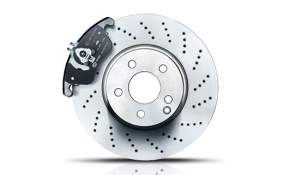
In fact, this is not true. At least in relation to through holes. The so-called "holes" are just a decoration that has no practical use. They appeared in the middle of the last century, when asbestos was widely used in the manufacture of brake pads.
Brembo Brakes
When heated strongly by friction, it released a large amount of gas, due to which an air cushion formed between the disc and the pad, catastrophically reducing the effectiveness of the brakes. At that time, perforation really helped to remove excess gas and create places with additional resistance to increase the overall friction coefficient. Nowadays, when asbestos, which turned out to be harmful to humans, has been abandoned and pads are made of other materials, this problem is no longer relevant.
Today, the holes, which in our reality are often clogged with dirt, are only an aesthetic component and ostentatious sportiness. But the notches on the discs (separately or together with perforation) are not without meaning. They appeared later than perforation and are designed to constantly clean the braking surface of the discs from the results of combustion, dust, dirt and steam removal in wet weather.
There is no particular sense in buying such discs. Firstly, this will affect the price of the spare part more than its efficiency. And secondly, the pads with such discs will wear out faster, which means they will have to be changed more often.
 The data shown here, especially the complete database of car spare parts, may not be copied. It is strictly prohibited to duplicate the data and database and distribute the same, and/or instruct third parties to engage in such activities, without prior consent from TecAlliance. Any use of content in a manner not expressly authorized constitutes copyright infringement and violators will be prosecuted.