

Exhaust System > Catalytic Converter
Pick your vehicle
Car catalytic converter: everything you need to know about its working principle, maintenance and selection
In today's automotive industry, environmental sustainability and clean exhaust emissions have become the number one priority. At the heart of it all is a component that is often unnoticed but plays a critical role – the car's catalytic converter . This device is responsible for converting toxic gases from the internal combustion engine into less harmful compounds before they are released into the atmosphere through the exhaust pipe. In this article, we will delve into the world of catalytic converters, examining their construction, common problems in different car models, and how proper maintenance and chemical products can extend the life of this expensive part.

picture. A car catalytic converter.
What is a car catalytic converter and how does it work?
A catalytic converter is a part of the exhaust system, usually located between the exhaust manifold and the muffler. Technically, it is a device where a chemical reaction takes place without the catalyst itself being consumed in the reaction. This is why the component is called a "catalyst". When it comes to terminology at the international level, a catalytic converter is known in English as a catalytic converter . This term accurately reflects the function of the device – to convert exhaust gases into cleaner ones.
The inside of the catalytic converter resembles a honeycomb structure, made of either ceramic or metal. This honeycomb is coated with a layer of precious metals, usually platinum, palladium and rhodium. As hot exhaust gases pass through these channels, the precious metals trigger oxidation and reduction reactions. Carbon monoxide (CO) is converted into carbon dioxide (CO2), unburned hydrocarbons (HC) into water vapour and carbon dioxide, and nitrogen oxides (NOx) into nitrogen and oxygen.
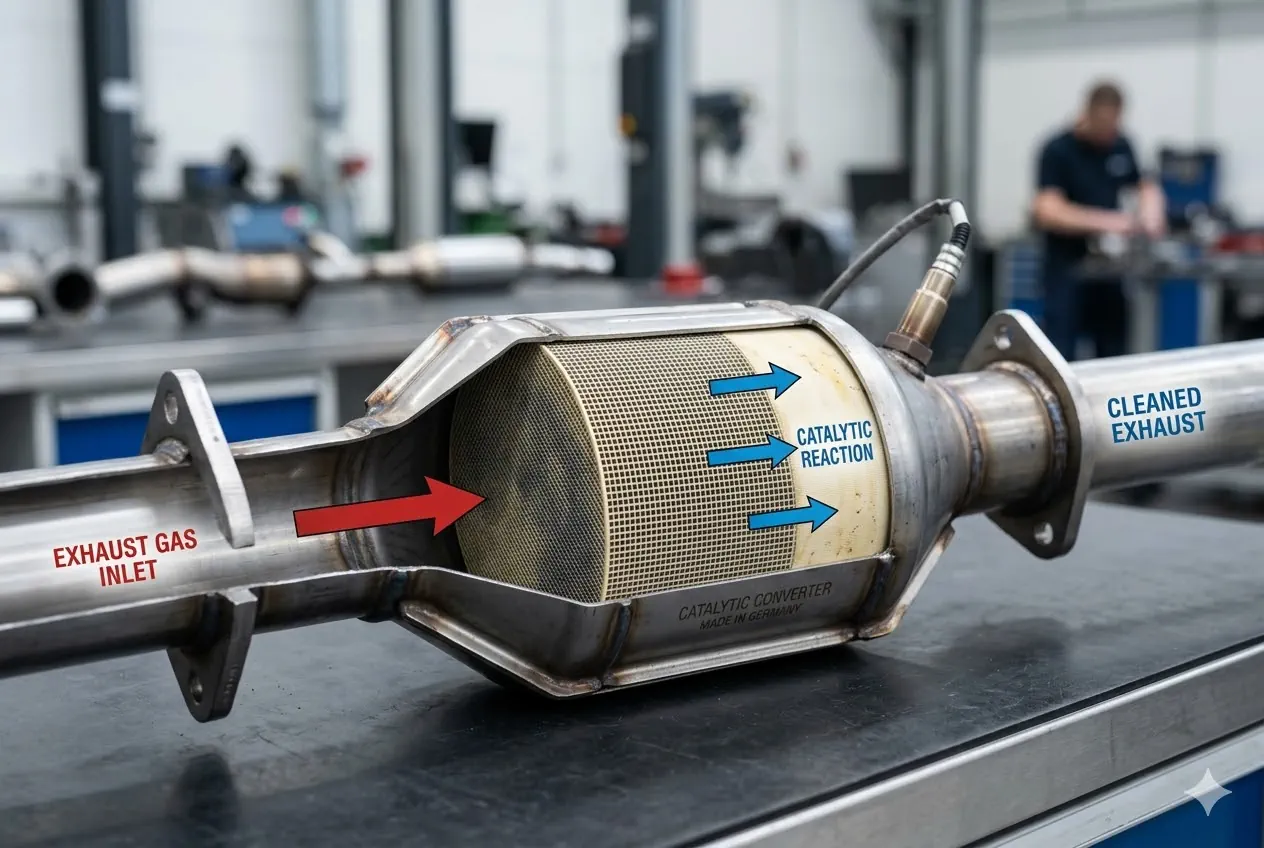
image. A cross-section of the catalyst reveals its complex ceramic honeycomb structure, coated with precious metals.
Price of a catalytic converter – why is it one of the most expensive spare parts?
Many car owners are shocked when they first hear the price of a new catalytic converter . There are two main factors behind its high cost: the content of precious metals and the complexity of the production technology. Platinum, palladium and rhodium are extremely expensive on the world market, and their amount in one device, although measured in grams, determines a large part of the final price.
In addition to the cost of materials, the price is also affected by whether it is a universal spare part or a brand-specific (close to original) product. Brand-specific catalytic converters are designed precisely with the geometry and engine parameters of a specific car model in mind, which makes their installation easier and their reliability higher. The price of universal products may be more affordable, but this often requires welding work and additional fitting.

image. A close-up of a ceramic honeycomb structure with iridescent particles of precious metals on its surface, which make the catalyst expensive.
common car models and their typical catalytic converter faults
Although a car's catalytic converter is designed to last almost the entire life of the car (usually 150,000 - 250,000 km), certain models have specific problems that can lead to premature failure.
Volkswagen Group (VW, Audi, Škoda, Seat)
Many Volkswagen Group models, especially the 1.2 and 1.4 TSI engines, have been reported to have problems with the ignition system. If the ignition coils or spark plugs are not working properly, unburned fuel can enter the catalytic converter, where it ignites and melts the ceramic cell. This causes restricted exhaust flow and loss of engine power. Older 1.9 TDI engines also have a problem with soot build-up, which can clog the catalytic converter if the car is only driven for short city trips.
BMW and Mercedes-Benz
In these premium brands, the problem is often with the sensors rather than the catalytic converter itself, but a faulty oxygen sensor (lambda sensor) can disrupt the catalytic converter's operation. In the BMW E90 and E60 series in particular, engine oil consumption (due to valve stem seal wear) can lead to oil residues depositing on the catalytic converter's surface, poisoning the precious metals and rendering them inoperable.
Toyota (especially hybrids like the Prius)
In the case of hybrid cars , the catalytic converter has received attention not so much because of technical failures as because of theft. Because hybrid engines operate more optimally, the precious metals in their catalytic converters are better preserved, making them attractive to thieves. On the technical side, Toyota models have been experiencing "p0420" error codes, which indicate that the catalytic converter's efficiency has dropped below the permissible limit, even when the car is apparently driving normally.
Ford and Opel
Ford Focus and Fiesta models often have problems with catalytic converters integrated into the exhaust manifold. In these cases, the housing can crack due to vibration, which causes exhaust gas leaks before the catalytic converter, interfering with the operation of the lambda sensors and giving false information to the engine control unit.
catalyst maintenance and chemical products
Can a catalytic converter be repaired or maintained? Yes, to a certain extent. Although physically broken or melted ceramics cannot be restored, it is possible to clean clogged or contaminated surfaces with special chemicals.
fuel additives
One of the most common ways to maintain the health of your catalytic converter is to periodically use high-quality fuel additives. These chemicals are designed to increase combustion temperatures or dissolve residues in the combustion chamber and exhaust system. They help remove soot and varnish-like deposits from the catalytic converter cell, restoring exhaust gas flow.
cleaning foams and liquids
In the case of more serious blockages, professional cleaning foams are used, which are injected directly into the catalytic converter through the lambda sensor opening. These foams penetrate deep into the structure of the cell and break down the accumulated pollution. The car must then be taken on a longer road trip to burn out the residue. This method is often the last resort before the cost of the catalytic converter and the need for replacement become unavoidable.
oil additives
Since many catalytic converter problems start with engine oil consumption, it is important to keep the engine seals and rings in good condition. There are special oil additives that help restore the elasticity of the seals and reduce oil ingress into the combustion chamber, thereby indirectly protecting the exhaust system.

picture. A mechanic adds a fuel additive to a car that helps keep the catalytic converter clean and prevent it from clogging.
the most well-known spare part brands in the world of catalytic converters
If the diagnosis is certain and the car's catalytic converter needs to be replaced, it is important to choose a reliable manufacturer. There are several brands on the market that offer solutions with different price-quality ratios.
- bosal: one of the world's leading manufacturers of exhaust systems. their catalytic converters are known for their precise fit and long service life. they offer both oem (original spare part) quality products and aftermarket solutions.
- Walker (Tenneco): an American giant whose product range covers almost all European and Asian car models. Walker is known for its innovative solutions and strict quality controls.
- JMJ: A Polish manufacturer that has gained popularity due to its affordable price. JMJ catalytic converters are a good choice for older cars where the owner wants to keep repair costs under control but still ensure clean emissions.
- Ernst: A German quality brand that focuses primarily on German cars. Their products are often identical to the factory installation, offering maximum efficiency and noise reduction.
- HJS: specializes in high-efficiency and tuned car catalytic converters, but also offers a wide range of standard replacement parts.
signs indicating catalytic converter failure
How do you know that a catalytic converter has outlived its useful life? There are several symptoms that a car owner should pay attention to:
- Check Engine Light: This is the most common sign. The car's on-board diagnostics (OBD-II) constantly monitors the efficiency of the catalytic converter and if it drops below a certain limit, the light will illuminate with the code P0420 or P0430.
- Loss of power: When the catalytic converter is clogged, exhaust gases cannot escape quickly enough. This creates back pressure that prevents the engine from "breathing". The car feels sluggish, acceleration is slow and top speed may drop.
- increased fuel consumption: because the engine has to work harder due to the blockage, fuel consumption also increases significantly.
- unpleasant smell: a faulty catalytic converter cannot process sulfur compounds properly, which can cause a "rotten egg" smell from the muffler.
- Rattling or rattling under the car: If the ceramic content of the catalytic converter is broken, the pieces may vibrate inside the housing and create a metallic rattling sound, especially when idling or accelerating.
catalyst replacement process
A car's catalytic converter is not usually a part that can be replaced at home without special equipment. Often, the bolts and nuts in the exhaust system are severely corroded by heat and moisture and require a gas torch or cutting tools to remove.
The replacement process begins with a diagnosis, which also checks the lambda sensors. It would be a mistake to replace an expensive catalytic converter when the problem is actually caused by a faulty sensor that is giving false information. After installing the new part, it is also recommended to perform an exhaust gas test to ensure that the system is fully functional.

Image: A mechanic replaces an old catalytic converter with a new one on a car lift to restore exhaust gas cleanliness and engine performance.
environmental impact and responsibility
Although the cost of a catalytic converter may seem like a big expense, its role in protecting the environment is irreplaceable. Without catalytic converters, the air quality in cities would be drastically worse, causing more respiratory diseases and acid rain. Therefore, removing or "emptying" a catalytic converter is an illegal and irresponsible activity that also does not pass a technical inspection.
It is also important to note that an old catalytic converter is a valuable waste material. It should never be thrown away with regular waste, but taken to a designated collection point where the precious metals can be recycled.
How to extend the life of the catalytic converter?
Finally, some practical advice on how to avoid the cost of the catalyst from draining your wallet too soon:
- Use high-quality fuel: cheap and dubious fuel may contain additives that poison the surface layer of the catalyst.
- Maintain the ignition system: change spark plugs according to spark requirements. No "missfire" is good for your catalytic converter.
- Avoid short trips: if you only drive a few kilometers, the catalytic converter will not reach its operating temperature (usually 400-800 degrees Celsius). This encourages the accumulation of pollution.
- Check your oil consumption: if you notice that you need to add engine oil often, have the engine's tightness checked.
In conclusion, a car's catalytic converter is a complex and valuable component that requires attention. By understanding how it works and using the right maintenance techniques and quality parts from brands like Bosal or Walker, you can ensure the longevity of your vehicle and a cleaner living environment for all of us.
Car exhaust system: functions, components and maintenance
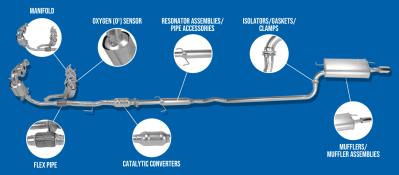 The car's exhaust system is one of the most important parts of a vehicle, its function is to safely direct exhaust gases generated during engine operation to the outside and reduce their environmental impact. This system helps to improve the vehicle's fuel efficiency, keep noise levels low, and meet legislative requirements that regulate the amount of pollutants.
... More...
The car's exhaust system is one of the most important parts of a vehicle, its function is to safely direct exhaust gases generated during engine operation to the outside and reduce their environmental impact. This system helps to improve the vehicle's fuel efficiency, keep noise levels low, and meet legislative requirements that regulate the amount of pollutants.
... More...

Why do wiper blades spoil quickly? Causes and effective solutions with deep cleaning
 Rapid wear of wiper blades is a problem that can occur even on brand new cars. If new wiper blades start to streak, leave spots on the glass or start to skip after just a few weeks or months, the fault is usually not with the product itself. Most often, the cause is invisible dirt accumulated on the surface of the windshield or the wipers are working at the wrong angle.
Below is an overview of the main causes and solutions.
... More...
Rapid wear of wiper blades is a problem that can occur even on brand new cars. If new wiper blades start to streak, leave spots on the glass or start to skip after just a few weeks or months, the fault is usually not with the product itself. Most often, the cause is invisible dirt accumulated on the surface of the windshield or the wipers are working at the wrong angle.
Below is an overview of the main causes and solutions.
... More...
Car muffler repair and muffler parts: A comprehensive guide to exhaust system maintenance
 The vehicle exhaust system, or muffler in popular parlance, is one of the most stressed and extreme components in the entire car. Imagine an environment where the internal temperature of the components can range from hundreds of degrees to even a thousand degrees (at the catalytic converter and DPF filter), while the external surface of the component is attacked by sub-zero temperatures, rainwater, dirt, abrasive sand and aggressive salt sprinkled on the roads in winter.
... More...
The vehicle exhaust system, or muffler in popular parlance, is one of the most stressed and extreme components in the entire car. Imagine an environment where the internal temperature of the components can range from hundreds of degrees to even a thousand degrees (at the catalytic converter and DPF filter), while the external surface of the component is attacked by sub-zero temperatures, rainwater, dirt, abrasive sand and aggressive salt sprinkled on the roads in winter.
... More...
Catalytic converter: faults, replacement and price - a comprehensive guide
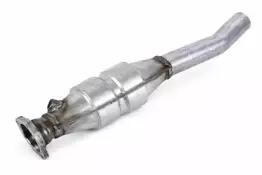 The catalytic converter is one of the most critical components of a modern internal combustion engine vehicle, fulfilling a role that is both environmentally friendly and essential to the operation of the engine. Although many drivers only come into contact with the catalytic converter when a warning light comes on on the dashboard or when a technical inspection reveals emissions problems, understanding how this device works and its maintenance needs is important for every car owner.
What is a catalyst and why is it necessary?
A catalytic converter is a part of the exhaust system that is designed to convert harmful gases produced during the combustion process of an engine into less dangerous compounds. The gases leaving the engine contain nitrogen oxides, hydrocarbons and carbon monoxide, which are harmful to health and the environment. Chemical reactions inside the catalytic converter convert these substances into water vapor, carbon dioxide and nitrogen.
... More...
The catalytic converter is one of the most critical components of a modern internal combustion engine vehicle, fulfilling a role that is both environmentally friendly and essential to the operation of the engine. Although many drivers only come into contact with the catalytic converter when a warning light comes on on the dashboard or when a technical inspection reveals emissions problems, understanding how this device works and its maintenance needs is important for every car owner.
What is a catalyst and why is it necessary?
A catalytic converter is a part of the exhaust system that is designed to convert harmful gases produced during the combustion process of an engine into less dangerous compounds. The gases leaving the engine contain nitrogen oxides, hydrocarbons and carbon monoxide, which are harmful to health and the environment. Chemical reactions inside the catalytic converter convert these substances into water vapor, carbon dioxide and nitrogen.
... More...
 The data shown here, especially the complete database of car spare parts, may not be copied. It is strictly prohibited to duplicate the data and database and distribute the same, and/or instruct third parties to engage in such activities, without prior consent from TecAlliance. Any use of content in a manner not expressly authorized constitutes copyright infringement and violators will be prosecuted.