

Car exhaust system: functions, components and maintenance
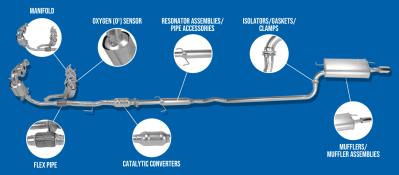 The car's exhaust system is one of the most important parts of a vehicle, its function is to safely direct exhaust gases generated during engine operation to the outside and reduce their environmental impact. This system helps to improve the vehicle's fuel efficiency, keep noise levels low, and meet legislative requirements that regulate the amount of pollutants.
Main functions of the exhaust system
Noise Reduction: Muffles engine noise for a quieter and more comfortable ride.
Emission Reduction: Uses special components such as a catalytic converter and a particulate filter to reduce emissions of harmful substances such as CO₂, NOx (nitrogen oxides) and particulate matter.
Efficiency Improvement: A well-functioning exhaust system helps to optimize engine performance and fuel economy.
Exhaust system components

A car's exhaust system consists of several interconnected parts that work together. Here's an overview of the main components:
1. Exhaust manifold
- Located on the engine and collects exhaust gases from all cylinders.
- Directs exhaust gases to the exhaust system.
- Usually made of heat-resistant steel or cast iron.
2. Oxygen sensors (lambda sensors)
- Measure the amount of oxygen in the exhaust gases before and after the catalytic converter.
- Provide feedback to the engine control unit (ECU) to optimize the fuel-air mixture.
- A faulty lambda sensor can increase the engine's fuel consumption and worsen its environmental impact.
3. Catalytic converter
- Reduces harmful substances in exhaust gases, making them less dangerous (e.g. carbon monoxide is converted to carbon dioxide and nitrogen oxides are converted to nitrogen).
- The operation of the catalytic converter is directly affected by the quality of the fuel and the condition of the engine.
- The performance of the catalytic converter can be improved by using special fuel additives designed to clean the catalytic converter.
4. Diesel Particulate Filter (DPF)
- Installed on diesel cars.
- Captures particulate matter (soot) and periodically burns it off at high temperatures (regeneration).
- A clogged diesel filter can cause reduced engine performance and higher fuel consumption.
- The performance of the diesel particulate filter (DPF) can be improved by using special fuel additives designed to clean the DPF.
5. Muffler
- Dampens exhaust noise using a special system of internal chambers and pipes.
- In some cases, it also improves the flow of exhaust gases, contributing to engine performance.
- You can find various tools for exhaust system repairs here.
6. Exhaust pipe
- The final part of the system that safely directs exhaust gases out of the car.
Exhaust system maintenance and problems
The exhaust system needs regular inspection and maintenance, as damage or failure can affect the car's performance, environmental impact and driver safety.
Signs that the exhaust system may need maintenance:
Increased noise: If the car becomes much louder than usual while driving, this may indicate a leak in the muffler or piping.
A smell of combustion gases in the car: This is dangerous and may indicate a broken or leaking pipe. Leaking exhaust gases can cause poisoning.
Increased fuel consumption: If the oxygen sensor is not working properly, this can cause the engine to run inefficiently.
Engine warning light: If the "Check Engine" light comes on on the dashboard, the problem may be related to components in the exhaust system, such as the lambda sensor, catalytic converter or DPF.
Rust or corrosion: The exhaust system is often susceptible to rust because it is exposed to moisture and temperature changes.
Exhaust system maintenance tips
- Regular inspection: Have your exhaust system inspected at every oil change or maintenance.
- High-quality fuel: Use fuel that meets the manufacturer's recommendations to prevent soot buildup and damage to the catalytic converter.
- Rust prevention: If you live in an area where road salt is used in the winter, have your exhaust system cleaned regularly.
- Timely troubleshooting: If you notice symptoms, contact a specialist immediately. For example, a clogged particulate filter can completely disable your engine if it is not serviced on time.
Can you repair the exhaust system yourself?
Some simple jobs, such as replacing muffler clamps or sealing pipes, can be done at home. However, more complex jobs, such as replacing a catalytic converter or a particulate filter, require special tools and knowledge. If you are an experienced technician, it is possible to do some of the work yourself, but for safety and quality reasons, it is recommended to contact a professional for complex problems.
Summary
The car's exhaust system plays a critical role in the vehicle's performance and environmental impact. It collects and safely directs the gases produced during engine operation, reducing their harmful effects and reducing noise. Regular maintenance and early detection of problems extend the life of the exhaust system and ensure safe driving and environmental friendliness.
You can find various universal exhaust pipes, exhaust clamps, and other exhaust components here.
 The data shown here, especially the complete database of car spare parts, may not be copied. It is strictly prohibited to duplicate the data and database and distribute the same, and/or instruct third parties to engage in such activities, without prior consent from TecAlliance. Any use of content in a manner not expressly authorized constitutes copyright infringement and violators will be prosecuted.