

Crankcase > Crankcase
Pick your vehicle
Crankshaft seals, crankcase covers and engine block nozzles: the anatomy of leaks and hidden dangers
One of the biggest fears of a car owner is noticing a dark puddle of oil or a spot of coolant under the car in the morning. While leaks at the top of the engine (like the valve cover) are easy to spot and fix, the bottom half of the engine, or crankcase, hides components that often require a lot of work and technical savvy to replace. In this article, we'll dive deep into the parts that keep the engine's "juices" inside: we'll talk about the crankshaft seal , the crankcase cover , and a sneaky part called the frost plug .
These components aren't just "seals." They're precision products that must withstand rotating shafts, hot oil, pressure, and corrosion. We'll explore why they break, what the most common faults are in popular car models, and which brands to trust to ensure your repairs last for years. 
1. crankshaft seal (simmerling) – rotating force guard
The crankshaft is the heart of the engine, rotating thousands of times per minute. To prevent oil from flying out of the engine, there are special lip seals at both ends of the crankshaft, which are colloquially called "simmerings".
front vs. rear gasket
The first crankshaft seal is located behind the pulley (in the nose of the engine). Its leak is usually the easiest to notice - oil sprays onto the front of the engine, the belts and the alternator. Although access is limited, it can usually be replaced without removing the engine.
The rear crankshaft seal is notorious, however. It's located between the engine and gearbox, behind the flywheel. If it leaks, it's a real headache, as you have to remove the gearbox, clutch and flywheel from the car to replace it. This turns a €10 replacement part into a job costing hundreds of euros.
The materials revolution: PTFE vs. rubber
In the past, Simmerlings were simple rubber rings with a spring. Nowadays , PTFE (Teflon) seals are mostly used. This is critical information for the DIYer:
- rubber seal: installed with grease (lubricated to the working surface).
- PTFE gasket: installed completely dry! If you lubricate the Teflon gasket with oil, it will immediately start leaking. In addition, the PTFE gasket requires a "calming time" (usually 4 hours) after installation before starting the engine, so that the material takes the shape of the shaft.
2. Body cover and crankcase cover – more than just a sheet metal
In many modern engines, the crankshaft seal is not a separate part, but is integrated into a larger aluminum or plastic cover. This is technically called a housing cover crankcase seal or housing cover crankcase .
This solution is common at the rear of the engine. Why is it important? Because the aluminum or composite cover also serves as a reinforcement for the engine block and seals the rear edge of the oil pan. When the seal gets tired, simply replacing the rubber is not enough – often the cover itself is deformed by heat or the seal is vulcanized to the cover, which means the entire part has to be replaced.
3. nozzle (frost plug) – small cap, large immersion
On the sides and ends of the engine block are round metal plugs, often referred to in parts catalogs as nozzles or frost plugs . Their original purpose is technological – they are holes through which the sand from the mold was removed from the factory. Later, plugs were punched in front of them.
Folklore calls them freeze plugs because, according to the myth, they are supposed to pop off when the coolant freezes in the block, saving the engine from freezing to pieces. In reality, this doesn't always work that way. Their main enemy is corrosion .
If the coolant is not changed regularly, it becomes acidic and eats away at the metal cap from the inside (the "eye of the needle effect"). The result is an unexpected coolant leak. Since these nozzles are often located behind the exhaust manifold or inside the transmission housing (behind the crank), replacing them is extremely difficult.
typical faults and specifics of car models
Each car manufacturer has its own engineering solutions that lead to specific problems with these components.
vag group (vw, audi, skoda, seat – 1.8 tsi / 2.0 tfsi)
The Achilles heel of these engines (EA888 series) is the rear crankshaft seal with flange (housing cover) .
Problem: The leak is often not caused by natural wear of the seal, but by a faulty crankcase ventilation (PCV valve). When the ventilation valve breaks, a large vacuum or overpressure is created in the engine, which "sucks" or "blows" the crankshaft seal lip in the wrong direction.
Solution: When replacing the rear gasket, it is mandatory to replace the crankcase breather valve as well. Otherwise, the new gasket will start leaking again after a week. It is recommended to use an original part or a top manufacturer's (elring/reinz) PTFE solution.
BMW (N-series engines: N52, N54, N55)
There is a serious risk with the first crankshaft seal on the Bavarian inline-6 engines.
Problem: If the oil filter housing gasket (located on top of the engine) leaks, oil will drip directly onto the V-belt. The belt will become slippery, come off the pulley, and – here’s the disaster – the engine will “suck” pieces of the broken belt through the first crankshaft seal into the crankcase. These pieces will clog the oil pan and the engine will stall.
Nozzles: BMW often uses threaded caps (nozzles) in the cylinder head, which over time begin to leak, causing confusion - people think the cylinder head gasket is gone.
Volvo (D5 diesel and petrol engines)
Similar to the VAG group, Volvo's 5-cylinder engines are very sensitive to crankcase ventilation.
"whistle test": if the engine makes a strange whistling sound at idle that disappears when you pull out the dipstick, the crankcase ventilation is about right. This excess pressure forces the oil out from between the camshaft and crankshaft seals. A simple gasket change won't help here - the system needs to be cleaned.
Ford / PSA (1.6 and 2.0 diesels)
These popular diesels (also used by Volvo, Mazda and Mini) often have the crankshaft pulley bolt tightened to a very high torque. There is a risk of damaging the crankshaft keyway when replacing the seal. They also use plastic crankcase covers which can crack, causing mysterious oil leaks that are difficult to detect.
diagnostics: how to detect a leak?
Because gravity pulls all fluids down, the bottom of the crankcase is always wet. This does not mean that the crankcase gasket is leaking. The oil may be coming from higher up – from the end of the crankshaft.
- First seal: look behind the crankshaft pulley. If it's wet there, the spinning wheel will spray oil all over the wheel.
- Rear seal: Look at the joint between the engine and the gearbox. If it's dripping clean engine oil (not gearbox oil), there's a 99% chance the culprit is the rear crankshaft seal or crankcase cover. Cars with automatic transmissions often have a small inspection hole with a rubber plug under the gearbox - remove it and look at the flywheel with a flashlight.
- Frost plugs: If you notice rust-colored drips on the side of the block, the "frost plug" is rusting through. This is the last warning before it breaks.
spare parts brands: quality is cheaper than re-repair
Since accessing the crankshaft seals and nozzles requires hours (or days) of demolition, skimping on the price of a replacement part is economic suicide. Here are the brands that experts trust:
seals & housing covers
- Victor Reinz (Dana) and Elring (Elringklinger): German top brands. Most of the original seals for European cars come from their factories. Their PTFE seals often come with a special installation sleeve, which is critically needed.
- Corteco: a brand of the Freudenberg Group that specializes in vibration dampers and simmerlings. Very high quality.
- Payen: known for its durability, especially on French and Japanese cars.
- febi bilstein / swag: often offer complete crankcase covers with seals.
frost plugs
In the case of nozzles, the material is decisive. Cheap sheet steel caps (e.g. Topran or unknown brands) can rust through again in a couple of years. It is recommended to look for brass caps that never rust, or high-quality steel caps from manufacturers such as febi or engine parts specialists (e.g. Kolbenschmidt ).
maintenance and prevention
How to prevent these expensive parts from breaking?
- Coolant change: Change the coolant every 2-5 years (depending on the type). Fresh fluid contains corrosion inhibitors that protect the "nozzles" from being corroded.
- Crankcase breather maintenance: this is the life insurance for the crankshaft seals. check the pcv valve regularly. simple test: with the engine running, the oil cap should be easy to unscrew (a little vacuum is normal, a lot of vacuum or pressure is not).
- correct oil change intervals: old and acidic oil attacks rubber seals, making them hard and brittle.
summary
The crankshaft seal, crankcase cover and cylinder head are parts that we often forget about until they fail. Replacing them is a big undertaking, but if done correctly and using high-quality spare parts (such as Elring or Reinz), it will ensure that the heart of your car will run dry and worry-free for many years. If you notice a leak, act sooner rather than later – oil on the clutch disc or coolant loss on the road has significantly more expensive consequences than timely repairs.
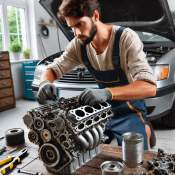
Car Engine Construction and Parts Drawing
 Car Engine Parts: A Detailed Overview
The reliability of a car engine depends largely on the precise functioning of various components. An engine is made up of many complex parts that work in concert to convert fuel energy into motion, which makes the vehicle move. Each component performs its own task to ensure the smooth and efficient operation of the engine. In this article, we will discuss the functions of car engine parts and their importance, including the water pump, oil pump, crankshaft, engine block, and many other components.
... More...
Car Engine Parts: A Detailed Overview
The reliability of a car engine depends largely on the precise functioning of various components. An engine is made up of many complex parts that work in concert to convert fuel energy into motion, which makes the vehicle move. Each component performs its own task to ensure the smooth and efficient operation of the engine. In this article, we will discuss the functions of car engine parts and their importance, including the water pump, oil pump, crankshaft, engine block, and many other components.
... More...

 The data shown here, especially the complete database of car spare parts, may not be copied. It is strictly prohibited to duplicate the data and database and distribute the same, and/or instruct third parties to engage in such activities, without prior consent from TecAlliance. Any use of content in a manner not expressly authorized constitutes copyright infringement and violators will be prosecuted.