

Engine Timing > Tappet / Push Rod/Push Rod Protection Tube
Pick your vehicle
hydraulic tappet or valve tappet: a key component for engine efficiency
A lifter or tappet is an important part of the valve train of an internal combustion engine, whose function is to transmit the movement of the camshaft to the valves. Its role is critical to the smooth operation of the engine, fuel economy and emission control.

What is a hydraulic pusher?
The hydraulic lifter is a small cylindrical component located between the camshaft and the valve train. Its main function is to convert the rotary motion of the camshaft into an up-and-down motion that opens and closes the valves. The use of hydraulic lifters improves engine performance, reduces wear, and extends engine life.
types of hydraulic thrusters
There are two main types of hydraulic thrusters:
-
Mechanical pushrods – also known as solid tappets. These require regular valve clearance adjustment and are often found in older or racing engines where maximum performance is important.
-
Hydraulic pushrods – These are self-adjusting and operate using engine oil to keep the valve train in the optimal range. Hydraulic pushrods are the most common in modern cars because they reduce maintenance and improve engine quietness.
How does a hydraulic pusher work?
The hydraulic pusher consists of a metal shell, a spring and an oil chamber. Its working process is as follows:
- When the camshaft pushes the hydraulic lifter, force is transmitted to the valve stem, which opens the engine valve.
- Engine oil fills the internal chamber of the hydraulic lifter, which prevents excessive play in the valve system.
- As the camshaft rotates further, the hydraulic tappet relaxes and the valve closes.
- The process repeats itself during each engine cycle, ensuring precise and smooth valve movement.
advantages of hydraulic thrusters
- reduced noise – hydraulic tappets keep the valve system properly adjusted, preventing excessive play and the accompanying rattling.
- less maintenance – because the hydraulic tappets adjust themselves automatically, there is no need to manually adjust the valve clearances.
- longer engine life – a properly functioning hydraulic lifter reduces wear on the camshaft and valve system.
- improved performance – ensures optimal opening and closing of valves, improving engine efficiency and reducing fuel consumption.
hydraulic pusher problems and maintenance
Failure of the hydraulic lifters can cause the engine to run unevenly and make excessive noise. The main problems include:
- Oil spills and blockages – dirty engine oil can clog the pushrods, causing them to operate inefficiently.
- Air pressure problems – air bubbles can prevent the hydraulic pusher from functioning properly.
- Wear and leaks – old or damaged pushrods can start to leak or lose their elasticity.
To avoid problems with hydraulic pushers, it is recommended to:
- Change engine oil and filters regularly.
- use high-quality oil that meets the manufacturer's specifications.
- Check engine noise and possible changes in valve clearances.
summary
The hydraulic lifter is an important component that helps ensure smooth engine operation, reduce wear and improve fuel economy. Understanding its operating principle and maintenance can help car owners prevent problems and extend the life of their engine. Regular oil changes and the use of high-quality spare parts will ensure that hydraulic lifters will function smoothly for years.
engine valve system (hydraulic tappet No. 8):

1. camshaft
2. finger follower
3. valve spring plate - spring retainer
4. valve spring
5. valve guide or valve seat guide
6. valve (guard)
7. valve seat
8. hydraulic lash adjuster or lifter or tappet (also known as hydraulic lash adjuster or lifter or tappet)
9. free roller or free roller
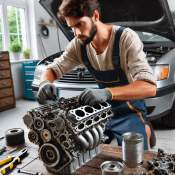
Car Engine Construction and Parts Drawing
 Car Engine Parts: A Detailed Overview
The reliability of a car engine depends largely on the precise functioning of various components. An engine is made up of many complex parts that work in concert to convert fuel energy into motion, which makes the vehicle move. Each component performs its own task to ensure the smooth and efficient operation of the engine. In this article, we will discuss the functions of car engine parts and their importance, including the water pump, oil pump, crankshaft, engine block, and many other components.
... More...
Car Engine Parts: A Detailed Overview
The reliability of a car engine depends largely on the precise functioning of various components. An engine is made up of many complex parts that work in concert to convert fuel energy into motion, which makes the vehicle move. Each component performs its own task to ensure the smooth and efficient operation of the engine. In this article, we will discuss the functions of car engine parts and their importance, including the water pump, oil pump, crankshaft, engine block, and many other components.
... More...

 The data shown here, especially the complete database of car spare parts, may not be copied. It is strictly prohibited to duplicate the data and database and distribute the same, and/or instruct third parties to engage in such activities, without prior consent from TecAlliance. Any use of content in a manner not expressly authorized constitutes copyright infringement and violators will be prosecuted.