

Engine mount – what is it and why does a car need it?
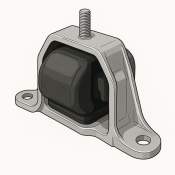 An engine mount is a part that holds the engine and gearbox in place and dampens vibrations so that the car runs smoothly and quietly.
simply put:
An engine mount is a car "cushion" that holds the engine nicely in place and prevents vibrations from reaching the cabin.

How does a motor pad work?
The engine is usually attached to the car frame with 3–4 engine mounts.
Each pillow consists of two parts:
-
metal frame – attaches to the body and engine.
-
rubber or hydraulic fill – dampens engine vibration and movement.
Modern cars often use hydraulic engine mounts , which are filled with oil or gel – they dampen vibrations particularly well, for example in Audi, VW, BMW, Volvo and other newer models.
What does an engine mount do?
-
keeps the engine stable,
-
reduces noise and vibration,
-
helps prevent metal-to-metal collisions,
-
ensures smooth gear shifting,
-
protects the exhaust pipe and other components from excessive movement.
if the engine mount were missing, the engine under the hood would jump back and forth with every press of the accelerator.
common problems with engine mounts
Over time, engine mounts wear out. Typical faults:
-
the rubber cracks or tears ,
-
hydraulic fluid is leaking ,
-
the pillow loses its strength and starts to sag,
-
metal fasteners break.
For example, VW and Audi engine mounts often fatigue due to high vibration, while Volvo models have hydraulic mounts that crack with age.
signs that the engine mount may be faulty
-
the car shakes more than usual, especially at idle,
-
feels a strong jolt when pressing the gas,
-
the gearbox jerks or makes sudden movements,
-
a dull “lung” is heard from under the hood,
-
The engine moves visibly when you open the hood and give it gas.
If the engine moves too much, it can also damage:
-
exhaust pipe,
-
cardan shaft,
-
gearbox mounts,
-
turbo system piping.
How to maintain engine mounts?
-
Replace the pads as soon as you notice cracks or strong vibrations.
-
Regularly check visually (especially on cars with high mileage).
-
Use high-quality spare parts , because a cheap pad will wear out the system faster.
When should the engine mount be replaced?
Replacement is necessary if:
- the rubber is torn,
- liquid has leaked out (hydropad),
- the engine moves unusually much,
- The vibration is strong and can be felt in the cabin,
- The cushion is broken from metal.
A new engine mount restores the car's smooth operation, quiet running, and extends the life of other components .
short summary
- The engine mount holds the engine in place and reduces vibration.
- problems come from wear, leaks or cracks.
- A faulty cushion makes the car noisy, shaky, and uncomfortable.
- The change is easy and necessary for safe driving.
- All cars – Audi, VW, Volvo, BMW, Mercedes, Toyota, Škoda, etc. – have engine mounts that work on the same principle.
Engine mount and its typical faults: why does the car shake and which models are at risk?
When driving a car, we only feel comfortable when the engine is quiet and vibration-free. Behind this comfort lies a small but critically important detail – the engine mount . This often underestimated component plays a central role in the health and driving comfort of a car. In this article, we take an in-depth look at what an engine mount is, how to recognize its wear, and what are the typical faults in popular car models.
What is an engine mount and why does it wear out?
The engine mount is the connecting link between the car body and the powertrain (engine and gearbox). It has two main functions: to hold the engine securely in place and to dampen vibrations from the engine's operation so that they are not transmitted to the interior.
The simplest mounts are made of strong rubber and metal (such as the original Imperium products), but modern cars are increasingly using more sophisticated hydraulic engine mounts . They contain a special fluid that helps to dampen vibrations even more effectively. Some premium cars even use electronically controlled vacuum mounts that change their stiffness according to engine speed.
Because the engine mount has to withstand constant heat, vibration, oil leaks and road grime, wear and tear is inevitable. Rubber cracks, hydraulic fluid leaks or metal parts fatigue.
Symptoms: How to tell if the engine mount is broken?
Before we look at specific models, it's worth knowing the general warning signs:
- Strong vibration at idle: the steering wheel or dashboard shakes when the car is stopped at a traffic light.
- I move when shifting gears or accelerating: the engine "jumps" under the hood, making a dull thud (especially on cars with manual transmission).
- Visual engine movement: When the hood is open and the gas is applied, the engine moves an unnatural amount.
- Gear lever movement: When accelerating or braking, the gear lever moves noticeably back and forth.
typical faults in common car models
Different car manufacturers have different engineering solutions for attaching the engine, which is why the problems vary from model to model.
volkswagen and audi (vag group)
Volkswagen Passat, Golf and Audi A4 and A6 models are known for their comfortable ride, but this is often achieved with the help of hydraulic cushions.
- Problem: Hydraulic mounts start to leak as they age. A characteristic sign is a purple or blackish oil leak around the mount. Once the fluid has leaked out, the mount loses its damping ability and engine vibrations are transmitted directly to the body.
- Special feature: on many cars in this group (e.g. 1.9 and 2.0 TDI engines), the " snub mount " located at the front often wears out, which is made of foam rubber and simply crumbles into powder over time, causing the engine to lean excessively when accelerating.
BMW (E39, E46, E60, E90 series)
BMW diesel engines are heavy and powerful, placing a heavy load on the pads.
- Problem: Many BMW models use vacuum-controlled engine mounts. A common fault is a cracked vacuum hose or a ruptured mount membrane. This results in extremely strong vibrations at idle that disappear as the revs increase.
- Diesel engines: you need to be especially careful with 3.0-liter diesels, where the left engine mount (driver's side) breaks more often than the right one due to torque.
Volvo (V70, S60, XC90)
In Volvo, the engine mount system is complex and consists of many parts.
- Problem: The weakest link in Volvo 5-cylinder engines is the upper engine mount (also known as the torque rod or stabilizer bar). This is a rubber bushing that sits on top of the engine and is easily visible. The rubber material cracks due to heat and the engine starts to jerk when shifting gears.
- Vacuum pads: Similar to BMW, Volvo uses vacuum pads in the lower section, which "sag" as they age, causing rubber to transfer into the body.
Mercedes-Benz
Mercedes is known for its smooth ride and broken pads completely ruin that experience.
- Problem: Mercedes hydraulic mounts are designed to collapse (get lower) as they wear out. Visually, the mount may appear to be intact (no leaks), but the engine has sunk too low, touching the half frame or axle beam.
- Transmission mount: On Mercedes rear-wheel drive models, it is also critical to check the transmission mount. Its wear causes vibrations in the cardan shaft and rear end, which are often confused with axle problems.
Ford and Mazda
The Ford Focus, Mondeo and Mazda 3/6 share many platforms and problems.
- Problem: These models often have a problem with the lower rear engine mount (known as the "figure of eight" or dog bone shape). Its rubber bushings tear quickly, especially with a sportier driving style. This causes the engine to wobble a lot, which can tear the muffler stocking and cause uncomfortable jolts when shifting gears.
Which brand to prefer?
Replacing an engine mount is labor-intensive, so it makes sense to choose a spare part that will last. There is a wide range of manufacturers available on the market:
- Premium class: Lemförder, Corteco and Hutchinson are often the manufacturers that also make parts for car factories (OEM). Their hydraulic and vacuum pads are of top quality.
- Mid-range and price leaders: febi bilstein, swag, meyle and original imperium offer a wide range and good price-quality ratio, being especially popular among owners of older cars who want to get rid of vibrations at a reasonable cost.
to summarize
A broken engine mount is not just a comfort issue. An overly moving engine can break the exhaust system, damage driveshafts, break radiator hoses and, in the worst case, even the engine block itself. If you feel unusual vibrations in your car, have a specialist check your engine mounts. Timely replacement will restore your car to its like-new ride comfort and save you from larger repair bills in the future.
 The data shown here, especially the complete database of car spare parts, may not be copied. It is strictly prohibited to duplicate the data and database and distribute the same, and/or instruct third parties to engage in such activities, without prior consent from TecAlliance. Any use of content in a manner not expressly authorized constitutes copyright infringement and violators will be prosecuted.