

How do you know if your car's brake pads are worn?
How to know if your car's brake pads are worn? A comprehensive guide for car owners
The technical condition of your car is directly related to your own safety, the safety of your passengers and all other road users. One of the most critical components in any vehicle is its braking system. Imagine a situation where you have to brake suddenly at highway speed because of a wild animal that suddenly ran into the road or a vehicle that suddenly stopped in front of you. In that split second, the entire responsibility for stopping the car falls on your braking system, the front line of which is the brake pads and brake discs.
Brake pads are consumable parts. This means that their wear is not a fault with the car, but a normal physical process that occurs with everyday driving. Every time you press the brake pedal, the brake pads are pressed with enormous force against the rotating brake discs. In this process, the car's kinetic energy, or motion energy, is converted into heat energy through friction, which ultimately brings the vehicle to a stop. This constant friction inevitably wears down the surface of the pads.

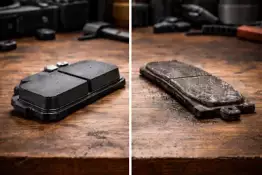
Picture: new car brake pads on the left, old, completely worn pads on the right.
In this extremely comprehensive guide, we will go into detail about how the brake system works, what the first and most critical signs of worn brake pads are, how to visually inspect them yourself, which material to prefer, and we will also look at specific common faults in the most popular car models. Read on to become an informed car owner who doesn't leave their safety to chance.
What are brake pads and how exactly do they work?
Before we get into the signs of wear, it's important to understand what we're talking about. A typical disc brake system (which is used on the front axle of almost all cars today, and most rear axles as well) consists of three main parts: the brake caliper, the brake disc, and the brake pads.
The brake pad consists of a strong metal base plate with a special friction lining material glued or riveted onto it. When you press the brake pedal, the brake booster and master cylinder push brake fluid through hoses into the brake caliper. Hydraulic pistons in the caliper push the brake pads against the brake disc. This enormous pressure creates friction. The temperatures at the contact surface between the brake pad and the disc can reach a couple of hundred degrees during normal city driving, but during aggressive braking, driving in the mountains or on a circuit, these temperatures can even rise to over 600–800 degrees Celsius.

Because the friction material is intentionally designed to be softer than a metal brake disc (to save on the more expensive disc), this material wears down micrometers with every braking action. When this friction material runs out, the metal backing plate of the pad starts to rub directly against the metal of the brake disc. This is a phase that no car owner should let their vehicle go through.
seven main signs that indicate worn brake pads
Cars today are built in a way that they give the driver a number of different signals when something is starting to wear out or break. The brake system is no exception. Some of the signals are acoustic, some are electronic, and some are felt through the car's steering wheel or pedals. Let's take a look at each of them in detail.
1. a high-pitched squeaking, whistling, or squeaking sound
This is by far the most common symptom and often the first symptom that car owners notice. Most quality brake pads have a special mechanical wear indicator built into them. It is a small, slightly bent piece of sheet metal that is attached to the pad's backing plate.
When the friction material in a brake pad wears down to about 2-3 millimeters thick, this small metal indicator will start to gently rub against the brake disc when you brake. This produces a very specific, high-pitched whistling or squealing sound. This sound is often best heard when you are driving at low speeds with the windows down, for example on a narrow street or between houses where the sound is reflected back from the walls. If you hear this sound, it is a clear reminder: it is time to book an appointment with a workshop or get new parts.
Brake pads may not always be worn out, it is also possible that small stones, sand or other dirt have got on the brake disc, this can cause a loud whistling or screeching sound when the brake is applied. This is often the case where a small stone is wedged between the brake disc and the protective plate behind it. In such a situation, using brake cleaner can help.
- Apply a lot of brake cleaner between the brake disc and the brake caliper.
- This product has high pressure, washes out dirt and evaporates quickly without leaving an oily residue.

Image: Using brake cleaner to clean brakes.
2. a creepy scraping, rattling, or metallic sound (critical!)
If you ignore the aforementioned whistling wear indicator and continue to drive for months, the friction material will eventually wear out completely. The result is what mechanics call "metal-on-metal" braking. The steel brake pad backing plate is now pressed directly against the cast iron brake disc.
The accompanying sound is no longer a subtle whistling sound, but a very loud, unpleasant, low-pitched scraping, grinding, or rattling sound. This sound is often so loud that it can be heard even with the windows closed and the radio playing loudly. Once you have reached this stage, the situation is dangerous. Your car's braking distance has been drastically increased, and you are irreversibly destroying your brake discs with every brake application, scratching deep grooves into them. You should no longer drive a car in this condition.
picture. car brake discs and brake pads
3. wear sensor indicator light on the dashboard
Many modern, and especially premium, cars have an electronic wear sensor instead of (or in addition to) a mechanical squealer. This is a small wire that is integrated directly into the friction material of the brake pad.
When the pad wears down to a certain minimum (usually around 3 mm), the sensor wire also wears out, which breaks the circuit. The car's on-board computer registers this break and lights up the corresponding warning light on the dashboard. This light is usually yellow or red, often showing a circle with broken brackets around it: (o). When this light comes on, you usually still have enough time (a few hundred kilometres) to reach a workshop safely and have the spare part replaced.

4. Vibration and pulsation of the brake pedal or steering wheel
If you press the brake pedal and feel that the pedal starts to vibrate or pulsate strongly under your foot, or the steering wheel starts to shake in your hand, this indicates problems with the brake discs, which are closely related to the operation of the pads.
This is often called "warped discs", although in reality the problem is often disc thickness variation (DTV). This happens when worn or overheated brake pads deposit material unevenly on the disc surface, or when the disc is deformed due to extreme heat and sudden cooling (such as when driving through deep mud with hot brakes). A vibrating steering wheel usually indicates a problem with the front axle, while a vibrating car body or seat indicates a problem with the rear axle brakes. In both cases, both discs and pads need to be replaced as a set.
5. The car pulls to one side when braking
If the steering wheel is straight and you apply the brakes, the vehicle should stop smoothly in a straight line. If you feel the car pulling to the left or right, this indicates uneven braking force on the axles. There can be several reasons for this, but one of the most common is that the brake pads on one wheel are significantly more worn than the other, or the pads on one side are stuck due to dirt and rust.
The problem may also be a stuck caliper guide rail (slider) or the brake piston itself. If the caliper cannot move freely, the disc is only pressed on one side or the pads are not fully released after braking, which leads to rapid and asymmetrical pad wear.
6. soft, springy or too deep brake pedal
A properly functioning brake system should have a firm feel to the brake pedal and engage within the first third of the pedal travel. If the pedal feels suddenly "spongy", springy or you have to press it almost to the floor to stop the car, this is a serious hazard.
With very worn pads, the caliper pistons have to move much further from their original position to press the pads against the disc. This requires more brake fluid, which can lower the fluid level in the reservoir. If the pedal sinks to the bottom, the problem could also be in the chemistry of the brake fluid (if the friction is too great and the fluid is old and has collected moisture) or even in a leaking brake system. This symptom requires immediate and urgent technical inspection.
7. significantly increased braking distance
Sometimes you may not hear any whistling or see any lights in the instrument panel, but over time, the effectiveness of your brakes gradually deteriorates. You may not notice this on a daily basis because you get used to it. But if you notice that when you turn off the road you have to press the pedal much harder and earlier than you did a year ago, for example, the friction material has lost its original properties. The material may have "vitrified" due to heat (the surface has become hard, shiny and slippery), which means that even if there is some thickness left, the pad no longer provides sufficient friction.
How do you visually check the brake pads yourself?
You don't have to be a licensed mechanic to assess the condition of your car's brake pads. In most cases, this can be done without even removing the wheels if your car has alloy wheels with a large enough gap.
step-by-step guide:
- Park the car on a level surface: make sure the engine is off, the car is in gear (or in park) and the handbrake is on. Wait until the brakes have cooled down completely – they can be dangerously hot after driving!
- Bring a flashlight: Even during the day, it's dark in the wheel arches. Use your smartphone's flashlight.
- Look through the spokes of the rim: Point the light at the brake caliper (the large metal component that sits on top of the brake disc like a clamp).
- Find the brake pad: you need to look where the caliper meets the brake disc. You will see a metal backing plate and the friction material between it and the brake disc.
- Assess the thickness: a general rule of thumb is that if the thickness of the friction material (only the softer part, do not count the metal backing plate) is less than 3 millimeters (about the thickness of two folded two-euro coins), it is time to plan a replacement. If there is 1-2 mm of thickness left, a replacement is critically urgent.
- Checking the inner pads: Remember that each wheel has two pads – an outer and an inner. You can usually only see the outer one through the rim. However, it is often the inner pad (the one directly pressed by the piston) that wears out faster. To get an accurate picture, the best solution is to jack up and remove the wheel, which gives a full view of the entire caliper and both sides of the disc.
Different types of brake pads: which material to choose?
When it's time to buy new parts, you'll notice that there are a variety of choices. Brake pads are broadly divided into three main categories based on their material composition. The right choice depends on your driving style, your car, and your budget.
organic brake pads (nao - non-asbestos organic)
In the past, brake pads were made from asbestos, which was banned due to its carcinogenic properties. Today's organic pads are made from a mixture of glass, rubber, Kevlar, carbon, and other organic compounds bonded to a heat-resistant resin.
Pros: very quiet, produce less aggressive brake dust (does not damage rims), save brake discs from wear, fairly affordable.
Cons: wear out the fastest, do not tolerate high heat well (can overheat and lose braking ability during aggressive driving, or brake fade ), softer brake pedal feel. Ideal for light cars and quiet city driving.
semi-metallic brake pads
The most common type of brake pad in the world. They contain 30% to 65% metal (steel wool, iron, copper, brass) mixed with graphite and lubricants.
Pros: excellent braking power in a wide temperature range, conduct heat very well, are durable and have a long lifespan. well suited for heavier cars, SUVs and more sporty driving.
Cons: can be noisier (tendency to squeak), produce a lot of black and heavy brake dust that stains the rims, and are more abrasive, meaning they wear out brake discs faster than organic pads.
ceramic brake pads
The most modern technology, where the friction material consists of a dense ceramic mixture and copper fibers, is often considered the best choice for everyday luxury and standard vehicles.
Pros: exceptionally quiet, long-lasting, produce very little dust and this dust is light in color, which does not turn the rim black. They hold their shape well and provide stable braking in all weather conditions.
Cons: Most expensive. Not suitable for thoroughbred track racing as they cannot dissipate heat as well as semi-metallic pads in extreme temperatures.
the most well-known and reliable spare parts brands
There are hundreds of manufacturers on the market, but when it comes to brakes, you shouldn't settle for the cheapest "no-name" brand. A poor-quality pad can tear off the backing plate, make a lot of noise, or dangerously increase your braking distance. Here are some of the world's top manufacturers whose products you can always trust:
- Brembo: The Italian giant known for its red brake calipers and sporty systems. They produce premium pads for both regular and sports cars, focusing on excellent heat dissipation and short braking distances.
- ate: original spare parts (oem) supplier for many german car manufacturers (vw, bmw, mercedes). very high quality. their "ate ceramic" series is particularly well known, which keeps the rims clean.
- Bosch: a global technology giant whose brake systems are found in almost every car brand. They offer reliable German quality, quiet operation and longevity.
- TRW: a manufacturer with a very wide range. Known for its innovative "COTEC" coating, which provides maximum braking power from the first kilometer, eliminating the need for a long break-in period.
- Zimmermann: best known for their "z-coat" corrosion-resistant brake discs, but they also produce perfectly matched brake pads. A good choice in harsh climates.
- Ferodo: A brand with deep roots in motorsport. Their "eco-friction" pads are environmentally friendly (copper-free) while offering top-notch performance.
- textar: a premium brand focused on precision and quality. often used as original equipment in luxury cars and heavy SUVs.
the most common car models and the characteristics and typical faults of their brake systems
Although the physics are the same for every car, different car manufacturers and platforms have their own specific "behavior patterns" and bugs that are worth knowing about.
volkswagen golf / škoda octavia / audi a3 (mqb platform)
These are some of the most common cars on our roads. A classic anomaly that surprises many owners is that the rear brake pads often wear out faster than the front ones . For decades, the rule was that a car's front brakes do 70% of the work and wear out half as fast. However, these models often have an electronic parking brake (EPB) and an auto-hold function that applies the rear brakes whenever you stop at a traffic light. Stability control (ESC) also uses the rear brakes to correct the car's trajectory. Another common type of fault is rusting of the slider pins on the rear brake calipers, causing the pads to stick and wear out unevenly.
BMW 3 Series and 5 Series (F and G Series)
Like the VAG group, many modern BMW owners complain about the mysteriously short life of their rear brake pads. BMWs are rear-wheel drive or rear-axle focused four-wheel drive. Their Dynamic Stability Control (DSC) is programmed to brake the inside rear wheels when cornering to help the car enter the corner better (torque vectoring). If you have a more aggressive driving style, the car will imperceptibly "eat" its rear brake pads to keep you on the road.
Toyota Corolla and RAV4 (especially hybrid models)
Toyota is known for its reliability. Hybrid models have an anomalously long brake pad life – it’s not uncommon for factory pads to last 100,000 km or more. This is due to regenerative braking, where an electric motor is used to slow the car, which also charges the battery, and the mechanical brakes are only applied at the last moment before a complete stop. But there is a downside: a common problem is brake rusting . Because the discs and pads are used so little, they are not cleaned enough during the friction process. Winter road salt and moisture cause the sliders and calipers to seize. Hybrid owners should have their brakes regularly disassembled, cleaned and lubricated, even if the pads are thick enough.
Honda Civic and CR-V
Honda brake systems are generally very reliable and offer a smooth and predictable pedal feel. However, the factory-installed brake pads are often quite soft. This means good stopping power, but the pads tend to wear out faster than average and produce a significant amount of brake dust. Civic owners often notice that the front wheels are covered in a layer of black dust again just a week after washing.
Mercedes-Benz C-Class and E-Class
In luxury cars, especially heavier models, the load on the brakes is high. Mercedes systems are effective but very sensitive to wear. One specific concern is often premature wear of the brake discs. Mercedes original pads are often made with a semi-metallic compound, which is quite abrasive. Customers often have to replace both pads and discs at the same time, as the minimum permissible disc thickness is reached at the same time as the pads wear.
Volvo XC60 and XC90
Swedish luxury SUVs are known for their safety and massiveness. The high curb weight of these cars (especially plug-in hybrids) puts enormous strain on the front brake system. The front brake pads and discs are clear wear items on Volvo SUVs , requiring replacement more frequently for heavy-footed drivers than on lighter passenger cars. Dynamic driving in a heavy car heats up the system quickly, which is why the choice of high-quality (e.g. ceramic or reinforced semi-metallic) spare parts is critical for these models.
What happens if you delay changing your pads for too long?
if you ignore the screeching and warning lights, things won't just get "a little worse" but will quickly escalate into a very costly and dangerous situation.
- Damaged brake discs: When the friction material wears out, the metal backing plate scratches the surface of the brake disc. This creates deep grooves in the disc surface. You can't save a disc like this - if you end up going to the shop, you'll have to buy new pads and new discs (which cost considerably more than the pads).
- Damaged brake calipers: If the pads are too thin, the caliper pistons have to come out of their seats as far as possible. In this position, they are very vulnerable to dirt, moisture and corrosion. The piston can seize or the seals can tear, which will require the caliper to be repaired or even replaced.
- Heat damage: Metal-on-metal friction generates many times more heat than normal braking. This extreme heat can boil brake fluid, melt sensor wires, and damage wheel bearings.
- Life-threatening situation: metal does not adhere to metal like friction material. Brakes lose effectiveness, braking distance can increase by tens of meters, and the car can lose control when braking.
How to extend the life of your brake pads?
Although brake pads are consumable parts, every driver can significantly extend their lifespan through their own behavior:
- Use engine braking: especially on cars with manual transmissions, but also on automatics (by downshifting), engine compression can be used to slow down. This reduces the load on the wheel brakes. This is especially important when driving on long downhill gradients (mountains).
- Look further ahead: smooth driving is the brakes' best friend. When you see a red light coming on from a distance, take your foot off the accelerator and let the car roll freely, instead of driving until the last moment and then braking hard.
- Get rid of excess weight: every extra kilo in the trunk is weight that the brakes have to work extra to stop. If you don't need the ski box on the roof of your car or heavy tools in the trunk, remove them.
- Regular maintenance is key: once a year, for example during your spring tire change, you should have your brake calipers cleaned by a mechanic and the slide pins lubricated with a special heat-resistant grease. This will ensure that the pads move freely, do not stick or wear out unevenly.
- Change your brake fluid: Brake fluid is hygroscopic, meaning it absorbs moisture from the air. Old, wet fluid lowers the boiling point of the system and promotes rusting in the brake lines and calipers. Brake fluid should be changed every two years.

picture. checking the quality of brake fluid with a special tester.
the role of brake discs and why they are often replaced with pads
You can't talk about brake pads without talking about brake discs. They are inseparable partners. If you buy new pads, but your old discs are grooved, rusty or worn below the minimum thickness, these bad discs will ruin your new pads in a very short time. The new smooth pad will not be able to "sit" in the grooves on the worn disc, which reduces the braking surface and causes vibration.
There is a recommended rule for modern cars: every other pad change, the brake discs should also be replaced. However, if your discs have become thinner than the minimum thickness (min th) stamped on the edge of the disc by the manufacturer, they should be replaced immediately. A worn and too thin disc cannot dissipate heat and can simply crack in half under extreme braking.

picture. measuring the thickness of the brake disc.
summary
Monitoring brake pad wear is not something that should be left to just your annual MOT. If you notice a squeaking, rattling, steering wheel vibration while driving, a warning light on your dashboard, or you feel like your car is braking more slowly than before, this is your car's way of telling you that it's time to take action.
Visual inspection is easy – the thickness should be at least 3 millimeters. Timely intervention will save you from much larger repair bills (for example, replacing brake discs and calipers) and, most importantly, ensure that your car can stop you and your family safely and in time in a dangerous situation.
Choose a quality spare part from trusted brands such as Brembo, Bosch or TRW, have a specialist clean the system properly and enjoy a safe and secure ride again!
 The data shown here, especially the complete database of car spare parts, may not be copied. It is strictly prohibited to duplicate the data and database and distribute the same, and/or instruct third parties to engage in such activities, without prior consent from TecAlliance. Any use of content in a manner not expressly authorized constitutes copyright infringement and violators will be prosecuted.