

Most common problems with ABS brakes
Comprehensive guide: most common ABS problems, symptoms and solutions
The safety equipment in modern vehicles has undergone enormous development over the decades. Where seat belts were once considered a luxury, today cars are equipped with dozens of electronic assistants that monitor the car’s movement, wheel grip and driver actions hundreds of times per second. The grandfather and foundation of all these complex active safety systems – such as electronic stability control (ESP) and traction control (TCS) – is the ABS, or anti-lock braking system. Without a flawlessly functioning ABS, your car will be unable to provide stability or control in a dangerous situation.
In this highly detailed and technical article, we will delve deep into the inner workings of the ABS system. We will examine exactly what components this life-saving system consists of, what physical and chemical factors cause its malfunctions, how to recognize the first signs of danger, and what are the specific typical faults of the most popular car brands. We will also provide an overview of the most reliable spare parts manufacturers whose products you can confidently trust for your safety.
1. How does the ABS system work and why is it vital?
The main purpose of ABS is not necessarily to shorten braking distances (although this is often the case on slippery roads), but to maintain vehicle control during sudden braking . We know from physics that stationary friction is always greater than sliding friction. If you press the brake pedal to the floor in a panic and the wheels lock up (start to slide along the asphalt or ice), the tire loses grip and the ability to change direction. The car becomes a sled, moving straight ahead due to inertia, no matter which way you turn the steering wheel.
ABS prevents this by automatically and extremely quickly "pumping" the brakes - up to 15-20 times per second. The system allows the wheel to roll for a fraction of a second to maintain traction and steering control, and then immediately brakes it again. This allows the driver to safely swerve around an obstacle during sudden braking.
Main components of the ABS system

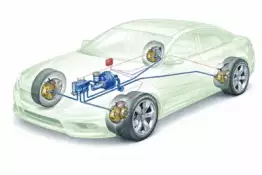
Picture. ABS system diagram and sensor location
1st and 2nd Wheel speed sensors (abs sensors): there is a sensor at each wheel that constantly reads the wheel rotation speed.
3. Hydraulic block (hydraulic unit) modulator unit : a device with valves and a pump located under the hood that physically regulates the brake fluid pressure to each wheel separately.
4. Master cylinder : The master cylinder is the central component of the brake system that converts the mechanical force applied to the pedal when the vehicle is driven into hydraulic pressure. This hydraulic pressure is used throughout the brake system to activate the brake mechanisms at each wheel.
5. Brake booster : makes braking easier by providing additional force to press the brake pedal.
6. Control module (ecu/bcm): the "brain" of the system, which analyzes information from the sensors and controls the hydraulic unit.
7. Brake disc
8. ABS ring (toothed belt or magnetic ring) gear pulser : an element attached to the wheel hub, drive shaft or wheel bearing, from which the sensor reads the speed.
2. Main symptoms indicating an ABS malfunction
The car's on-board computer constantly monitors the health of the ABS system. If any of the components do not meet expectations, the system will alert the driver. Here are the most common symptoms:
Warning lights on the dashboard have come on
The most obvious sign is a yellow or red "ABS" warning light. Very often, however, it will come on in conjunction with other lights, forming a "Christmas tree". Since the Electronic Stability Control (ESC), Traction Control (TCS) and sometimes the Tire Pressure Monitoring System (TPMS) use the same ABS sensors to operate, if one sensor fails, all of these systems will be disabled. A general brake system warning light with an exclamation mark may also come on.

Brake pedal pulsation and rattling at low speeds
This is an extremely common and frightening symptom. You are driving slowly (for example, 10-20 km/h) and are about to stop at a traffic light. The road is completely dry and clean. When you gently press the brake pedal, the pedal starts to clatter violently under your foot and a loud rattling sound is heard from under the hood (the sound of the hydraulic pump working). This happens when a faulty ABS ring or a sensor full of dirt sends a signal to the brain that one of the wheels has suddenly locked, although in fact it is rolling. The system mistakenly applies ABS.
Speedometer not working
Many vehicles do not have a separate speed sensor in the transmission, but the car reads its speed directly from the ABS sensors (often the left rear or front wheel). When this particular sensor fails, the speedometer will drop to zero, the odometer will stop counting kilometers, and often the cruise control will stop working as well.
Wheel locking during sudden braking
When the ABS light is on, the system is in emergency mode (off). Your car's regular brakes will still work, but if you have to brake suddenly, the wheels will spin. This is important to know and remember until your car is repaired.
3. Most common technical problems of the ABS system
Although the electronics are durable, the ABS wheel components operate in the harshest environment in a car – they are constantly exposed to water, mud, road salt, extreme temperature fluctuations and vibration. Let's look at the main causes of failure.
Physical and electrical failures of wheel speed sensors
The sensors themselves are generally reliable (they are often just magnets with coils or Hall sensors), but their wiring is vulnerable. This is especially true for the front wheels, which constantly move left and right when you turn the steering wheel and move up and down with the suspension. Years of bending will wear out the sensor cable until the copper fibers inside the insulation break. The failure may initially be intermittent - the light only comes on when you turn the steering wheel all the way out.
Cracked or rusted abs belts (timing belts)
Older and many more affordable cars have a metal ring with teeth pressed onto the end of the drive shaft (on the constant velocity joint). Over time, moisture and salt get trapped between the joint and the ring. The rust that forms expands (rust takes up many times more space than pure steel) and stretches the ABS ring until it snaps in half. The gap between the teeth of a cracked ring becomes wider in one place, which confuses the sensor reading, causing the aforementioned pedal rattling at low speeds.

Destruction of magnetic ABS rings in the wheel bearing
Newer cars no longer use metal toothed rings. Instead, an active ring consisting of hundreds of small magnets is integrated into the rubber dust cover of the wheel bearing. This technology is more accurate and can read the speed even when the car is almost stationary. Unfortunately, this system is extremely vulnerable in our climate. Salt water can get between the dust cover of the bearing, rust lifts the magnetic rubber layer and the sensor starts to physically rub it off. In the event of a failure, you cannot just replace the ring, but have to press out the entire wheel bearing.
Dirt and metal shavings on the tip of the sensor
ABS sensors are magnetic. When your car's brake discs or pads wear, fine metal dust is released into the air. Over time, this dust sticks to the magnetic tip of the sensor, forming a "beard". Eventually, this layer of metal dust becomes so thick that it blocks the sensor's ability to read the signal from the ring teeth or magnets. Often, all that is needed is to remove the sensor and wipe it clean with a cloth.
Control unit (ecu) and hydraulic pump failures
This is the most expensive and feared scenario. The ABS control unit is attached directly to the hydraulic pump in the engine compartment, where it must withstand high heat and vibration. The constant expansion and contraction causes the microscopic solder joints (cold solders) on the block's printed circuit board to crack. The connection is broken and the brain "loses" contact with the pump or sensors. The brushes on the hydraulic pump's electric motor can also wear out, causing the pump to no longer be able to create brake fluid pressure.
4. Most common car models and typical faults in their ABS systems
Depending on which manufacturer's components the car factory used and how the system was installed in the vehicle, different brands have developed very specific, even legendary, typical faults.
BMW (3 Series E46, E90; 5 Series E39, E60; X5 E53)
BMW owners are very familiar with the phenomenon popularly known as the "BMW trifecta" - the ABS, DSC (stability control) and handbrake lights (often yellow) on the dashboard come on at the same time.
- E39 and older E53: the absolute standard fault for these models is the electronic failure of the bosch 5.7 abs module. the module is installed under the hood, right next to the hot exhaust manifold. heat destroys the solder joints on the circuit board over the years. often the system initially starts to malfunction only when the engine is warm, and works again when it cools down. the modules can be restored by specialists.
- E90 and E87 (1st series): these rear wheel drive cars have a massive problem with the rear drive shafts. the end of the drive shaft rusts and swells, pressing the abs ring against the sensor. eventually the ring simply rubs off the plastic head of the sensor. the solution is to clean the half shaft and press on a new abs ring.
Volkswagen Group cars (VW Passat B5, B6, Golf, Škoda Octavia, Audi A4, A6)
VAG Group cars are very common on our roads and their ABS system problems vary depending on the generation.
- Older models (Passat B5, Audi A4 B5/B6): Similar to BMW, these suffer from cold soldering problems with Bosch 5.3 and 5.7 modules. A common error code is "wheel speed sensor circuit" or "ABS pump motor defective", which is often a false positive - the fault is actually in the brain.
- Golf 5, 6, Octavia II, Passat B6: These cars already use magnetic sensor rings, which are integrated into the rear wheel bearings. On our salty roads, moisture starts to seep under the dust cover and destroys the magnetic layer. The entire wheel bearing must be replaced as a unit. On the front axle, a common problem is the sensor wiring breaking at the shock absorber leg.
Mercedes-Benz (c-class w203, w204; e-class w211, w212)
Mercedes is a pioneer in safety systems, but they also have their Achilles heel.
- E-Class W211 (2002-2006): This car used the legendary SBC (Sensotronic Brake Control) system. It is a "drive-by-wire" brake system, where there is no direct hydraulic connection between the pedal and the brakes (in normal mode). The system's pump and ABS unit operate under enormous pressure. Mercedes programmed a life limit (a certain number of braking cycles) into the pump. When the limit is reached, a red warning light comes on and the car requires the expensive SBC unit to be replaced, even if it is still physically working.
- C-Class W204 and E-Class W212: Here too, the biggest problem is the magnetic pulse rings located on the rear drive shafts. The rings are loosely attached to the half shaft and begin to swell due to rust, rubbing the sensors to pieces. Replacing the ring requires disassembling the entire rear suspension assembly (control arm).
Volvo (S60, V70, XC90 - P2 Platform 2000-2007)
Volvo, considered a symbol of safety, struggles with a couple of specific ABS-related woes in our climate.
- BCM (Brake Control Module) Errors: Especially on early 2000s models, the solders on the pump motor power connectors in the control unit manufactured by ATE break. The computer gives an error code for a pump motor power circuit failure. Fortunately, this module is easily accessible and the solders are easy to repair.
- front abs rings cracking: this is a classic for volvos on the p2 platform. the metal timing belt on the front drive shaft grenade (constant velocity joint) breaks in half, causing strong brake pedal kickback at low speeds. for volvo these rings are sold cheaply as separate parts.
Toyota and Lexus (aAvensis, Corolla, RAV4, RX)
Japanese car manufacturers, led by Toyota, generally use very reliable hydraulic blocks manufactured by AISIN or DENSO, which rarely experience electronic "brain" failures. However, there are problems with the wheels.
- Sensor connectors and corrosion: Corrosion is Toyota's biggest enemy. Sensors are often so corroded into the steering knuckle that they have to be drilled out to replace a faulty sensor. The sensor connectors in the wheel arches also tend to get wet, which oxidizes and interrupts the signal.
French cars (Peugeot, Citroën, Renault)
In the case of French cars (for example Peugeot 307, 308, Citroen C4, Renault Laguna), electronic problems are closely related to poor wiring insulation.
- Wiring faults: Sensor cables are often installed in a way that they rub against body or suspension parts. Water can get between the insulation and rot the copper wire into green dust.
- Rear discs with integrated bearing: On many models, the rear wheel bearing is integrated directly into the brake disc, and this bearing also has a magnetic ABS ring attached to it. When replacing discs, you must be extremely careful to ensure that the new discs have the ring with the correct number of teeth/magnets, otherwise the car will immediately throw an ABS error.
5. How is the ABS system diagnosed?
Unlike worn brake pads, ABS system faults cannot be diagnosed simply by "ear" or visual inspection. It requires special equipment.
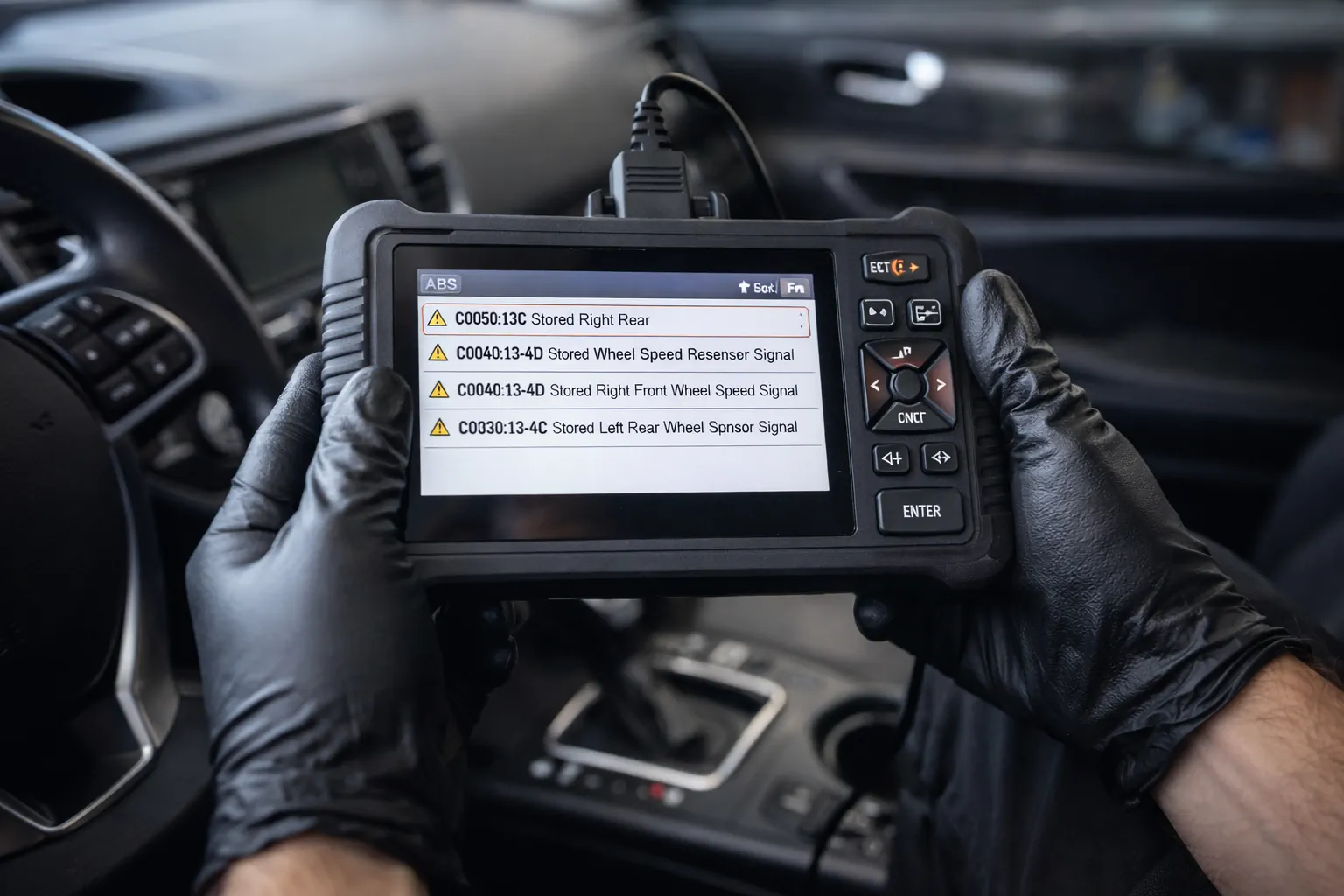
- Reading OBD2 fault codes: The first step is always to connect a diagnostic device to the car. The car's brain can tell exactly which circuit has the fault (for example, "right front wheel speed sensor - no signal"). It is important to use a device that can read specifically the ABS/ESP module, not just the standard engine codes.
- Live data monitoring: If the error code is vague (e.g. "signal illogical"), the mechanic takes the computer to the car and goes for a test drive. The screen monitors the speed of all four wheels as a graph. If three wheels show a speed of 50 km/h, but one jumps between 0 and 50, it is clear that the sensor or rim of that wheel is defective.
- Using a multimeter and oscilloscope: To check the sensor, you can use a multimeter (for measuring resistance on passive sensors) or an oscilloscope, which displays an accurate sine or square wave graph on the screen that is generated by the sensor as the wheel rotates.
- Visual inspection: Finally, the car is lifted and the problem wheel sensor, wiring and ABS ring are visually inspected. Rust, cracks or loose wires are often visible to the naked eye.
6. The most well-known and reliable spare parts brands
If diagnostics are done and it turns out that the sensor, ring or bearing needs to be replaced, you will find a large number of different manufacturers on the spare parts market. When it comes to brake systems, especially electronic components, you should never choose the cheapest unknown brand. A cheap sensor may not be able to read the signal at the correct frequency and the car's stability control may behave unpredictably at highway speeds.
For best results and to restore factory quality, we recommend the following brands:
- Bosch: inventor and developer of the ABS system. Their sensors and hydraulic blocks are used as original equipment (OEM) in most European cars. Bosch spare parts are always a safe choice.
- ATE: ATE, part of Continental AG, is another giant in the world of braking systems. They produce very high-quality sensors, ABS blocks and brake hydraulics.
- TRW: Also an original equipment supplier to many car manufacturers, TRW wheel speed sensors are known for their accuracy and durability.
- Hella and Delphi: Both are global automotive electronics manufacturers that offer premium quality sensors.
- SKF, SNR and FAG: If your car has a wheel bearing with an integrated magnetic ABS ring, these three brands are the absolute top of the bearing industry. Their magnetic rings are manufactured with the correct polarity and provide the correct information to the sensor immediately after installation.
7. Can I continue driving with the ABS light on?
The short answer is: yes, but you need to be aware of the risks involved.
The system is designed so that in the event of an electronic failure, ABS (and often stability control) simply switches off. The hydraulic brake system itself (brake fluid, pipes, calipers, pads) continues to work exactly as it did in old cars that didn't have ABS. You can safely stop the car and drive to the nearest workshop.
The danger lies in the unexpected. If an animal jumps into your path and you habitually press the brake pedal with full force, assuming that the car will help you steer, then in the event of an ABS failure the wheels will lock. The car will slide straight ahead and it will be impossible to avoid the obstacle. Also, in slippery winter conditions, a car without working stability control (which requires ABS sensors) is significantly more likely to skid when cornering.
Therefore, repairs should not be postponed. A faulty ABS is also a direct reason why a car fails a technical inspection – a lit warning light in the dashboard means an immediate repeat inspection is required.
Summary
ABS is the heart of the entire active safety system in a modern car. It relies on precise information provided by sensors and rings that read wheel speed hundreds of times per second. In our harsh climate, it is completely normal for salt and rust to damage these components, eventually causing the pedal to rattle under your foot or the warning lights to come on in the dashboard. Whether you drive a BMW, Volvo, Volkswagen or Toyota, each brand has its own weak points, from cracked rings to the breakdown of solder in the control unit.
Knowing these symptoms means you don’t have to blindly rely on assumptions at the repair shop. Respond to danger signs immediately, have your car properly diagnosed, and always opt for parts from trusted manufacturers like Bosch, ATE, or SKF. This way, you’ll restore your car to factory quality and ensure that in a split second, when the limits of physics and grip are tested, your car will react exactly as the engineers designed it to be safe.
 The data shown here, especially the complete database of car spare parts, may not be copied. It is strictly prohibited to duplicate the data and database and distribute the same, and/or instruct third parties to engage in such activities, without prior consent from TecAlliance. Any use of content in a manner not expressly authorized constitutes copyright infringement and violators will be prosecuted.