

Urea Injection > Hoses Adblue
Pick your vehicle
Car AdBlue Hoses, Pipes and Connectors: Everything You Need to Know About the SCR System Circulation
Owners of modern diesel vehicles are inevitably familiar with the word AdBlue today. In order to meet increasingly stringent environmental requirements and reduce harmful nitrogen oxides (NOx) emissions, most car manufacturers have introduced SCR technology (Selective Catalytic Reduction). In this system, AdBlue is a vital component that is sprayed into the hot exhaust gases to convert the toxic gases into safe nitrogen and water vapor.

But the liquid does not reach the muffler from the tank by itself. For this purpose, a whole special "blood circuit" is built into the car - AdBlue hoses, pipes and connectors . These seemingly simple plastic and rubber parts are actually high-tech components that must withstand extreme temperatures, chemical corrosion and enormous pressure. In this extremely comprehensive guide, we will dive deep into the anatomy of the AdBlue pipeline. We will examine why these hoses break, how heated pipes work, what are the symptoms of a faulty system and which car models are most prone to typical defects with the pipeline. We will also look at which spare part brands are worth giving preference to in order to ensure long-term and trouble-free operation of the system.
What is AdBlue and why is its piping so special?
To understand why AdBlue hoses and connections are constructed differently than regular fuel or coolant hoses, you first need to understand the chemistry of the fluid itself. AdBlue (technically known as AUS 32 or DEF - Diesel Exhaust Fluid) is not a fuel additive. It is a very precise solution consisting of 32.5% high-purity urea and 67.5% demineralized water.
This chemical composition poses three extremely big challenges for hoses and pipes:
- Freezing and expansion: AdBlue freezes at -11 °C. When frozen, this liquid expands by about 7% of its volume. Normal rigid plastic or metal pipes would burst immediately under such expansion. Therefore, AdBlue hoses must have a certain elasticity and are often equipped with a complex heating system.
- Aggressive corrosion: AdBlue is very aggressive towards certain metals. It reacts strongly with copper, zinc, aluminium and cast iron. Therefore, standard brass fittings must not be used in AdBlue piping or connections. All pipes are made of special polymers (such as PTFE or Teflon, EPDM rubber or special nylon mixtures) and only high-quality stainless steel or titanium is used for metal parts.
- Crystallization: When AdBlue comes into contact with air (for example, if a hose connection is not 100% airtight), the water evaporates quickly, leaving behind white, hard urea crystals. These crystals are extremely strong and can build up and push apart connections or block hoses from the inside.
Heated AdBlue hoses: the technological pinnacle of winter reliability
Since in our climate the temperature often drops below -11 °C in winter, car manufacturers have had to come up with a way to prevent AdBlue from freezing in the pipes and how to quickly melt the already frozen liquid after starting the engine. The solution is heated AdBlue hoses .
These are not just empty rubber tubes. A heated AdBlue hose is a complex multi-layered component. Its inner layer is often made of smooth PTFE to prevent the liquid from sticking. A thin electrical resistance wire (heater) is integrated around or into this layer, which runs in a spiral along the entire length of the hose. The wire is surrounded by a thick layer of thermal insulation, and the entire assembly is covered with a corrugated (waved) plastic or rubber protective sheath. At both ends of the hose there are special electrical connectors that connect to the car's SCR control unit.
How does it work? When the outside temperature drops to a critical level, the brain sends an electric current to the heating wires in the hose. The hose heats up evenly along its entire length, melting the ice in a matter of minutes so that the nozzle can start spraying the liquid into the exhaust gases. The system is intelligent – it allows the engine to start and run in cold weather, because the factory requirements allow the system to melt the ice for about 20-30 minutes after starting, before the exhaust gas cleaning system needs to reach full capacity.
Problem: These heating elements are the weakest link in the hoses. Constant temperature fluctuations, car vibrations and uneven roads tire the thin heating wire until it breaks at one point ( an open circuit occurs). The brain sees that the hose is not heating up and throws an error message to the control unit. Since the heating wire is cast into the hose, it cannot be repaired separately - the entire expensive hose assembly must be replaced.
AdBlue connections and quick couplings: the most delicate link in the system
In addition to the hoses themselves, there are several connection points in the system. The pipe goes from the tank to the pump module, from there to the filter housing, then along the bottom of the car towards the engine compartment and finally connects to the injector (doser) on the muffler pipe.
Most of these connections are made with quick connectors . They are similar to fuel line fittings – they are pushed on and they lock with a click, holding the pressure with the help of special internal O-rings (seals). In the AdBlue system, these fittings operate at a pressure of around 5 to 9 bar.
These joints are prone to breakage for several reasons:
- Micro-leakage and crystallization: As the o-ring on a fitting ages, it starts to sweat a little. The liquid that leaks out comes into contact with air and immediately crystallizes into a white crust. As the crystals grow, they physically push the fitting apart, which in turn increases the leak. It's a vicious cycle that often ends with the fitting simply being knocked off the end of the pipe under pressure.
- Heat: The injector connection is located near the muffler and DPF filter, where temperatures can reach hundreds of degrees. Although the connection is protected by heat shields, constant heat exposure can make the plastic connections brittle. The connection is in place when the engine is cold, but as it heats up and expands, it can start to leak.
- Mishandling during repair: Quick connectors are often fragile. If a mechanic tries to remove them with the wrong tools or force, the plastic retaining tabs break easily.
How to recognize a faulty AdBlue hose or connection? (symptoms)
Unlike many other car systems, AdBlue system errors are very visible to the driver and often very stressful, as the car warns you that after a certain number of kilometers the engine will refuse to start.
1. Instrument panel warnings and error codes (OBD-II)
If a heater hose wire breaks or there is a leak in the system, the check engine light will come on first, and often a special AdBlue/Urea symbol will also come on. Common error codes that directly indicate problems with hoses and connections include:
- p20be: reductant heater "b" control circuit performance (often indicates a break in the heating cable in the pipeline).
- p20e8: reductant pressure too low (indicates a leak in the hose or a loose connection, the pump is running, but the pressure is lost).
- p208b: reductant pump control circuit range/performance (may be caused by a clogged hose overloading the pump).
2. Deadly Mileage Count
This is the symptom that all diesel car owners fear. A message appears on the dashboard (for example: "no engine start in 1000 km" ). This happens when the car's brain understands that the scr system is not working correctly (for example, a hose is broken and the fluid is leaking, so the nox level in the muffler does not drop). This is a function required by law, which forces the driver to correct the problem. If you let the kilometers go to zero, the car's immobilizer will no longer allow the engine to be started, even if the car is mechanically perfect.
3. visual "white snow" under the car or under the hood
The most obvious physical sign of a leaking AdBlue hose or connection is a build-up of white salt-like crystals. If you jack up your car and see a large white crystalline mass around the AdBlue tank, along the underbody piping, or under the hood near the muffler, you are certain to have a leak. This mass of crystals is often so thick that it resembles a winter snowdrift or limestone.
4. excessive adblue consumption
If you have to refill your AdBlue tank abnormally often (for example, every few thousand kilometers, while a full tank usually lasts 10,000 - 15,000 km), there may be a hole in the hose or a connection leaking while driving, spraying the fluid directly onto the road.
most common car models and their specific AdBlue piping faults
Each car manufacturer has created its own specific design for the layout of the AdBlue system piping. However, statistics over the years have shown that certain car models experience hose and connection failures significantly more often than others.
Volkswagen, Audi, Skoda (VAG Group) – TDI engines
The most common diesel engines in the German automotive industry (for example, the 2.0 TDI models in the VW Passat B8, Audi A4 B8/B9, A6 C7, Škoda Superb III) are technologically very advanced, but their AdBlue hoses are a known pain point. These cars have a long heated pipe that runs from the rear tank to the front of the engine compartment. A very common problem is the reductant line heater breaking . In cold winters, this wire often short-circuits or breaks. In the case of VAG cars, this is especially unpleasant, as the hose is often installed in such a way that replacing it requires removing several underbody covers and even bridge parts. Also, the quick connectors on the injector side of the Audi A6 and Q7 models often leak, covering the entire area around the injector with a thick white crust.
Peugeot, Citroen (PSA Group) – BlueHDI engines
French car manufacturer PSA (whose BlueHD engines are also used in many Ford, Mazda and Toyota models) has a design for the AdBlue system that has caused a huge amount of headaches. In the case of PSA Group cars (such as the Peugeot 308, 508, 3008; Citroen C4, C5 Aircross), the main problem is tank ventilation and clogged hoses . The liquid tends to crystallize in the hoses and pump even when there are no leaks. Many earlier BlueHD models had a design flaw where the hose heater or connection could not be replaced separately - the entire piping, pump and often even the AdBlue tank formed one huge and insanely expensive unit that had to be replaced as a whole if a hose leaked or the heater burned out.
Mercedes-Benz – Bluetec systems
Mercedes was one of the first to start using AdBlue (Bluetec in their language) systems on a large scale. In models such as the E-Class (W212, W213), C-Class (W204, W205), GLC and GLC, as well as commercial vehicles such as the Sprinter, pipeline failures are commonplace. In the case of Mercedes , the heated pipe (delivery line) leading from the pump to the metering valve breaks on a large scale. In Sprinters, which drive a lot on rough terrain and vibrate, AdBlue pipes often rub against the frame and break. Mercedes' diagnostic system is very sensitive; even with a minimal pressure drop in the hose, it immediately displays the notorious message "start impossible in 800 km".
BMW – SDrive and XDrive diesels (N47, B47, N57, B57)
BMW 5 Series (F10, G30), 3 Series (F30, G20) and X Series (X3, X5) SUVs also use sophisticated heated AdBlue systems. BMWs very often have problems with the hose nozzle on the dosing valve (sprayer) side . Due to the heat, the plastic at the connection becomes brittle and starts to drip, coating the catalytic converter and DPF area with a thick layer of white crystals. Another known problem with BMWs is that the temperature sensor integrated into the hose stops working, requiring the entire hose line to be replaced.
High-quality spare parts brands: who to trust?
Since replacing an AdBlue heated hose is a laborious and expensive process, it is absolutely not worth saving a few dozen euros on buying a B-spare part of unknown origin. A bad heating wire will burn out in the first winter. Car owners and workshops should definitely give preference to the following reputable manufacturers:
- Bosch: As the inventor and original developer of the Denoxtronic (AdBlue) system for almost all German car manufacturers, Bosch is the absolute gold standard. Their pipes, fittings and heating elements are identical to those that come from the factory (often just without the car brand logo). When you buy Bosch, you get the best quality.
- Metzger (Metzger Autoteile): This German company has made aftermarket parts for AdBlue and SCR systems one of its biggest strengths. They offer an extremely wide range of heated hoses, tanks and injectors for models that previously could only be purchased from the dealership at very competitive prices. Their quality is excellent and their price range is very competitive.
- VDO (Continental): Like Bosch, VDO is an original parts supplier for many French and German cars. The AdBlue pumps and associated hoses they produce are of the highest OEM quality.
- febi bilstein / swag (bilstein group): this brand offers excellent value for money and their catalogue includes a wide range of specific adapters, o-rings and pipe kits. They often include original equipment manufacturer (oem) parts in their packaging.
- Gates: Known primarily for their belts, Gates also produces world-class specialty hoses. Their SCR hoses are reinforced, exceptionally resistant to chemicals and flexing, and are a highly reliable choice if you are looking for longevity.
How to prevent AdBlue pipes and connections from failing? (preventive maintenance)
Although you cannot change the resistance of the heating wire built into the hose, you as a car owner can significantly extend the life of the system by following certain rules:
- Use only clean and high-quality AdBlue: the fluid must comply with the ISO 22241 standard. Never use fluid that has been standing, exposed to the sun or of suspicious origin. Dirt or dust in the tank will immediately clog the hoses and damage the heating.
- Do not fill the tank to the brim (especially in winter): if you fill the AdBlue tank completely to the brim, there will be no room for expansion when the liquid freezes. The expanding ice will first push out the quick connectors on the pipes, break the pump or tear the inner Teflon layer of the hose. Always leave room for expansion.
- Keep the filling area clean: just one drop of diesel or engine oil in the AdBlue tank can damage the entire rubber and plastic interior of the pipe, causing millions of crystals to form. Always wipe the area around the filling hole clean.
- Never start the engine without AdBlue: if you drive with the tank completely empty, the pump draws air into the hoses. The air promotes the immediate crystallization of the residual fluid on the pipe walls. When pouring in new fluid, these crystal pieces can break off and clog the injector.
Adblue piping replacement: important knowledge for repairs
If an AdBlue hose or connection needs replacing, it is a job that requires specific knowledge and extreme cleanliness. AdBlue is water soluble, but leaves a white film when it dries. If you notice crystals under the bonnet, never remove them with brake cleaner or by mechanical scraping! The most correct and safest way to remove the crystals is to use plenty of warm, clean water, which will dissolve the urea in minutes.
When installing new hoses, make sure that the hose is not kinked or twisted anywhere, as this will immediately break the internal heating wire. The quick connectors must be pressed into place until a clear "click" is heard, and then always pull back slightly to check that they are locked. After replacing the piping, it is absolutely necessary to bleed the system with a car diagnostic device and, if necessary, carry out an adaptation or reset of the SCR system so that the brain erases the load indicators of the old pump and hoses and removes the "deadly mileage count" from the instrument cluster.
summary
AdBlue hoses, pipes and their quick connectors are some of the most complex and stressed components in modern diesel vehicles. They must withstand harsh chemicals, constant heating and freezing, and high pressure. By being aware of the specifics of heated hoses and fragile connections, you can better understand your car's warning lights and the symptoms they cause.
Noticing white crystals under the car, error messages in the dashboard or threatening warnings that the engine will not start are signs that there is a break or leak in the system's "blood circulation". Ignoring this is not the solution here, because leaking fluid will further damage other sensors and wires. By choosing only well-known and reliable quality brands such as Bosch, Metzger or VDO as spare parts for your car, and by entrusting the installation to specialists who adhere to extreme cleanliness, you ensure that your car's SCR system will continue to save nature and measure the roads for hundreds of thousands of kilometers without any worries.
Would you like me to help you find step-by-step instructions on how to read and interpret error codes from your car's AdBlue system?
Car urea (adblue) system and its parts
 Car urea (adblue) injection system and its parts, construction and drawing
Urea (injection system, often also known as SCR (Selective Catalytic Reduction) system, is a technology used in modern diesel engines, which aims to reduce harmful nitrogen oxides (NOx) emissions. It works using a special urea solution (AdBlue), which neutralizes NOx particles contained in exhaust gases. The system consists of several interconnected components that ensure efficient operation and precise control of the system.
1. Supply Module (Feed module)
... More...
Car urea (adblue) injection system and its parts, construction and drawing
Urea (injection system, often also known as SCR (Selective Catalytic Reduction) system, is a technology used in modern diesel engines, which aims to reduce harmful nitrogen oxides (NOx) emissions. It works using a special urea solution (AdBlue), which neutralizes NOx particles contained in exhaust gases. The system consists of several interconnected components that ensure efficient operation and precise control of the system.
1. Supply Module (Feed module)
... More...
Car exhaust system: functions, components and maintenance
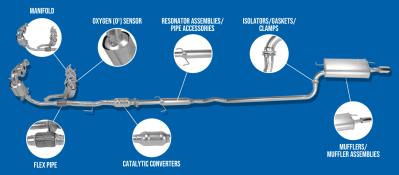 The car's exhaust system is one of the most important parts of a vehicle, its function is to safely direct exhaust gases generated during engine operation to the outside and reduce their environmental impact. This system helps to improve the vehicle's fuel efficiency, keep noise levels low, and meet legislative requirements that regulate the amount of pollutants.
... More...
The car's exhaust system is one of the most important parts of a vehicle, its function is to safely direct exhaust gases generated during engine operation to the outside and reduce their environmental impact. This system helps to improve the vehicle's fuel efficiency, keep noise levels low, and meet legislative requirements that regulate the amount of pollutants.
... More...

Car muffler repair and muffler parts: A comprehensive guide to exhaust system maintenance
 The vehicle exhaust system, or muffler in popular parlance, is one of the most stressed and extreme components in the entire car. Imagine an environment where the internal temperature of the components can range from hundreds of degrees to even a thousand degrees (at the catalytic converter and DPF filter), while the external surface of the component is attacked by sub-zero temperatures, rainwater, dirt, abrasive sand and aggressive salt sprinkled on the roads in winter.
... More...
The vehicle exhaust system, or muffler in popular parlance, is one of the most stressed and extreme components in the entire car. Imagine an environment where the internal temperature of the components can range from hundreds of degrees to even a thousand degrees (at the catalytic converter and DPF filter), while the external surface of the component is attacked by sub-zero temperatures, rainwater, dirt, abrasive sand and aggressive salt sprinkled on the roads in winter.
... More...
 The data shown here, especially the complete database of car spare parts, may not be copied. It is strictly prohibited to duplicate the data and database and distribute the same, and/or instruct third parties to engage in such activities, without prior consent from TecAlliance. Any use of content in a manner not expressly authorized constitutes copyright infringement and violators will be prosecuted.