

Car urea (adblue) system and its parts

Car urea (adblue) injection system and its parts, construction and drawing
Urea (injection system, often also known as SCR (Selective Catalytic Reduction) system, is a technology used in modern diesel engines, which aims to reduce harmful nitrogen oxides (NOx) emissions. It works using a special urea solution (AdBlue), which neutralizes NOx particles contained in exhaust gases. The system consists of several interconnected components that ensure efficient operation and precise control of the system.

1. Supply Module (Feed module)
2. Adblue return pipe
3. Temperature sensor
4. Adblue tank
5. Adblue level sensor
6. Adblue inlet pipe
7. Dosing control unit (DCU)
8. Sensors
9. Actuators
10. Dosing Module
11. Engine coolant
12. Temperature sensor
13. SCR catalytic converter (SCR catalytic converter- Selective Catalytic Reduction converter)
14. Diagnostic CAN
15. Engine CAN (Controller Area Network)
16. Temperature sensor
17. NOx sensor. Measures the nitrogen oxides in the exhaust gases before and after the SCR catalysts.
18. Engine coolant pipe
19. Urea quality sensor: Monitors the concentration and quality of the AdBlue solution.
Main parts:
Function:
Draws AdBlue fluid from the storage tank.
Pressurizes the fluid and transports it to the dosing module.
Monitors and regulates the temperature to prevent freezing or overheating.
Main components:
- The pump moves AdBlue through the system.
- Filters keep AdBlue free of contaminants.
- Heating elements keep AdBlue in a liquid state in cold weather.
- Sensors monitor flow, pressure and temperature in the supply line.

Image: AdBlue supply module (pump module)
2. Adblue return pipe
3. Temperature sensor: Monitors the temperature of the exhaust gases to ensure optimal response.
4. Adblue tank. The urea tank is a special container for storing AdBlue. The tank is made of materials that are resistant to chemical corrosion and temperature fluctuations. In addition, the tank usually has a filler opening, level sensors and a heating system that keeps the solution usable even in cold weather.
5. Adblue level sensor. Indicates the level of AdBlue fluid in the tank.
6. Adblue inlet pipe
7. Dosing control unit (DCU).
Not every system needs a dosing control unit. The dosing control unit is the electronic brain of the Adblue dosing system. It manages and coordinates the operation of the dosing and supply modules based on data from various sensors.
Function:
Receives real-time data from sensors (e.g. NOx sensors, exhaust gas temperature sensors and engine load sensors).
Calculates the exact amount of AdBlue required to effectively neutralize NOx emissions.
Controls the dosing module to ensure accurate injection.
Communicates with the engine ECU (Engine Control Unit) via CAN (Controller Area Network) for seamless integration.
Main inputs:
- NOx levels (measured by upstream and downstream NOx sensors).
- Exhaust gas temperature.
- Engine operating conditions (speed, load, etc.).

How they work together:
The supply module delivers AdBlue from the tank to the dosing module at the correct pressure and temperature.
The dosing control unit (DCU) receives sensor data and calculates how much AdBlue is needed.
The DCU instructs the dosing module to inject the exact amount of AdBlue into the exhaust system.
Inside the SCR catalytic converter, the injected AdBlue breaks down into ammonia, which reacts with NOx to produce harmless nitrogen and water.
8. Sensors The urea injection system relies on a number of sensors that collect the necessary information to enable the control system to make accurate decisions.
9. Actuators
General Role of Actuators in a Urea System
Actuators are the muscles of the urea dosing system, converting electrical signals from the control unit into physical actions that ensure the system operates efficiently and reliably. They work in coordination with the sensors, dosing controller and other components to:
- To reduce NOx emissions, accurately spray AdBlue.
- Maintain correct system pressure and flow.
- Ensure that the system operates smoothly under all environmental and engine conditions.
10. Dosing Module
The dosing module is responsible for injecting a precise amount of urea solution (AdBlue/DEF) into the exhaust stream to reduce NOx emissions.

Image. AdBlue dosing module in the vehicle’s AdBlue system
Function:
It atomizes and sprays the AdBlue into the exhaust system upstream of the SCR catalytic converter.
Ensures optimal mixing with the exhaust gases for efficient chemical reactions in the catalytic converter.
Main components:
Injector: Delivers the AdBlue as a fine mist.
Sensors: Monitor flow and pressure to ensure accurate dosing.
Heater: Prevents freezing in cold conditions.
11. Engine coolant
12. Temperature sensor
13. SCR catalytic converter- Selective Catalytic Reduction converter
The SCR catalytic converter (Selective Catalytic Reduction converter) is a key component in modern diesel engines designed to reduce harmful nitrogen oxides (NOx) emissions from exhaust gases. It is part of the Selective Catalytic Reduction (SCR) system, which uses a chemical reaction, facilitated by a urea-based solution (commonly called AdBlue or DEF), to convert NOx into harmless substances.
How it works
Urea injection: A urea solution (AdBlue/DEF) is injected into the exhaust gas stream before the SCR catalytic converter.
Thermal decomposition: The heat from the exhaust gas causes the urea to decompose into ammonia (NH₃) and carbon dioxide (CO₂).
Chemical reaction: In the SCR catalytic converter, ammonia reacts with NOx in the exhaust gas in the presence of a catalyst, producing nitrogen (N2) and water vapor (H2O), which are harmless and naturally occurring substances.
Key Components
Catalyst:
A catalytic converter contains a ceramic or metal substrate coated with materials such as vanadium, tungsten, or zeolites that act as a catalyst for chemical reactions.
Substrate Design:
The substrate is typically honeycombed to maximize surface area for efficient reactions.
Urea Injection Point:
Installed upstream of the catalytic converter to ensure ammonia is available for the reaction.
Purpose
The main function of an SCR catalytic converter is to reduce NOx emissions, which are harmful pollutants that contribute to smog and acid rain. This helps diesel engines comply with strict emission standards such as Euro 6, EPA Tier 4 and others.
Benefits
High efficiency: Reduces NOx emissions by up to 90%.
Fuel efficiency: Allows the engine to be better tuned to optimize fuel efficiency, as the SCR system treats NOx emissions separately.
Environmental impact: Significantly reduces the release of harmful pollutants into the atmosphere.
Maintenance requirements
AdBlue refill: The urea solution must be refilled regularly.
Sensor functionality: NOx sensors and temperature sensors must function properly to optimize the system.
Periodic cleaning: Deposits can build up in the catalytic converter, requiring cleaning or replacement over time.
The SCR catalytic converter is an essential part of modern exhaust control systems, ensuring compliance with environmental regulations while maintaining engine performance.
14. Diagnosis CAN
Diagnosis CAN is a dedicated network used for monitoring, troubleshooting and diagnostics of the urea dosing system. It focuses on ensuring the correct operation of the system and identifying faults or maintenance needs.
Function:
- Collects and transmits data from urea system sensors and components to a diagnostic tool or on-board diagnostic (OBD) system.
- Monitors parameters such as:
- NOx levels before and after the SCR catalytic converter.
- Urea tank levels and quality.
- Flow rates and pressure in the dosing system.
- Sensor functionality and system errors.
- Warns the driver or technician if there are problems in the system (e.g. insufficient AdBlue, clogged injector or sensor failure).
Easily facilitates maintenance and repair by providing detailed fault codes (e.g. via OBD-II).
Ensures compliance with emissions regulations by monitoring system performance.
Example data flow:
When the NOx sensor detects high NOx levels downstream of the SCR catalytic converter, the diagnostic CAN transmits this data to the OBD system, triggering a fault code and potentially a warning light in the dashboard.
Key differences between engine CAN and diagnostic CAN:
Function Engine CAN Diagnostic CAN
Primary role Real-time communication between engine and system System diagnostics and fault monitoring
Data type Engine performance and operating parameters System faults, sensor status and fault codes
Users used by the DCU for active dosing control Used by technicians or OBD systems for repairs
Purpose Optimization of dosing to reduce emissions Identify and resolve system problems
Conclusion:
Engine CAN ensures that the urea dosing system works in harmony with the engine to achieve optimal emission reduction.
Diagnosis CAN provides the tools and data needed to effectively monitor, troubleshoot and maintain the urea system.
Both networks are critical to ensuring that the urea system operates efficiently and meets stringent emission regulations.
15. Engine CAN (Controller Area Network)
Engine CAN is the main communication network between the engine control unit (ECU) and the urea system. It handles real-time data exchange related to engine operation and emission control.
Function:
- Provides the urea dosing control unit (DCU) with critical engine-related data, such as:
- Engine load and speed.
- Exhaust gas temperature.
- Fuel injection timing and quantity.
- Exhaust gas flow rate.
- Helps the DCU determine the exact amount of AdBlue (urea solution) to be injected into the exhaust system.
Ensures that the urea dosing system operates in sync with the engine operating conditions.
Optimizes the efficiency of NOx reduction by adjusting dosing rates based on the real-time engine performance.
Example data flow:
When the engine load increases (e.g. during acceleration), the engine CAN transmits this to the DCU, which adjusts the urea injection rate according to the increased NOx emissions.
16. Temperature sensor
17. NOx sensor. Measures the nitrogen oxides content in the exhaust gas before and after the SCR catalysts.
18. Engine coolant piping
19. Urea quality sensor: Monitors the concentration and quality of the AdBlue solution.
For passenger cars, it is important to note that the quality sensor is usually not sold separately as a standalone small part. Instead, it is integrated into the tank's "internals" or the pump module.
Here are specific examples of codes from well-known manufacturers and car brands where this sensor is located:
a. VAG Group (Audi, VW, Skoda, Seat) – The most common example
On German cars, the quality sensor is built into a single unit with the heater element and the level sensor. This set is officially called a "Repair Kit."
-
Manufacturer: Continental / VDO (produces the original for VAG)
-
Original Code (OE): 5Q0 131 969 (or newer versions ending in "B", "C", etc.)
-
What it is: This is the "cup" assembly that goes inside the AdBlue tank. It contains the ultrasonic quality sensor, the level sensor, and the heater. If an Audi displays an "AdBlue Quality Error," this is usually the part that gets replaced.
b. BMW
On BMWs, this is also part of a larger module (often called the "Delivery Module") located inside the tank.
-
Manufacturer: Bosch
-
Original Code (OE): 16 19 7 244 138 (or similar, depending on the model)
-
Description: Delivery module with fluid level sensor (also contains the quality control logic).
c. Trucks and Heavy Machinery (Separate Sensor)
On trucks (Scania, Volvo, DAF), the quality sensor is often a separate long rod or "lance" inserted into the tank.
-
Manufacturer: WEMA or TE Connectivity (the world's largest manufacturers in this field).
-
Example Code (Scania): 2294291
-
Product Name: Urea Quality & Level Sensor. This is a combined sensor: a float inside the tube measures the level, and an ultrasonic head at the bottom measures the quality.
d. Component Manufacturers (Aftermarket / OEM)
If you are searching by the manufacturer's name, the main "parents" of this technology are:
-
Continental (VDO): Their product line is called "UniQ Sensor" (Urea Quality Sensor).
-
Bosch: Parts of the Denoxtronic system.
-
Sunwoda and TE Connectivity: Also produce many original sensors.
Summary Recommendation: If you need this for a passenger car (e.g., Passat or A6), do not search for a "sensor," but rather for an "AdBlue tank repair kit" (the OE code 5Q0 131 969 is a good starting point for your search).
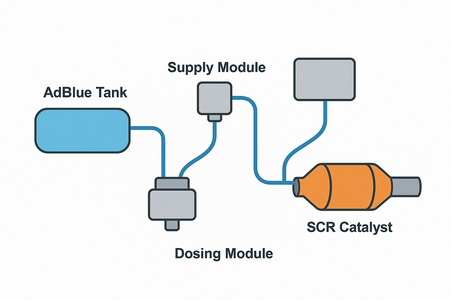
Adblue simplified diagram:
How does the system work?
The urea injection system starts by storing urea solution (AdBlue) in a tank. When the engine starts and reaches operating temperature, the supply system pumps the solution into the dosing module. The dosing module sprays the required amount of solution into the exhaust pipe, where it mixes with the hot exhaust gases. In the catalytic converter system, urea decomposes into ammonia, which reacts with nitrogen oxides to form harmless nitrogen and water vapor.
Benefits and maintenance
The SCR system offers several advantages, including lower fuel consumption and significantly lower NOx emissions. However, it requires regular maintenance, including checking the AdBlue level and using a high-quality solution. It is also important to monitor the proper functioning of sensors and other components, as faulty parts can affect the efficiency of the entire system.
In our online store, you can find pumps for transferring AdBlue fluid from barrels, as well as other AdBlue tools, here.
 The data shown here, especially the complete database of car spare parts, may not be copied. It is strictly prohibited to duplicate the data and database and distribute the same, and/or instruct third parties to engage in such activities, without prior consent from TecAlliance. Any use of content in a manner not expressly authorized constitutes copyright infringement and violators will be prosecuted.