

Urea Injection > Tank Unit Adblue
Pick your vehicle
Car AdBlue Tank: How It Works, Common Problems, and Maintenance
For owners of modern diesel vehicles, the word "adblue" has become an everyday term. Due to increasingly strict exhaust emission standards (starting with the Euro 6 standard), car manufacturers have had to find new ways to reduce the amount of dangerous nitrogen oxides (nox) emitted into the air by diesel engines. The solution is the scr (selective catalytic reduction) system, of which the adblue tank is arguably one of the most important, complex and, unfortunately, problematic components. In this in-depth technical review, we will dive deep into the anatomy of the adblue tank, examine its operating principles, dissect the notorious common faults of different car brands and see which spare parts manufacturers are worth trusting when repairing the system.

What is AdBlue and why does it need a special tank?
Before you open the tank itself, you need to understand what it contains. AdBlue is not a fuel-like additive that is mixed with diesel. It is a high-purity solution consisting of 32.5% synthetic urea (urea) and 67.5% demineralized water. This solution is sprayed into the vehicle's hot exhaust system, just before the SCR catalytic converter, using a special nozzle. In the heat, the urea decomposes into ammonia, which reacts with toxic nitrogen oxides in the catalytic converter, converting them into harmless nitrogen (N2) and water vapor.
Since AdBlue is a separate liquid, it requires its own storage system – the AdBlue tank. But unlike a regular windshield washer fluid or fuel tank, the AdBlue tank is not just an empty plastic container. It is an extremely complex mechatronics module that includes pumps, sensors, heaters and electronics.
The inner anatomy of an AdBlue tank: more than just a plastic container
In order for the SCR system to function flawlessly in all weather conditions, several critical components are integrated into the AdBlue tank. A modern AdBlue tank (or supply module) includes:
- Feed pump: this is an electric pump whose job is to create the necessary pressure in the system (usually 4 to 6 bar) to force the fluid from the tank through the pipes to the nozzle in the exhaust pipe. When the engine is stopped, the pump often sucks the fluid from the pipes back into the tank to prevent the fluid from freezing and the pipes from bursting in winter.
- Heater (heating mat or coil): One of the biggest physical disadvantages of AdBlue is its freezing point. The solution begins to crystallize and freeze at -11 °C. Since minus degrees are common in our climate, every AdBlue tank is equipped with a heater. This melts the frozen liquid when the engine is started so that the system can function. On many models, the pipes leading from the tank to the injector are also equipped with heating.
- Level sensor: the control unit must constantly know how much reducing agent is left in the tank. Different technologies are used to measure the level – floats, ultrasonic sensors or sensors based on electrical resistance. Ultrasonic is more modern because it has no moving parts that could jam due to urea crystals.
- Temperature sensor: The system needs to know the temperature of the fluid to decide whether and for how long to turn on the heater. The sensor also warns the system of excessively high temperatures that can damage the fluid quality.
- Vent valve: Since liquid is constantly being sucked out of the tank, a vacuum would otherwise form in the closed container. The vent valve lets air into the tank but does not allow liquid or vapors to escape.
- Control electronics (on some models): in some cars, a special brain (module) is also integrated into the tank, which processes sensor signals and communicates with the car's main computer (ECU) via the CAN line.
Why do AdBlue tanks and systems break?
Although the idea sounds great on paper, in the real world, AdBlue systems have proven to be one of the biggest sources of headaches and expense for car owners. The root of the problems lies mainly in the chemical properties of urea and design flaws in the tanks.
urea crystallization
The biggest enemy is the crystallization of the liquid itself. When AdBlue comes into contact with air or when the liquid slowly evaporates in the system (for example, due to high temperatures), the liquid turns into solid, rock-hard white crystals. These crystals clog the pump filter, block the movement of the level sensor, clog the injector and damage the valves. When the pump tries to push the crystallized liquid, its motor often burns out due to the high load.
freezing and swelling
Although the tank has a heater, it does not work if the car is parked at night in a parking lot with temperatures of -20 °C. Adblue freezes and, even worse, like water, it expands when it freezes (about 7% of its volume). Years of constant freezing and expansion wear out the plastic of the tank and the heater components. Liquid penetrates the tank's integrated electronics through microcracks. Since the urea solution is extremely corrosive (especially to copper and other metals), just one drop on the printed circuit board is enough to destroy the entire module.
Burnout of heating elements
This is probably the most common mechanical failure. The heating element at the bottom of the tank, which is often molded into plastic, simply burns out over the years. If the heater is not working, the engine's brain sees in the winter that the fluid cannot be defrosted, the system shuts down, and an error message lights up in the car's dashboard.
most common car models and their typical AdBlue tank faults
Although almost all manufacturers use SCR systems, over the years certain car brands and models have emerged where AdBlue tanks are the daily bread of repair shops. The design choices made by engineers have created specific standard errors that can be extremely costly to eliminate.
PSA Group (Peugeot and Citroën) - BlueHDI Engines
Peugeot and Citroen vehicles with 1.6 and 2.0 BlueHDI engines (e.g. Peugeot 308, 508, 3008; Citroen C4, Berlingo) are notorious for AdBlue problems. PSA engineers made a design choice where the pump, heater, level sensor and control electronics are permanently fused (integrated) into one large plastic tank.
Common mistakes in PSA:
1. Clogged vent valve: The vent valve in the tank cap or on the side of the tank gets stuck. As the pump sucks the fluid out, a huge vacuum is created in the tank. This vacuum is so strong that it physically wrinkled the large plastic tank. The tank deforms and breaks the pump and level sensor inside. This is why many mechanics recommend drilling a small hole in the cap of the AdBlue tank on PSA models to prevent the vacuum from forming.
2. urea error message and heater failure: the red "urea" light and the message "emissions fault: starting prevented in 1100 km" come on in the instrument panel. Diagnostics often show low pump pressure (due to crystallization) or a heater failure.
Since the pump module on a PSA tank cannot be replaced separately, the failure of even one small sensor or heater means replacing the entire AdBlue tank (which often costs over a thousand euros) with a new one.
VAG Group (Volkswagen, Audi, Škoda, Seat) - TDI SCR Engines
VAG Group diesels (such as the Passat B7/B8, Audi A4/A6, Škoda Superb with 2.0 TDI engines) use slightly better modulated systems, but are still not free from errors.
Typical errors in vag:
1. Heater element burnout: the most common problem (error codes p202a, p202b, etc.). especially common on older Passat B7 models. The good news is that many VAG models have a separate part called the "delivery module" (which includes the pump and heater). This means that the large plastic tank itself can be left under the car and only the pump module with the heater can be replaced, which makes the repair significantly cheaper than in the case of the PSA.
2. Ultrasonic sensor errors: On some Audi models, the ultrasonic level sensor tends to go haywire due to fluid splashing and temperature fluctuations, constantly showing that the tank is empty even though it is full to the brim. The factory has often released software updates to fix this, but sometimes the hardware still needs to be replaced.
Mercedes-Benz (Bluetec models)
Mercedes-Benz is the pioneer of SCR technology and their systems are more complex. Many older models (e.g. W166 ML, W212 E-Class) even have a two-tank system – a smaller, "active tank" with a heater near the engine and a larger "passive tank" behind.
Typical faults with Mercedes-Benz:
1. Active tank heater failure: Like others, the heating elements in the active tank burn out. The error code P20BE is all too familiar to Mercedes owners.
2. "Communication" between the NOx sensor and the tank: often the problem may not be directly in the tank, but the system throws an error message because the expensive NOx sensors located in the exhaust read the wrong exhaust gas value. NOx sensor failures are extremely common in Mercedes, and often, when diagnosing incorrectly, the AdBlue tank is the first thing to be looked at.
BMW (Blueperformance engines)
Like Mercedes, BMW often uses a two-tank (active and passive tank) system (for example, on the X5 E70 and F15 models).
Typical errors in BMW:
1. Transfer pump failure: The system works by pumping fluid from the passive tank to the active tank. The small transfer pump between the tanks tends to jam or burn out due to crystallization. The car gives an error message because the active tank runs out of fluid, even though there is plenty of fluid in the large tank.
2. Corrosion of level sensors: BMW's active tank level sensors oxidize and begin to show illogical values, requiring replacement of the entire module.
signs indicating a malfunction of the AdBlue tank and system
How does a car owner know that there is a problem with the system? The scr system is closely linked to the car's engine brain and safety requirements. Since a car with an empty or broken system pollutes the environment, legislation has made it so that you cannot simply ignore the problem.
- warning lights come on: a yellow or red warning light that resembles flowing fluid comes on in the instrument cluster, often accompanied by the usual "check engine" icon.
- Immobilizer countdown: This is the scariest symptom. The message on the information display reads: "Engine start will be blocked after 1000 km (or miles)". This is no joke. When the kilometers reach zero and you turn off the car, the car's brain (ECU) will no longer allow the starter to be started, even if the tank is later filled to the brim. To remove the immobilizer, the car must be towed to a workshop and the system reset using a diagnostic tool.
- Increased AdBlue consumption: If you notice that you need to refill AdBlue more often than before, there may be a leak in the system (often white crystallized debris around the tank or piping is a sure sign of a leak).
Maintenance and prevention: how to protect the AdBlue tank?
Although the life of a tank depends a lot on the design of the engineers, with certain tricks, the car owner can significantly extend the life of the system and postpone costly repairs.
- Use high-quality AdBlue and monitor the shelf life: AdBlue is a solution that has a shelf life. Urea decomposes quickly in direct sunlight and heat. Do not buy canisters from gas stations that have been left in the sun all summer. When the solution gets old, its concentration drops and the system throws an error code through the NOx sensors, blaming poor catalyst efficiency.
- Do not fill the tank "to the brim": this is one of the biggest mistakes! As mentioned earlier, the fluid expands when it freezes. If the tank is filled to the brim in winter, the ice will have nowhere to expand and will break the tank body or the internal plastic sensors. Always fill the system to the required volume (for example, if the car asks for 10 liters, pour 10 liters, not 15).
- Keep the tank cap and filler neck clean: dirt, dust and even the smallest fuel droplets will damage the chemical composition of AdBlue. The system is extremely sensitive to any contamination. If you accidentally pour even a drop of diesel into the AdBlue tank, the entire system (tank, pipes, pump, injector) will be permanently damaged and must be replaced.
- Use anti-crystallization additives: special additives are available on the auto chemical market that can be dosed directly into the AdBlue tank. These fluids change the surface tension and prevent the formation of urea crystals in the pump, sensors and injectors. Their preventive use is particularly recommended on PSA Group vehicles where tank replacement is a must.
repairs and reliable spare parts brands
Repairing an AdBlue system is usually not a simple "do-it-yourself" (DIY) project in a home garage. Replacing a new pump, sensor or entire tank almost always requires computer diagnostics to "introduce" the new component to the car (adaptation), remove blockages caused by incorrect values and test the operation of the heater.
When you are faced with the need to replace an AdBlue tank or its components, the choice of spare parts is critical. Since it is an extremely delicate symbiosis of electronics and mechanics, it is not worth trusting unknown Asian copies. Original parts (OE) are often very expensive, but fortunately the aftermarket offers excellent alternatives from well-known brands that also produce parts directly for car factories (OEM quality).
The most well-known brands in the SCR and AdBlue component market:
- bosch: the world's largest manufacturer of automotive electronics and injection systems. bosch denoxtronic systems are used in the factory by many car manufacturers (including vag and bmw). bosch pumps, heaters and supply modules are top quality and a solid choice, ensuring a long service life.
- VDO (Continental): A very strong player in sensor technology and feed systems. Their products include many precise level sensors and pump modules.
- Valeo: a French components giant whose products are often first installed on French cars (PSA, Renault).
- Pierburg: a German company specializing in engine exhaust and pump systems. Pierburg AdBlue pumps and modules are highly regarded in the aftermarket for their durability.
- Metzger: Although not always an OEM, Metzger has done a great job of solving aftermarket bottlenecks. They often offer solutions (including whole new AdBlue tanks) for models that would otherwise only require an expensive dealership, such as excellent replacements for PSA BlueHD tanks.
- febi bilstein and swag: reliable providers whose selection often includes repair kits, seals, plugs and heaters for a wide range of car brands.
summary
The AdBlue tank is an indispensable component in keeping a modern diesel engine clean, but unfortunately a very capricious component from a technical point of view. The crystallization of urea and the freezing characteristic of our climate severely test the fine mechanics (heaters, pumps and sensors) integrated into the tank. Being aware of the specific typical faults of your car (be it a PSA BlueHDI or a VAG TDI) and following basic maintenance rules – such as using high-quality fluid, avoiding overfilling and using special additives – allows you to significantly extend the life of the SCR system.
However, if a warning error message lights up in the instrument cluster and the start countdown has begun, the problem should not be ignored. By trusting recognized spare parts manufacturers (such as Bosch, Pierburg or Metzger) for repairs and contacting a competent diagnostician, you can be sure that your vehicle will return to the road as clean and worry-free as when it left the factory gate.
Car urea (adblue) system and its parts
 Car urea (adblue) injection system and its parts, construction and drawing
Urea (injection system, often also known as SCR (Selective Catalytic Reduction) system, is a technology used in modern diesel engines, which aims to reduce harmful nitrogen oxides (NOx) emissions. It works using a special urea solution (AdBlue), which neutralizes NOx particles contained in exhaust gases. The system consists of several interconnected components that ensure efficient operation and precise control of the system.
1. Supply Module (Feed module)
... More...
Car urea (adblue) injection system and its parts, construction and drawing
Urea (injection system, often also known as SCR (Selective Catalytic Reduction) system, is a technology used in modern diesel engines, which aims to reduce harmful nitrogen oxides (NOx) emissions. It works using a special urea solution (AdBlue), which neutralizes NOx particles contained in exhaust gases. The system consists of several interconnected components that ensure efficient operation and precise control of the system.
1. Supply Module (Feed module)
... More...
Car exhaust system: functions, components and maintenance
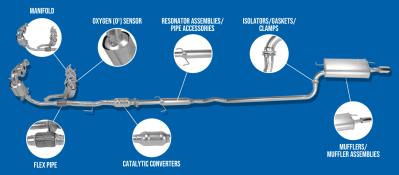 The car's exhaust system is one of the most important parts of a vehicle, its function is to safely direct exhaust gases generated during engine operation to the outside and reduce their environmental impact. This system helps to improve the vehicle's fuel efficiency, keep noise levels low, and meet legislative requirements that regulate the amount of pollutants.
... More...
The car's exhaust system is one of the most important parts of a vehicle, its function is to safely direct exhaust gases generated during engine operation to the outside and reduce their environmental impact. This system helps to improve the vehicle's fuel efficiency, keep noise levels low, and meet legislative requirements that regulate the amount of pollutants.
... More...

Car muffler repair and muffler parts: A comprehensive guide to exhaust system maintenance
 The vehicle exhaust system, or muffler in popular parlance, is one of the most stressed and extreme components in the entire car. Imagine an environment where the internal temperature of the components can range from hundreds of degrees to even a thousand degrees (at the catalytic converter and DPF filter), while the external surface of the component is attacked by sub-zero temperatures, rainwater, dirt, abrasive sand and aggressive salt sprinkled on the roads in winter.
... More...
The vehicle exhaust system, or muffler in popular parlance, is one of the most stressed and extreme components in the entire car. Imagine an environment where the internal temperature of the components can range from hundreds of degrees to even a thousand degrees (at the catalytic converter and DPF filter), while the external surface of the component is attacked by sub-zero temperatures, rainwater, dirt, abrasive sand and aggressive salt sprinkled on the roads in winter.
... More...
 The data shown here, especially the complete database of car spare parts, may not be copied. It is strictly prohibited to duplicate the data and database and distribute the same, and/or instruct third parties to engage in such activities, without prior consent from TecAlliance. Any use of content in a manner not expressly authorized constitutes copyright infringement and violators will be prosecuted.