

Timing Belt/Set > Timing Belt
Pick your vehicle
Engine timing belt: the basis for engine efficiency and reliability
The timing belt is an important part of a car engine, its job is to transmit torque between different parts of the engine. It plays a critical role in the engine's operation, helping to coordinate the engine's intake and exhaust systems and ensuring that all parts work together.

Fig. car timing belt
Timing belt function
The timing belt is driven by the engine's crankshaft. As the crankshaft rotates, the timing belt transfers this motion to the camshaft, which controls the opening and closing of the engine's intake and exhaust valves. This precise timing ensures that:
- valves and pistons do not collide with each other: an incorrectly selected belt in the engine can cause valves and pistons to collide, which can cause serious engine damage.
- optimal combustion: correct synchronization ensures that the air-fuel mixture ignites at the right moment, maximizing engine efficiency.
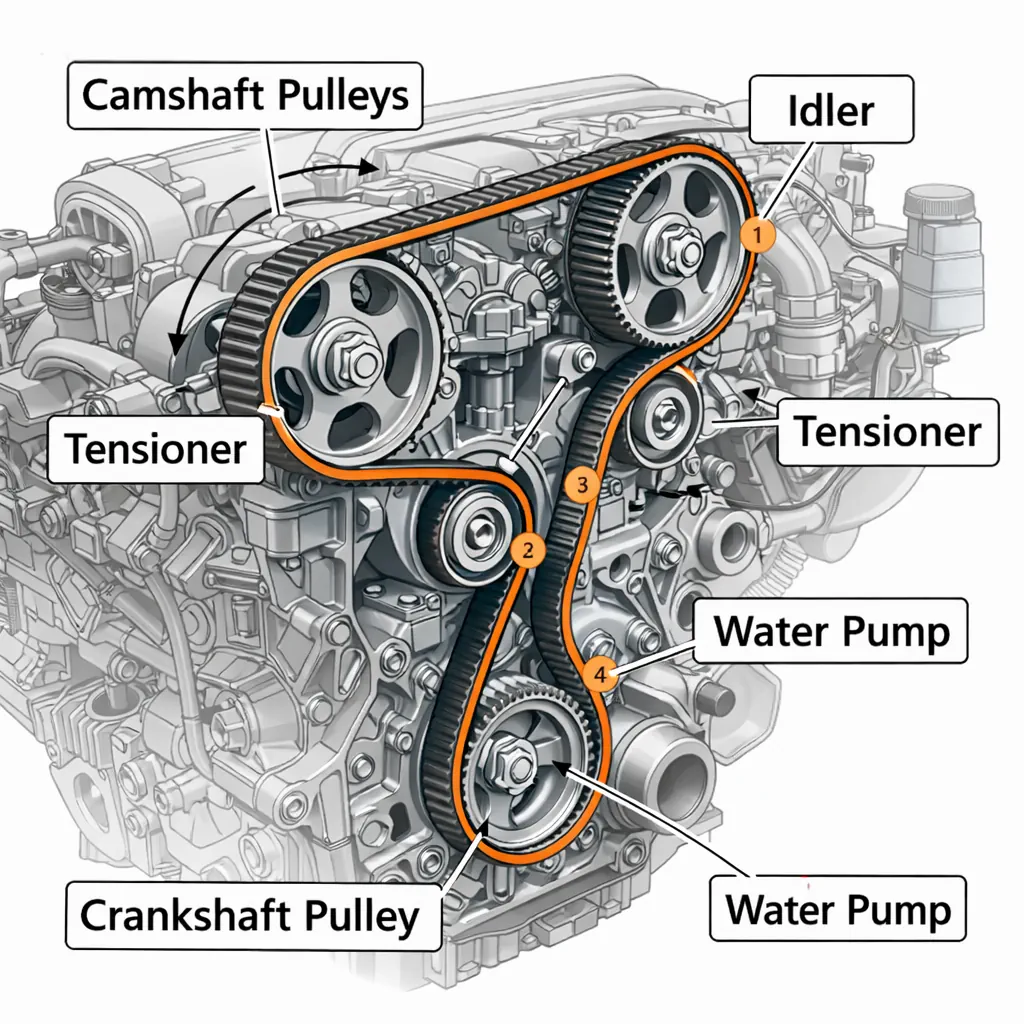
Fig. car timing belt path
Strap types
-
Smooth belt : used mainly in simple engine systems where precise synchronization of camshaft movements is not required.
-
Timing belt : has a toothed edge that meshes with the engine's camshafts and other components, ensuring precise timing. This is the most common option in modern cars because it offers better precision and efficiency.
Timing belt problems
The timing belt can wear out or become damaged over time, which can cause serious engine problems. Typical problems that drivers may face include:
- Wear and tear : Over time, the timing belt can begin to wear out and eventually break, causing engine parts to collide and cause serious damage.
- Incorrect timing : If the timing belt is incorrectly installed or worn, it can cause engine timing problems, which can lead to reduced performance or engine malfunctions.
- Noise : Abnormal noise in the engine area may indicate a worn timing belt or other problems in the timing belt system.

Fig. old cracked timing belt
Maintenance and replacement
It is important to regularly check the condition of the timing belt and follow the manufacturer's recommended maintenance intervals. Many manufacturers recommend replacing the timing belt every 60,000 to 100,000 km, but this can vary depending on the type and model of car.
Timing belt replacement should be done by professional mechanics to ensure proper installation and timing.
Conclusion
The timing belt is an essential part of a car's engine to ensure its efficiency and reliability. Regular maintenance and attention to the condition of the timing belt will help prevent serious problems and ensure that your car runs smoothly and reliably. Timely replacement of the belt with a new one and professional installation are crucial to ensuring maximum engine performance and durability.
Timing belt: the silent hero of your engine and its typical faults on popular models
A car engine is a complex orchestra, with hundreds of metal parts moving at breakneck speed, often just millimeters apart. The conductor of this orchestra is the timing belt . It is a deceptively simple piece of rubber and cords that synchronizes the crankshaft and camshaft. When this synchronization is lost or the belt breaks, the result is silence – and often a very expensive silence.
Many car owners know that the belt needs to be replaced after a certain mileage, but few know that different car brands have specific "diseases" and weak points that can lead to the belt breaking long before the official replacement interval. In this article, we will take an in-depth look at why timing belts break, what are the danger signs in common car models, and which spare parts to prefer to avoid engine overhaul.
What is the actual role and risk of the timing belt?
The function of the timing belt (or chain on some cars) is to ensure that the valves open and close at exactly the right moment as the piston moves up and down in the cylinder. Most modern engines are of the so-called "interference" type. This means that if the belt breaks, the piston moves forward, but the valves remain in the open position. The piston will bend the valves, break the rocker arms and can even damage the cylinder head.
The belt itself rarely breaks from "old age" (unless the timing belt has been drastically overstretched). Usually, the culprit is another component in the belt system: a stuck water pump, a broken tensioner pulley, or an oil leak that has made the belt soft.
Common faults in car models
Although the timing belt is a consumable part in every car, on certain models, engineers have made choices that require more attention from the owner.
1. Volkswagen Group (VW, Audi, Skoda, Seat) – 1.6 and 2.0 TDI
These are some of the most common diesel engines on European roads. The official maintenance interval is often stated as very long (up to 210,000 km), but practice shows otherwise.
- Water pump problem: on vag group engines the water pump is driven by a timing belt. in many cases the factory fitted water pump has a plastic impeller or an electronically controlled valve ("variable displacement pump"). these pumps tend to seize or leak as early as 150,000 km. when the pump seizes the belt will rub against it to pieces in seconds.
- Tensioner pulley stud bolt: It is critical to replace the stud bolt that holds the tensioner pulley in place during a belt replacement. If the old bolt is overtightened or left un-replaced, it can break from fatigue, causing the belt to come off.
2. Volvo (D5 diesels and 5-cylinder petrol engines)
Volvo engines are known for their durability, but they have one insidious enemy that isn't even inside the timing belt housing.
- Auxiliary belt (generator belt) hazard: Volvo 5-cylinder engines have a common defect where a broken or frayed auxiliary belt (which drives the alternator and air conditioning pump) gets pulled in between the timing belt housing. This "foreign object" will cause the timing belt to become out of sync or break completely. Therefore, it is critical for Volvos to replace the auxiliary belt and its tensioner along with the timing belt.
3. Ford (1.0 Ecoboost) – "belt in oil"
Ford's small and capable EcoBoost engine introduced a technology called "belt in oil" (BIO) to the masses. The timing belt runs in engine oil, which should theoretically reduce friction and noise and extend the life of the belt.
- Material degradation: In reality, these belts are extremely sensitive to oil quality and change intervals. If you use the wrong oil or leave the oil change late, the belt material will begin to chemically degrade. Rubber pieces and fibers released from the belt clog the oil filter in the crankcase. The result is oil starvation and engine failure, although the belt itself may still appear healthy visually.
4. Ford and psa group (peugeot, citroën) – 1.6 and 2.0 hdi/tdci
In addition to the main timing belt, these engines also have a short chain inside the engine, between the two camshafts.
- Chain stretching: the timing belt is often replaced, but the chain between the camshafts and its tensioner are neglected. If this chain stretches or the tensioner breaks, the result is valve damage, even though the timing belt was new. A characteristic symptom is a "rattling" sound from the top of the engine on cold starts.
5. Alfa Romeo, Fiat, Opel (1.9 jtd/cdti)
This legendary diesel engine is very durable, but its weak point is once again the water pump.
- Pump breakage: The original often used water pumps with plastic blades, which over time came loose from the shaft or broke. This leads to engine overheating or belt breakage. It is recommended to always use aftermarket water pumps with metal impellers.
When to change the belt? Don't blindly believe the book
Car manufacturers often give very optimistic timings for belt replacement – 180,000, 210,000 or even 240,000 kilometers. In the Estonian climate, where temperatures fluctuate between -30 and +30 degrees and journeys are often short (many starts), these numbers are dangerous.
Recommended rule: wax the belt no later than 5 years after the previous change or 20-30% earlier than the manufacturer's maximum mileage. Rubber ages over time, even if the car is parked in a garage.
If you buy a used car and the seller does not have solid proof (invoice) of the belt change, the belt must be replaced immediately. A service book stamp or a note under the hood ("changed at 100k") is not a guarantee.
A complete approach: why trade "all or nothing"?
Replacing a belt is a labor-intensive process, with the price of the spare part often accounting for only half of the total cost. Therefore, it is extremely unreasonable to replace only the belt.
A complete set should always include:
- new timing belt.
- new tensioner pulley and guide pulleys (bearings wear out as quickly as the belt).
- new water pump (if belt-driven).
- new mounting bolts and nuts (many of them are single-use expansion bolts).
Spare parts brands: quality is cheaper than engine repair
The timing belt market is clearly divided between top manufacturers and low-cost brands. Since the cost of a belt break is in the thousands of euros, there is no room for experimentation.
recognized manufacturers (premium)
- Continental (Contitech): Top of the line German engineering. Their kits often include reinforced water pumps and high-quality rollers.
- Gates: one of the world's largest belt manufacturers, supplier to many car manufacturers (OEM). Their "PowerGrip" kits are known for their durability.
- INA (Schaeffler Group): known primarily for its bearings and rollers. In an INA belt kit, the belt is often from a manufacturer such as Gates or Continental, but the rollers are their own top-of-the-line product.
- SKF: Swedish bearing manufacturer whose kits are very reliable, especially when it comes to tensioners and water pumps.
- dayco: particularly strong in "belt in oil" systems and supplying Italian/French cars.
Summary
A timing belt doesn't give you any warning. Unlike worn brakes that whine or a loose axle that rattles, an old timing belt runs quietly until the fatal moment. By knowing the specific weaknesses of your car model – whether it's a Volvo timing belt, a VW water pump or a Ford oil belt – you can prevent disaster.
Don't put off changing your belt. Choose a high-quality complete kit (belt, pulleys, pump) from a reputable manufacturer and have the job done by a professional with the right tools. It's an investment in peace of mind knowing that your car's engine is working exactly as the engineers intended.
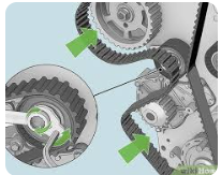
Car Timing Belt Kit with Water Pump – a good choice!
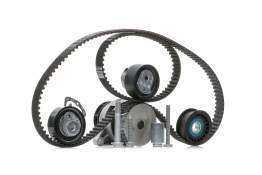 Car Timing Belt Kit with Water Pump – Why Is It the Best Choice?
... More...
Car Timing Belt Kit with Water Pump – Why Is It the Best Choice?
... More...
Car belts: The under-the-hood heroes that keep the engine running
 When you open the hood of your car, you're faced with a complex maze of hoses, wires, and belts. To many car owners, these black rubber bands are just "some belts," but in reality, they play a critical role in the operation of your engine.
Without these belts, your car wouldn't run, your battery wouldn't charge, and your steering wheel would be as heavy as a rock. In this article, we'll explain the difference between the main types of belts – timing belts and V-ribbed belts – and why replacing them on time is cheaper than repairing your engine.
There are several different belts under the hood, each with its own function.
1. Timing belt – the heart of the engine
The timing belt is arguably the most important belt in your car. It's hidden under the engine covers and you don't usually see it when you open the hood.
What is its function?
The timing belt synchronizes the operation of the engine's crankshaft and camshaft. Simply put, it ensures that the engine's valves open and close at exactly the right moment as the pistons move up and down. The inside of the belt has "teeth" that mesh with the gears to prevent slipping.
The "teeth" of the timing belt are critical to maintaining accurate engine timing.
What happens if the timing belt breaks?
... More...
When you open the hood of your car, you're faced with a complex maze of hoses, wires, and belts. To many car owners, these black rubber bands are just "some belts," but in reality, they play a critical role in the operation of your engine.
Without these belts, your car wouldn't run, your battery wouldn't charge, and your steering wheel would be as heavy as a rock. In this article, we'll explain the difference between the main types of belts – timing belts and V-ribbed belts – and why replacing them on time is cheaper than repairing your engine.
There are several different belts under the hood, each with its own function.
1. Timing belt – the heart of the engine
The timing belt is arguably the most important belt in your car. It's hidden under the engine covers and you don't usually see it when you open the hood.
What is its function?
The timing belt synchronizes the operation of the engine's crankshaft and camshaft. Simply put, it ensures that the engine's valves open and close at exactly the right moment as the pistons move up and down. The inside of the belt has "teeth" that mesh with the gears to prevent slipping.
The "teeth" of the timing belt are critical to maintaining accurate engine timing.
What happens if the timing belt breaks?
... More...
 The data shown here, especially the complete database of car spare parts, may not be copied. It is strictly prohibited to duplicate the data and database and distribute the same, and/or instruct third parties to engage in such activities, without prior consent from TecAlliance. Any use of content in a manner not expressly authorized constitutes copyright infringement and violators will be prosecuted.