

Brake caliper structure and parts

The brake caliper is one of the important components in the vehicle's braking system, whose function is to apply the brake pads to the brake disc or drum to achieve vehicle braking. The brake caliper consists of various elements that work together to ensure effective and safe braking. In this article, we will discuss the components of the brake caliper, their functions and importance.
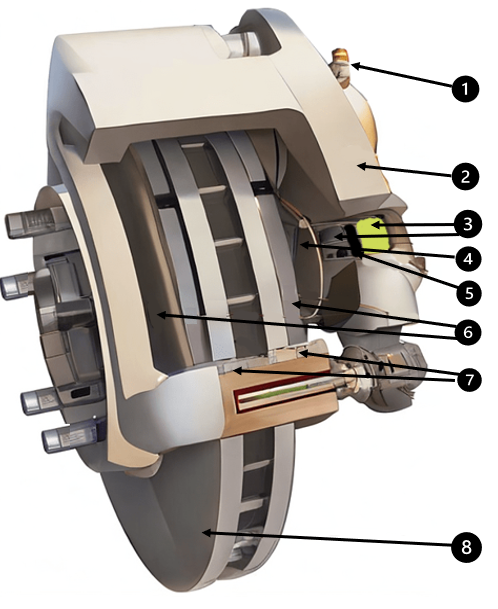
Brake caliper parts:
1. Bleed screw (bleed nipple)
2. Caliper housing
3. Piston
4. Dust boot
5. Piston seal
6. Brake pads
7. Anti-rattle clips
8. Brake disc.
1. Bleed Screw
The bleed screw is a small component that is usually located on the brake caliper. Its function is to allow air to be removed from the brake system, especially during the process of bleeding the brake fluid. If there is air in the brake system, it can cause the brakes to lose their effectiveness or even stop working. The bleed screw allows air to be removed through the mechanism to restore the precise operation of the brake system.
Function: The bleed screw allows air or air bubbles to be removed from the brake system to ensure the accuracy and reliability of the brakes.
2. Caliper Housing
The caliper housing is the main part of the brake caliper, housing all the other components, such as the piston and brake pads. The housing is usually made of a strong metal (such as aluminum or steel) to withstand the high heat and stress generated during braking. The housing holds all the parts of the caliper together and allows them to move.
Function: The caliper housing holds all components of the brake caliper in place and ensures their cooperation at the point where the brake pads meet the brake disc.
3. Piston
The piston is the most important moving part of the brake caliper. When the brake pedal is depressed, brake fluid pushes the piston forward, forcing the brake pads to move against the brake disc and causing braking force to be generated. The piston is usually made of stainless steel or other durable material and is designed to withstand high loads and high temperatures.
Function: The piston moves the brake pads against the brake disc or drum to create braking force and reduce the vehicle's speed.
4. Dust Boot
The dust boot is a flexible rubber cover that covers the brake caliper piston. Its purpose is to protect the piston from dust, dirt, and water that can get caught between the moving parts of the piston and interfere with the operation of the braking system. The dust boot helps ensure that the braking system remains clean and operates efficiently.
Function: The dust boot protects the piston from contaminants, extending the life of the brake system and ensuring reliability.
5. Piston Seal
The piston seal is located between the piston and the caliper body. Its function is to keep the brake fluid in the correct places and prevent fluid leakage from the brake system. The seal ensures that the brake system works properly to maintain the brake fluid pressure at the correct level and ensure the brakes work effectively.
Function: The piston seal prevents brake fluid from leaking and ensures that the system has the correct pressure so that the brake pads can make contact with the brake disc.
6. Brake Pads
Brake pads are one of the most important components of the braking system. They are made of wear-resistant materials, such as composite materials or metal-ceramic mixtures. The brake pads are pressed against the brake disc by the brake caliper to generate braking force. They wear out during braking, which is why it is important to replace them regularly to ensure the reliability of the braking system.
Function: Brake pads create a braking force that slows or stops the vehicle's motion by pressing against the brake disc and converting kinetic energy into heat.
7. Anti-Rattle Clips
Anti-rattle clips are small metal parts that are mounted on the brake pads. They prevent the brake pads from moving in the caliper, preventing the clicking and noise that can occur when the brakes are applied. Anti-rattle clips help ensure smooth and quiet braking.
Function: Anti-rattle clips hold the brake pads in place in the caliper, reducing vibration and noise that can occur during brake operation.

The brake caliper is one of the most important components in a vehicle's braking system, responsible for ensuring effective and reliable braking. Its various parts, such as the bleed screw, caliper housing, piston, dust boot, piston seal, brake pads and anti-rattle clips, work together to ensure precise brake operation and vehicle safety. Regular maintenance and component replacement are necessary to ensure that the braking system remains reliable and efficient throughout the vehicle's life.
Brake caliper (brake support) components in detail

1.Inner brake pad shim
2. Inner brake pad
3. Outer brake pad
4. Outer brake pad shim
5. Sealing washer
6. Brake caliper housing
7. Brake hose
8. Bolt
9. Brake piston
10. Brake piston seal
11. Piston dust boot
12. Brake pad spring (anti-rattle spring)
13. Brake pad retaining clips / pad retainers
14. Guide pin / slider pin (caliper pin)
15. Guide pin boots (dust boots)
16. Brake caliper carrier / bracket
17. Guide pin grease (applied to guide pins – item 14)
Brake caliper common faults and repair: A comprehensive guide for car owners
Brake caliper (brake support): Why does it seize, how to identify faults, and what are the typical problems in popular car models?
A car’s braking system is an integrated whole in which every component plays a vital role. While brake pads and discs are so-called “wear items” that car owners are accustomed to replacing, the brake caliper (also known as the brake support or caliper housing) is a component that often only comes to mind when a warning light illuminates on the dashboard or smoke starts rising from a wheel.
The brake caliper is the “muscle” of the braking system. It is a hydraulic device that converts pressure from the brake pedal into physical force by pressing the pads against the rotating brake disc. When this mechanism fails, both passenger safety and your wallet are at risk, as a seized caliper can quickly destroy new brake discs, pads, and even the wheel bearing.
In this comprehensive guide, we take an in-depth look at how brake calipers work. We analyze why they fail, what the most common faults are in car models found on our roads, and which types of chemicals and maintenance practices are required to ensure long-term reliability of the braking system.
How does a brake caliper work, and what goes wrong?
To understand faults, it is first necessary to understand the operating principle. Passenger cars mainly use two types of brake calipers:
Floating caliper:
The most common type in standard passenger cars. It has one or two pistons on only one side of the caliper. The caliper itself moves back and forth on metal guide pins to pull the outer brake pad against the disc as well.
Main risk area: Guide pins seizing due to corrosion or incorrect lubrication.
Fixed caliper:
Used in sporty and luxury vehicles. The caliper is rigidly bolted in place, and pistons are located on both sides of the brake disc (4, 6, or even 8 pistons).
Main risk area: Oxidation and seizure of the pistons, caused by the interaction between the aluminum caliper body and steel pistons.
Why do brake calipers fail?
Brake calipers operate under extreme conditions. They are located in the wheel arch, where they are constantly exposed to water, dirt, road salt, and brake dust. In addition, they experience extreme temperature fluctuations — in winter the caliper may be at −20 °C, and moments later, during braking, it can heat up to +200 °C.
The main causes are:
-
Damaged dust boots: Rubber seals that protect the piston and guide pins crack over time. Moisture enters, and corrosion begins.
-
Old brake fluid: Brake fluid is hygroscopic, meaning it absorbs moisture. If the fluid is not replaced regularly, water accumulates inside the caliper cylinder, causing corrosion from the inside outward (pitting).
Incorrect chemicals: Mineral oil–based greases cause rubber seals to swell, leading to seized and sticking brakes.
5 symptoms that a brake caliper needs attention
Before the car comes to a complete stop, it usually gives warning signs.
-
The car pulls during braking: If one front caliper works while the other is seized (or does not engage), the steering wheel will pull strongly to one side when braking.
-
Overheated wheel: After driving, one wheel is noticeably hotter than the others. This indicates that the piston is not retracting and the brake pad is constantly rubbing against the disc.
-
Burning smell: A distinct, sharp odor caused by overheating brake pads.
-
Uneven wear: One brake pad is worn down to the metal, while the other looks almost new. This is a clear sign of seized guide pins.
- Soft pedal or fluid leak: If the piston seal fails, brake fluid leaks out. The pedal sinks toward the floor and braking force is lost.
Typical faults by car model: Where and what fails?
Although braking systems are similar in design, each car manufacturer has its own “Achilles’ heels.” Below is an overview of the most common problems by brand.
Volkswagen Group (VW Passat, Golf, Audi A4, A6, Skoda Octavia)
Vehicles from the VAG Group are among the most popular on our roads, but they do have a few specific weak points.
Rear electric parking brakes (EPB):
On models such as the Passat B6/B7 and Audi A6, the rear brake calipers are equipped with an electric motor.
Typical fault: The plastic motor housing cracks with age. Saltwater gets inside, the motor corrodes and seizes, and a fault message appears on the dashboard.
Solution: In many cases, the entire caliper or the motor unit must be replaced.
Mechanical parking brake:
On older models, the parking brake mechanism inside the caliper corrodes. The cable moves, but the shaft inside the caliper is seized.
Toyota, Honda, and Mazda (Japanese cars)
Japanese engineers build very durable engines, but their braking systems have one weak point – tight tolerances.
Seized guide pins:
On models such as the Avensis or Accord, the guide pins have very tight tolerances. Even a small amount of corrosion is enough for the pin to seize in its bore.
Special characteristic: Often the lower guide pin has a rubber bushing that swells when exposed to the wrong grease, completely blocking movement.
BMW (3 Series, 5 Series, X Series)
Steel vs. aluminum:
On many models, an aluminum caliper body is combined with a steel piston. This leads to galvanic corrosion, where an oxide layer builds up under the dust boot and causes the piston to seize.
Ford (Focus, Mondeo)
Return springs:
Ford rear calipers often suffer from weak return springs. The lever does not return to its original position, and the brake pads remain dragging.
Corrosion in guide pin channels:
The caliper carrier corrodes around the guide pin bores, squeezing the guide pin and causing it to seize.
Chemicals and maintenance products: What is allowed and what is NOT allowed?
Brake caliper repair and maintenance is an area where using the wrong chemicals can have catastrophic consequences. Below is a list of essential products and important warnings.
This is the foundation of all work. An aerosol that removes oil, grease, brake dust, and old lubricant. Before installing new parts, all surfaces must be thoroughly cleaned and completely free of contaminants.
2. Guide pin grease – CRITICAL!
This is where about 80% of mistakes are made. Ordinary grease or copper paste must not be used here!
- Correct product: Silicone-based grease or a special PAG grease.
- Why? Petroleum-based greases cause rubber dust boots to swell, which leads to seized and sticking brakes.

Image. Lubricating squeaking brake caliper guide pins with silicone grease
3. Brake pad assembly paste (ceramic paste)
It is applied to the metal backing plate of the brake pad and to the pad “ears”.
- Recommendation: Prefer ceramic paste.
- Warning: The use of copper paste is not recommended on modern vehicles with ABS systems and aluminum components, as it can cause galvanic corrosion.
4. Brake fluid
Most modern vehicles use DOT 4 or DOT 5.1 brake fluid.
Note: DOT 5 (silicone-based) is not compatible with the others and must not be mixed.
Repair vs. replacement: When should you do which?
When should you choose a repair kit?
It is worth considering if the caliper housing is intact, the guide pin bores are not ovalized, and you are prepared for some “dirty work.”
When should you buy a new or remanufactured caliper?
-
The parking brake lever is seized due to corrosion.
-
The bleeder screw has snapped off.
-
The caliper cylinder is heavily corroded internally (pitting).
-
The electric parking brake motor is defective.
Today, the prices of remanufactured brake calipers have become so affordable that they are often a safer and more reliable option than replacing seals alone.
Electric parking brake (EPB) – modern convenience and a curse
How do you replace brake pads or a caliper on a car with EPB? Unlike a conventional system, with EPB the piston cannot simply be pushed back in.
-
Diagnostic tool: The official method is to use a diagnostic computer and activate “Service Mode.”
-
Manual method: Removing the motor and manually winding the mechanism back (risky!).
-
Warning: Never try to force the piston back on an electric parking brake caliper — this will irreversibly damage the actuator!
Preventive maintenance: How to avoid caliper seizure
The best repair is prevention. Here are simple steps to follow every time you change tires or brake pads:
-
Visual inspection: Check the rubber dust boots. If you see any cracks, replace them immediately.
-
Guide pin lubrication: Remove old grease and apply fresh silicone grease.
-
Brake pad movement: Make sure the pads move freely in the caliper carrier. If necessary, clean the contact surfaces with a file.
Brake fluid replacement: Every 2 years, to protect the caliper from internal corrosion.
Summary
The brake caliper is a component that demands respect and proper care. A failure is not just an inconvenience, but a direct threat to life. Whether you have a Volkswagen, Toyota, or BMW in your garage, the laws of physics and corrosion apply equally to all.
By recognizing early warning signs such as uneven wear or an overheating wheel, you can take action before serious damage occurs. And if you decide to carry out the repair yourself, remember the golden rule: use the right chemicals in the right places. Copper grease on guide pins is death — silicone grease is life.
Properly functioning brakes provide peace of mind. Inspect your car’s brakes regularly and choose parts that are built to last — because cutting corners on brakes is never worth the risk.
Here you can buy a brake caliper for your car.
 The data shown here, especially the complete database of car spare parts, may not be copied. It is strictly prohibited to duplicate the data and database and distribute the same, and/or instruct third parties to engage in such activities, without prior consent from TecAlliance. Any use of content in a manner not expressly authorized constitutes copyright infringement and violators will be prosecuted.