

Changing car brake discs and brake pads
The described procedure is for one wheel and must be repeated on the other wheel of the axle.
Disassembling the wheel
1. Remove the wheelRemoving the brake pad
2. Remove the brake pads and retract the brake piston(s). Use a special tool to press the brake pistons!
Image: Removing the brake pads
Brake caliper disassembly
3. Remove the caliper from the mount.DANGER! Do not disconnect the brake fluid supply line from the caliper. Allow the brake caliper to hang and make sure the supply hose is not tight.
If necessary, disassembling the wheel hub
4. If necessary, disassemble the wheel hub before removing the brake disc. Then remove the brake disc.Cleaning the mounting surface of the new brake disc
5. Clean the mounting surface of the new disk.WARNING! Do not smear the mounting surface with oil or grease.
Cleaning the mounting surface of the wheel hub disc
6. Thoroughly clean the mounting surface of the wheel hub disc, removing all deposits and rust; check that the surface is not damaged or deformed and, if necessary, restore it to the correct condition.Checking the rotation of the bearings
7. Check the wheel bearings for smooth rotation.Reinstalling the wheel hub
8. If the wheel hub has not been removed: install the new disc on the wheel hub and fasten with the fixing bolt; adjust the bearing if necessary, following the vehicle manufacturer's instructions.Assembling the wheel hub and disc
9. If the wheel hub was removed in step 4 : Assemble the hub and disc by tightening the mounting bolts to the specified torque. Install the hub-disc assembly on the wheel axle, adjust the bearing and carry out the installation operations according to the vehicle manufacturer's instructions.
Image: Installing the brake disc
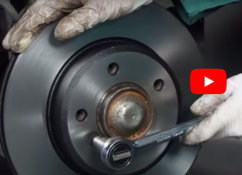
Checking the side run of the brake disc with an indicator
 10. Check the lateral runout of the brake disc disc using a gauge; the indicator must be located as shown in the figure, at a distance of 5 mm from the outer diameter. Secure the disc with several wheel nuts to simulate the condition of the wheel being attached.The maximum run value per full revolution of the disc is: 0.10 mm for passenger cars - 0.12 mm for commercial vehicles. If necessary, remove the disc and install it on the wheel hub in a different position, then repeat the measurement.
WARNING! Do this test with caution. A higher than indicated side run value causes abnormal wear and generates vibration during braking.
11. If the side run reading is unacceptable, measure the side run of the wheel hub mounting surface; if necessary, replace the hub and reinstall the disc.
WARNING! The value of the permissible side run of the mounting surface of the wheel hub is approximately half of that specified for the disc.
Reinstalling the brake caliper
12. Install the brake caliper on its mount; for a floating caliper, check the smooth sliding of the body on the guides.CAUTION! Check that the rubber parts are not damaged. Replace if necessary.
Installing new brake pads
13. Install new brake pads with corresponding springs and pins. Lubricate the back and edges of the brake pads with suitable grease where indicated.Connect the wear indicator if fitted.
Brake pedal activation
14. Press the brake pedal to bring the brake pads closer to the disc. Repeat this process until the pedal travel is as it should be.15. Check the brake fluid level in the tank, add if necessary.
16. Reinstall the wheel and tighten the wheel nuts according to the vehicle manufacturer's instructions.
17. Balance the wheel.
Testing and break-in
Road test the vehicle, making sure not to hit the brakes or hold the pedal down for more than 3 seconds; make sure there is no noise or vibration from the brakes.
The user of the vehicle should drive at least 200 km with the new discs and pads, braking gently and sparingly and without activating the ABS.
CAUTION! If the new brakes have not been properly broken in, the braking system may be hindered from working effectively
DANGER! Before starting the replacement, make sure that the parts match the make and model of the vehicle. In order for the warranty to be valid, repair work may only be performed by a qualified person who has received training and/or who has experience in installing and using the product.
The installer must have tools suitable for his profession and the knowledge and experience to deal with vehicle repairs. Improper or improper installation, whether caused by failure to follow these instructions exactly and completely or otherwise, will void the limited warranty.
It is important to change the brake discs of each axle, taking them from the same box. Whenever you replace discs, replace the associated brake pads as well.
Avoid contact of lubricants with the brake surfaces of the disc and pads, as this can affect the effectiveness of the braking system.
We are not responsible for damages or injuries caused by repairs performed under this article.
Common Brake Pad and Brake Disc Defects in Popular Car Models
The braking system is the most important safety system in a vehicle, yet brake pads and brake discs are the components that most often suffer from recurring and model-specific problems. Although brakes are wear parts, not all wear is normal—over the years, certain car models have developed characteristic brake issues that recur with similar symptoms and causes.
In this article, we will look at:
-
why brake pads and discs wear unevenly on certain vehicles
-
the most common model-specific brake problems
-
how to recognize these issues
-
when wear is considered normal and when it is a design-related defect
how to extend the service life of your brakes
Why Do Brake Design Defects Occur?
Brake design defects do not necessarily indicate poor quality. In most cases, they are the result of a design compromise, where:
-
priority is given to comfort and quiet operation
-
the brakes are undersized relative to the vehicle’s weight or power
-
softer brake pad materials are used
-
the brake caliper design is sensitive to dirt and corrosion
These typical problems tend to recur because the same brake design is often used for many years across multiple models built on the same vehicle platform.
 Image: Worn vs new brake pads
Common Brake Pad and Disc Defects by Car Model
The examples below are based on practical observations and recurring symptoms. They do not mean that every listed vehicle is necessarily problematic, but rather that under certain conditions, faults occur more frequently than average on these models.
Volkswagen, Škoda, SEAT (VAG Group Models)
Common problems
-
brake discs warp relatively quickly
-
brake pads wear unevenly
-
corrosion on disc edges and along the friction surface
Typical symptoms
-
steering wheel vibration during braking
-
pulsation felt when braking
-
brakes begin to squeal after a short period of use
Causes
-
thin brake discs
-
softer brake pads chosen for comfort and low noise
-
city driving and frequent short trips
In many cases, the brake pads are replaced while the discs are left in place, which leads to rapid wear of the new pads and increased noise.
Mercedes-Benz
Common problems
-
corrosion on brake discs
-
uneven brake pad wear
-
brakes “sticking” or binding
Typical symptoms
-
the vehicle does not roll freely
-
brakes overheat
-
uneven braking performance
Causes
-
corrosion of brake caliper guide pins
-
limited brake movement due to gentle driving style
-
long service intervals
These issues are especially common on vehicles that are driven infrequently and spend long periods standing still.
Ford (Focus, Mondeo, Transit)
Common problems
-
brake disc warping
-
vibration during braking
-
uneven brake pad wear
Typical symptoms
-
steering wheel shake when braking
-
pulsation felt in the brake pedal
-
metallic noises
Causes
-
relatively thin brake discs
-
heavy load (especially on vans)
-
uneven heat distribution
On the Transit, the problem is often linked to heavy loads combined with frequent braking in city driving conditions.
Peugeot and Citroën
Common problems
-
rapid brake pad wear
-
brakes tend to squeal
-
rear brakes seize or bind
Typical symptoms
-
high-pitched squealing during braking
-
overheating of the rear wheels
-
uneven braking performance
Causes
-
soft brake pad compounds
-
brake caliper design
-
infrequent servicing
Rear brake issues are often related to the parking brake mechanism.
Opel
Common problems
-
corrosion on brake discs
-
uneven brake wear
-
brakes dragging or sticking
Typical symptoms
-
vehicle pulls to one side when braking
-
brakes overheat
-
pads wear more on one side
Causes
-
lack of lubrication on caliper guide pins
-
corrosion
-
long service intervals
Toyota and Lexus
Common problems
-
brake disc corrosion
-
brakes feel “lazy” or unresponsive
-
uneven braking force
Typical symptoms
-
soft brake pedal feel
-
inconsistent braking performance
-
rust on the outer edges of the brake discs
Causes
-
comfort-oriented brake tuning
-
soft brake pad materials
-
low brake load
These problems occur most often during city driving and on short trips.
Audi (larger and more powerful models)
Common problems
-
brake discs overheat
-
rapid brake pad wear
-
brake vibration during use
Typical symptoms
-
steering wheel shake when braking
-
reduced braking efficiency
-
uneven braking performance
Causes
-
high vehicle mass
-
powerful engines
-
brakes undersized for real-world use
Common Brake Pad Defects Regardless of Brand
In addition to brand-specific issues, several general brake pad problems are frequently encountered:
-
brake pads that are too soft → accelerated wear
-
brake pads that are too hard → increased brake disc wear
-
incorrect pad compound for the disc material
- improper bedding-in of new brake pads
Common Brake Disc Defects
When it comes to brake discs, the following issues are most commonly repeated:
-
warping due to heat
-
corrosion on the friction surface
-
uneven wear
-
microcracks
It is often assumed that a brake disc is “warped,” but in many cases the real issue is uneven transfer of brake pad material onto the disc surface, which causes vibration and pulsation during braking.
How to Distinguish a Design-Related Brake Issue from Normal Wear?
Normal wear:
-
brake pads wear evenly
-
brakes operate quietly
-
braking is smooth and consistent
Design-related defect:
-
vibration
-
noise
-
uneven wear
-
the same problem returns shortly after replacement
If an issue comes back quickly, it is not a coincidence.
How to Prevent Brake Pad and Disc Problems?
Practical recommendations:
-
replace brake pads and discs together
-
clean and lubricate caliper guide pins
-
use the correct brake pad compound
-
bed in new brake pads properly
-
inspect the brakes at every service interval
Brake maintenance is not an area where rushing pays off.
Do Design Defects Mean the Car Is Bad?
No. Design-related defects usually indicate:
-
certain construction-related characteristics
-
the need for more informed maintenance
-
more frequent brake inspections
Most of these issues are preventable with proper servicing and correct component selection.
Conclusion
Design-related brake pad and brake disc issues are recurring across many car models and are most often linked to brake system design, driving conditions, and maintenance habits. Understanding these problems helps car owners react early, prevent uneven wear, and maintain reliable braking performance.
Informed brake maintenance means better safety, lower costs, and greater confidence behind the wheel. Brakes are one area where awareness and prevention always pay off.
Buy brake discs at a great price from our online store!
You can also purchase brake pads here!
 The data shown here, especially the complete database of car spare parts, may not be copied. It is strictly prohibited to duplicate the data and database and distribute the same, and/or instruct third parties to engage in such activities, without prior consent from TecAlliance. Any use of content in a manner not expressly authorized constitutes copyright infringement and violators will be prosecuted.