

Car water pump: a guide to troubleshooting
 When we talk about the longevity and reliability of a car engine, thoughts often turn to oil changes, filters, or timing belts. But under the hood lies one component whose importance is often underestimated until it's too late. It's the car's water pump .
The water pump is the heart of the cooling system. Just as the human heart pumps blood through the body, the water pump pumps coolant through the engine block, cylinder head, and radiator. When this heart stops working, the consequences can be catastrophic – from being stranded on the side of the road to the complete destruction of the engine.
In this article, we'll dive deep into the world of water pumps. We'll look at how they work, what are the most common faults in popular car models, and how to choose the best spare part for your car.

How does a car's water pump work and why is it critical?
When an engine is running, a huge amount of heat is generated. Without effective cooling, the metal parts of the engine would melt in minutes, the pistons would seize, and the cylinder head would warp. This is where the water pump comes into play.
centrifugal force and circulation
Most modern cars with internal combustion engines use centrifugal pumps. Inside the pump is an impeller that spins rapidly, forcing coolant out of the center of the pump. This creates a flow that draws cool fluid from the radiator into the engine and hot fluid from the engine back into the radiator to cool.
mechanical vs. electric water pump
Depending on the car model and engine design, we can find two types of pumps:
-
Mechanical water pump: This is the most common type. It is driven by the engine itself, usually via a timing belt or a V-belt (accessory belt). The speed of the pump is directly related to the engine speed - the more you give it gas, the faster the pump will run.
-
Electric water pump: More and more modern vehicles (especially hybrids and luxury cars, e.g. BMW) use electric pumps. They operate independently of engine speed. The car's computer (ECU) controls the speed of the pump as needed, which helps reduce fuel consumption and provides better cooling, for example when using the start-stop system or after the engine is stopped to cool the turbo.
5 signs that your car's water pump is dying
Water pump failure usually doesn't come unexpectedly, but gives you a warning. Knowing how to read these signs can save you thousands of euros in engine repairs.
1. coolant leak under the car
This is the most obvious symptom. Water pumps have a special "weep hole." When the pump's internal seal (the seal that keeps fluid away from the bearings) starts to wear out, coolant will start to drip out of this hole.
-
What to look for: a green, red, pink or orange puddle under the front of the car (the color depends on the antifreeze used).

picture. coolant leak under the car.
2. engine overheating
If the impeller is broken or the shaft is split, the fluid will no longer circulate in the system. The engine temperature gauge will quickly rise into the red zone.
-
Warning: if the gauge goes into the red, stop the car immediately! Continuing to drive to the "nearest service" could mean the end of the engine.
3. strange noise from the engine compartment
Worn bearings make noise.
-
Howling or whistling: can indicate a loose belt, but often also that the pump pulley is misaligned or the bearing is "dry". Special belt tensioning sprays for cars are available to quickly tighten the belt — you can find them here.
-
Clog or rattle: this is a sign that the bearings are completely broken and the impeller may be rubbing against the pump housing.
4. steam from under the hood
This is a sign of an existing leak where coolant has come into contact with a hot engine block or exhaust and evaporated. It is usually accompanied by a sweet, distinctive odor.
5. slack in the water pump pulley
This can only be checked when the engine is stopped. If you grab the water pump pulley with your hand and shake it, there should be no noticeable play. If there is play, the bearing is worn out.
common problems by car model
Although the working principle of a water pump is universal, different car manufacturers have their own "typical flaws". Here is an overview of the models common and the specific features of their water pumps.
volkswagen group (vw passat, golf, audi a4, a6, skoda octavia)
VAG Group cars, especially older diesel and gasoline engines, have a notorious problem with plastic impellers .
-
Problem: The original factory pumps often used plastic, which over the years became brittle due to heat and chemicals. The result was that the impeller either broke into pieces or came off the shaft. The motor runs, the belt drives the pump, but the water does not move.
-
Solution: It is highly recommended to choose a water pump with a metal impeller as a replacement part. This is a "bombproof" solution that will last longer than the plastic version.

Picture: on the left is an old, broken plastic impeller pump (missing blades) and on the right is a new, strong metal impeller pump.
BMW (3 Series E46, E90, 5 Series E39, E60)
BMW is known for its sophisticated cooling systems.
-
Mechanical pumps (older models): Similar to Audi, plastic impellers are a problem. In addition, BMW cooling systems are under high pressure, which puts a strain on the seals.
-
Electric pumps (newer N-series engines): BMW was one of the first to widely adopt electric water pumps. They often have a lifespan of around 100,000-150,000 km. Unlike a mechanical pump, which will start making noise or leaking before it dies, an electric pump can die overnight without warning, causing immediate overheating (often accompanied by a yellow or red warning light in the dash).
Toyota (avensis, corolla, rav4)
Toyota is known for its durability and water pumps are no exception. However, they have one specific concern.
-
Leaks: Toyota water pumps tend to leak rather than seize up in the bearings. A typical sign is a pink (Toyota Super Long Life Coolant) crust around the pump. This "sugar" indicates long-term seepage.
-
Hybrids: The Prius and other hybrids have an inverter cooling pump in addition to the engine water pump, which you shouldn't forget.
Ford (Focus, Mondeo)
Ford EcoBoost engines are compact and powerful, but the cooling system is critical.
-
Plastic housings: Many Ford models have the water pump integrated into a plastic housing or thermostat housing. These tend to crack over time, causing leaks that are difficult to detect because the fluid evaporates quickly on a hot engine.
Opel (Astra, Insignia)
A common problem with Opels is a leaking water pump seal. Especially on 1.9 CDTI engines, the water pump is under the timing belt and its replacement is part of the mandatory belt replacement. If this is not done, there is a risk that the old pump will jam and break the new timing belt, leading to engine failure.
Timing belt and water pump: why replace them together?
This is one of the most common questions in car services: "why do I need to replace a working water pump when I only came to change the timing belt?"
The answer lies in location and labor costs. On most cars (e.g. VW, Audi, Volvo, many French cars) the water pump is driven by a timing belt. The water pump is deep in the front of the engine, behind the covers.
-
Double the work: to access the water pump, you have to remove the same parts as when changing the timing belt. If you leave the old pump and it starts leaking after 10,000 km, you will have to pay the entire cost of changing the timing belt again (which is often hundreds of euros).
-
Risk to the engine: the new timing belt is tight and strong. It puts more pressure on the old water pump with its worn bearings than the old stretched belt. This "shock" can cause the old pump to break quickly immediately after maintenance. If the water pump jams, the timing belt breaks and the pistons hit the valves crooked.
Rule of thumb: if the water pump is driven by a timing belt, always replace them as a set. It's the cheapest insurance for your engine. You can find a timing belt and water pump kit for your car here.
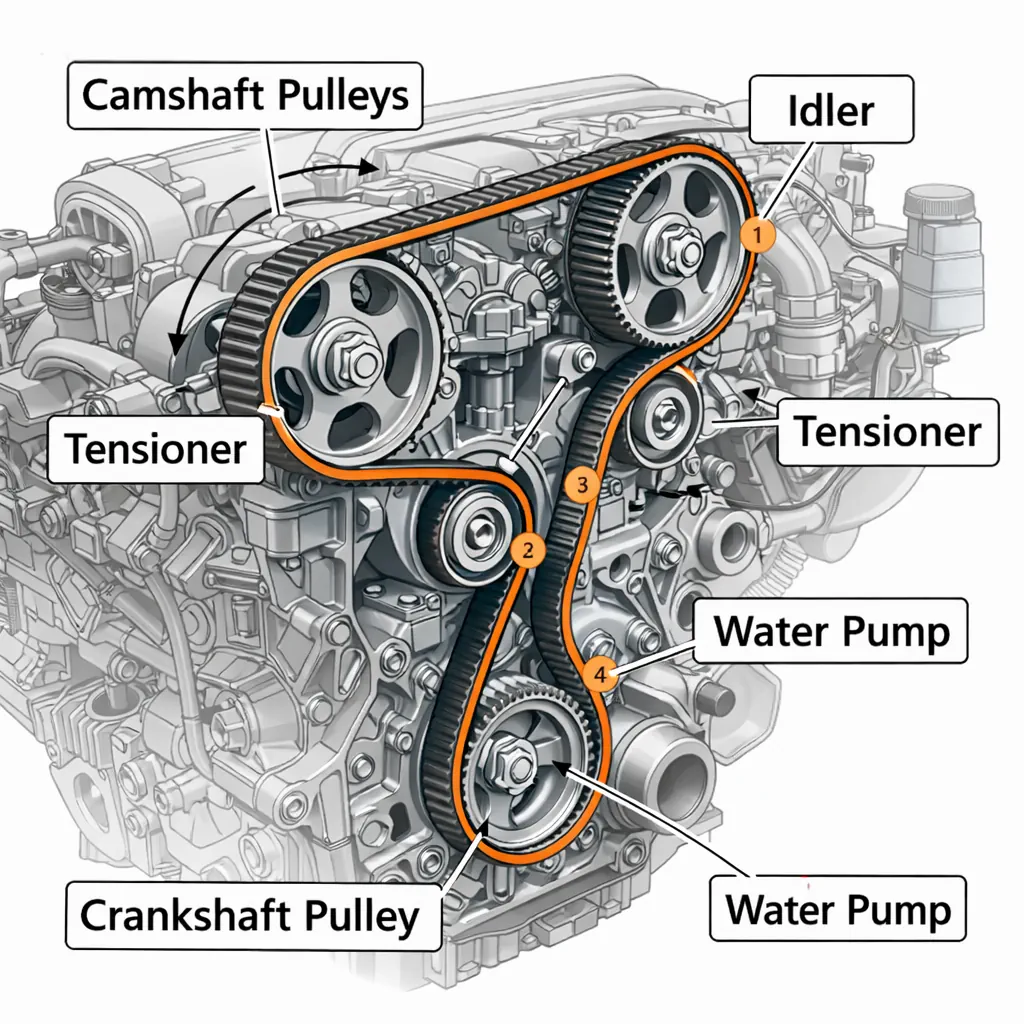
picture. diagram of an open engine compartment showing the path of the timing belt and how it runs over the water pump pulley.
How to choose the right water pump?
There are hundreds of manufacturers on the aftermarket. How do you distinguish a quality product from junk?
1. impeller material
As mentioned, many original parts have plastic impellers (composite material). These are lighter and cheaper to manufacture. Pumps with metal (steel, cast aluminum or brass) impellers are often offered on the aftermarket.
-
Recommendation: prefer a metal impeller, especially for older German cars. It will not crumble or separate from the shaft. However, you should make sure that the metal impeller is of high quality - a heavy and unbalanced impeller can strain the bearing.
2. Seal quality
A water pump is worthless without a proper seal. Cheap pumps come with paper seals that require additional silicone. High-quality manufacturers come with metal or special rubber compound o-rings that ensure a leak-free installation without "marking".
3. Brand and warranty
Well-known brands (like SKF, INA, Gates, Bosch, Hepu, Valeo, etc.) test their products thoroughly. "No-name" Chinese pumps may cost half as much, but their bearings are often of lower quality and are already empty of grease when new. Considering how labor-intensive it is to replace a pump, it's not worth taking the risk to save 20 euros.
DIY Corner: Water Pump Replacement Basics
Can you replace a water pump yourself? Yes, if you have the experience, tools, and patience. If the water pump is driven by a V-belt, the job is easier. If it is a timing belt, this job is more for advanced users.
Here is the general process (always check the manual for your car brand):
preparation and safety
-
NB! Never open the cooling system when the engine is hot! The system is under pressure and hot fluid can splash into your face.
-
disconnect the negative battery terminal (especially if you are working near electric fans).
steps:
-
Drain the system: find the tap at the bottom of the radiator or remove the lower hose. Catch the old fluid in a container (it is dangerous for the environment, do not pour it down!).
-
Creating access: remove the engine covers, air ducts and, if necessary, the fan.
-
Removing the belt: Loosen the tensioner and remove the belt (ribbed belt or timing belt). Note the direction of movement of the belt if you plan to put the old one back on (ribbed belt only!).
-
pump removal: unscrew the pump bolts. the pump may be "stuck" to the block. tap it carefully with a rubber mallet. do not use a screwdriver between the sealing surfaces - scratches will cause leaks later.
-
cleaning the surfaces: this is the most important step . clean the surface of the engine block completely from old gasket and oxide. use a sandpaper or fine sandpaper. the surface must be smooth and clean.
-
Installing a new pump: Fit a new seal. Some seals require lubrication with coolant, others are dry-installed (read the manual). Tighten the bolts to the correct torque (use a torque wrench!). Tightening too hard can damage the seal or break the bolt.
-
assembly: install belts and tensioners. make sure the timing is in place (in the case of timing belts).
-
Filling and bleeding: Pour in new coolant. Bleeding is critical – if there is an air bubble in the system, the fluid will not circulate and the engine will overheat. Many cars have special bleeding nipples. Newer cars require the use of a diagnostic tool or a special procedure (e.g. holding the accelerator pedal in the ignition) to initiate the electric bleeding mode.
Here you can find various special tools for cooling systems and water pumps.
Coolant: the secret to water pump life
Many people don't know that coolant (antifreeze) isn't just there for cooling. It has another very important function: lubrication .
The coolant contains additives that lubricate the water pump seal and prevent corrosion.
-
Old fluid kills the pump: over time these additives break down. The fluid becomes acidic and starts eating away at the metal (impeller) and seals. It also loses its lubricating ability.
-
Wrong fluid: Never mix different types of fluids (e.g. green and red). This can cause a chemical reaction that turns the fluid into a thick "slimy" mass, clogging the pump and radiator.
-
Tap water: do not use tap water! The minerals (scale) in it will deposit on the pump walls and impeller, reducing efficiency and causing malfunctions. Always use distilled water to dilute the concentrate.
Recommendation: Change the coolant every time you change the water pump, or as recommended by the car manufacturer (usually every 2–5 years).
You can find coolant fluids here.
Cavitation – the silent killer of water pumps
On a more technical note, it's worth mentioning a phenomenon called cavitation . It occurs when the pressure in the cooling system is too low or the fluid is old. During operation, small bubbles due to vacuum form behind the impeller blades. When these bubbles burst, they create microscopic shock waves. Over time, these explosions "eat" away pieces of the metal or plastic of the impeller. The result is a holey impeller that can no longer move water.

To prevent cavitation:
-
use high-quality coolant.
-
Make sure the system is airtight and holds pressure (the cap is in place).
Summary
A car's water pump is a detail we don't think about every day, but a failure can ruin your whole day (and your bank account). Whether you have an Audi, Toyota, BMW or Ford – the principles are the same.
Remember the three golden rules:
-
Watch for warning signs (leaks, noises, temperature rise).
-
When you change the timing belt, always change the water pump as well.
-
Don't skimp on the quality of the spare part - a metal impeller and a well-known manufacturer are a sure bet.
Take care of the "heart" of your car, and it will take you to your destination in any weather. Timely maintenance is always cheaper than engine repair. When looking for spare parts, always prefer stores that offer a wide selection and expert advice - this way you can be sure that the right part will end up under the hood of your car.
Have a safe journey and a cool engine!
You can find an informative news article about coolant fluids here.
 The data shown here, especially the complete database of car spare parts, may not be copied. It is strictly prohibited to duplicate the data and database and distribute the same, and/or instruct third parties to engage in such activities, without prior consent from TecAlliance. Any use of content in a manner not expressly authorized constitutes copyright infringement and violators will be prosecuted.