

Engine cylinder pressure and compression
The Heart of the Engine: Everything You Need to Know About Cylinder Compression, Its Loss, and Restoration
In the automotive world, people often talk about horsepower, torque, and acceleration. But there is one fundamental parameter without which none of these would exist — engine compression. It is the engine’s “blood pressure.” When it is within specification, the engine runs smoothly and delivers strong performance. When compression is low or uneven, the vehicle becomes underpowered, fuel consumption increases, and in the worst case, the engine may stop running altogether.
In this comprehensive guide, we break down the anatomy of engine compression. We will examine what physically happens inside the cylinder, why compression is lost, how to measure it correctly, and which popular car models are most prone to compression-related problems.

Image: The pressure gauge of a compression tester showing low compression pressure.
What Is Engine Compression and Why Is It Critical?
Simply put, compression is the pressure created inside an engine cylinder when the piston moves from bottom dead center to top dead center, compressing the air–fuel mixture (or, in the case of a diesel engine, only air) into an extremely small volume within the combustion chamber. The more tightly the mixture is compressed, the more powerful the subsequent ignition and the more energy is released.
Engine compression plays three vital roles in engine operation:
Heat generation: When gases are compressed, their temperature rises. This is crucial in diesel engines, which do not use spark plugs — the fuel ignites solely due to the heat of the compressed air.
Mixture preparation: In gasoline engines, fuel vaporizes better under pressure, ensuring more even and cleaner combustion.
Efficiency: Higher compression generally means greater efficiency — the engine can produce more mechanical work from the same amount of fuel.
In a typical gasoline engine, normal compression pressure ranges from 10–14 bar (145–200 psi). Diesel engines, which require much higher pressure for ignition, usually operate between 20–35 bar (290–500 psi). However, more important than the absolute numbers is uniformity — the pressure difference between cylinders should not exceed 10%.
Symptoms of Low Compression: How Your Car Talks to You
Before reaching for the tools, it’s worth listening to and feeling what the car is telling you. Low compression usually does not occur overnight (except in cases such as a timing belt failure); instead, it is typically a gradual, creeping process that develops over time.
1. Difficult starting (especially when cold)
This is the most classic symptom. If the piston rings or valves are worn, the starter cannot spin the engine fast enough to build the pressure needed in the cylinder for the first combustion. This problem is especially pronounced in diesel engines during winter — the engine cranks for a long time before reluctantly starting.
2. Rough idle and engine vibration
If one cylinder has lower compression than the others, the engine begins to “limp.” That cylinder does not produce the same amount of power, causing the crankshaft to rotate unevenly. The result is vibration felt in the steering wheel and seats, and engine speed may fluctuate at idle.
3. Loss of power and increased fuel consumption
When gases escape from the combustion chamber (for example into the crankcase), part of the energy is wasted. The car accelerates sluggishly, especially during overtaking or uphill driving. The driver instinctively presses the accelerator harder, which increases fuel consumption without a corresponding gain in speed.
4. Blue smoke and oil consumption
If compression loss is caused by worn piston rings, engine oil can enter the combustion chamber and burn there. This produces blue smoke from the exhaust and a characteristic burnt-oil smell.
Where Does the Compression Go? The Main Culprits
 In the image: 1.Worn piston rings allowing compression to leak into the crankcase (blow-by). 2. Leaking intake and exhaust valves. 3. Blown head gasket between the engine block and the cylinder.
An engine cylinder must be a sealed chamber during operation. Leakage points can occur in three main areas:
1. Piston rings and cylinder walls (lower leakage)
Around the piston are elastic metal rings whose job is to seal the gap between the piston and the cylinder wall. Over time, these rings wear out, lose their elasticity, or become carboned up (stuck due to carbon deposits). The cylinder walls themselves may also become scratched or worn (loss of the honing pattern). As a result, compression escapes past the piston and leaks into the crankcase.
2. Valves and valve seats (upper leakage)
Each cylinder has intake and exhaust valves, which must close perfectly to seal the combustion chamber.
Common causes include:
-
Carbon buildup: In direct-injection engines (GDI, TSI, FSI), carbon accumulates on the valves, preventing them from closing properly.
-
Burned valve: Especially common in vehicles running on LPG or with an incorrect air–fuel mixture. The valve edge burns away, creating a physical hole.
- Bent valve: If the timing belt or timing chain breaks or slips, the piston can strike the valve and bend it.
3. Cylinder head gasket (side leakage)
The cylinder head gasket is located between the engine block and the cylinder head. If it blows or fails, compression can leak into several areas:
-
The cooling jacket (coolant overheats or boils).
-
An oil passage (oil and coolant mix together).
- A neighboring cylinder (two adjacent cylinders show low compression).
Measuring Engine Compression: A Step-by-Step Guide
Measuring compression is one of the simplest yet most informative diagnostic procedures. It can be done in a home garage using a dedicated compression gauge.
Preparation
Warm up the engine to operating temperature, as metals expand when hot and seal better. Switch off the engine and remove the spark plugs (on diesel engines: glow plugs or injectors). IMPORTANT: Remove the fuel pump fuse or relay to prevent fuel delivery. Disconnect power to the ignition coils. Make sure the battery is fully charged. A weak battery cranks the engine too slowly and can give false readings.
Procedure
Screw the compression gauge into the spark plug hole of the first cylinder (by hand only, not with tools, to avoid damaging the threads). Have an assistant hold the accelerator pedal fully down (a fully open throttle allows maximum air intake). Crank the engine for about 5–7 seconds, until the gauge needle stops rising. Write down the reading and repeat the process for all cylinders.
“Wet” Test – Identifying the Culprit
If one cylinder shows low compression, perform a so-called wet test. Pour about one teaspoon of clean engine oil into the cylinder through the spark plug hole and measure again.
Interpreting the result:
-
Compression rises noticeably: The oil temporarily sealed worn piston rings. The fault lies in the rings or cylinder walls.
- Compression stays the same: The oil made no difference. The problem is in the upper area — leaking valves or a blown head gasket.
Common Faults and Issues in Popular Car Models
Although wear is a natural process, certain engines are more prone to compression problems due to specific engineering characteristics.
1. Volkswagen Group (TSI / TFSI gasoline engines)
The most notorious examples are the 1.4 TSI (chain-driven) engines and early 1.8 / 2.0 TSI units.
Problem: These engines tend to suffer from stuck piston rings (carbon buildup) and piston failures (ringland failure). Timing chain stretch is also a common issue. If the chain jumps, the valves and pistons collide, resulting in zero compression.
Symptoms: Rough idle, high oil consumption (up to 1 liter per 1,000 km), and eventually complete cylinder failure.
2. Subaru (Boxer engines, especially 2.5 Turbo)
Subaru EJ25 engines are well known for ringland failure.
Problem: The material between the piston rings cracks due to high heat and detonation.
Diagnosis: If removing the oil cap reveals heavy smoke (“blow-by”), it is a strong indication that compression is leaking into the crankcase.
3. BMW (N47 and N57 diesel engines)
These popular 2.0 and 3.0 diesel engines are efficient but have a known weak point in the intake system.
Problem: The swirl flaps in the intake manifold can break off and fall into the cylinder. A metal fragment inside the cylinder destroys the piston and valves, causing instant compression loss.
Solution: As a preventive measure, the flaps are often removed or replaced with reinforced versions.
4. Toyota and Lexus (2.2 D-4D / D-CAT)
Despite Toyota’s otherwise bulletproof reputation, there was a period (approximately 2005–2009) when the 2.2-liter diesel engines suffered from cylinder head gasket issues.
Problem: Carbon buildup between the piston and the cylinder head caused the head gasket to fail.
Result: Compression leaked into the cooling system, forcing coolant out of the expansion tank.
5. Mazda (RX-8 Wankel engine)
The rotary engine is a special case where compression is the number-one wear factor.
Problem: The rotor seals (apex seals) wear relatively quickly. Compression in a Wankel engine is not measured with a standard gauge but with a special tester that measures the pressure of all three chambers separately.
Service life: Many rotary engines require a major rebuild before 100,000 km, primarily due to low compression (a typical symptom is that the engine will not start when warm).
6. Ford (1.0 EcoBoost “EcoBoom”)
Small, high-output engines operate at very high temperatures.
Problem: If the cooling system fails (for example, a plastic coolant pipe breaks), the cylinder head can overheat and warp extremely quickly.
Consequence: After overheating, cylinder ovality and cylinder head warping are often so severe that compression is permanently lost, and the engine usually requires complete replacement.
Can Low Compression Be Fixed Without Repairs?
This is a question many car owners ask while hoping for a “miracle in a can.” The answer is: it depends on the cause.
Chemical additives and cleaning:
If low compression is caused by stuck piston rings (due to carbon or varnish buildup), special engine flushes, fuel additives, or soak-in treatments poured directly into the cylinder can sometimes help free the rings. In such cases, compression may improve noticeably.
Ceramic additives:
Some oil additives claim to fill microscopic scratches in the cylinder walls with ceramic material. These may temporarily reduce smoke and slightly increase compression, but they do not repair physically worn metal or cracked pistons. The effect, if any, is usually temporary.
Mechanical repair is unavoidable when:
-
A valve is burned or bent
-
A piston is cracked
-
The cylinder head gasket has failed
-
The timing belt has broken
In these situations, no “magic fluid” will help — the only solution is opening the engine and replacing the damaged components.
Prevention: How to Keep Your Engine “Healthy”?
Maintaining compression is directly linked to regular maintenance. Here are the golden rules:
-
Oil changes: Change the oil regularly (preferably every 10,000–15,000 km rather than extended “longlife” intervals of 30,000 km). Clean oil keeps piston rings free-moving and reduces wear.
-
Air filter: A dirty air filter allows dust and sand into the engine, which acts like sandpaper inside the cylinder, wearing down cylinder walls and piston rings.
-
Cooling system: Avoid engine overheating. Even a single serious overheat can permanently damage the head gasket and reduce piston ring elasticity.
-
Fuel quality: Poor-quality fuel creates more carbon deposits, which accumulate on valves and piston rings.
-
Timing belt replacement: Do not delay timing belt or chain replacement. A broken belt is the fastest (and most expensive) way to lose compression in all cylinders at once.
 Image. On the left, a clean new piston; on the right, a piston with carbon buildup and worn piston rings.
Conclusion
Engine compression is the foundation of a car’s health. Losing compression does not always mean a death sentence for the vehicle, but it does require quick and accurate action. It is important to distinguish whether the issue is normal wear that requires a major overhaul, or a simpler problem such as carboned-up piston rings that can be resolved with cleaning.
If you are planning to buy a used car, a compression test is one of the most reliable ways to make sure you are not buying a “pig in a poke.” This small investment in inspection can save thousands of euros in future engine repair costs. Take care of your engine, change the oil regularly, and listen to what your car is telling you — a strong “heart” ensures worry-free kilometers for years to come.
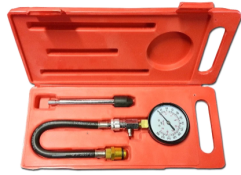
You can find the necessary tools for measuring compression here.
 The data shown here, especially the complete database of car spare parts, may not be copied. It is strictly prohibited to duplicate the data and database and distribute the same, and/or instruct third parties to engage in such activities, without prior consent from TecAlliance. Any use of content in a manner not expressly authorized constitutes copyright infringement and violators will be prosecuted.