

Car chassis construction and parts
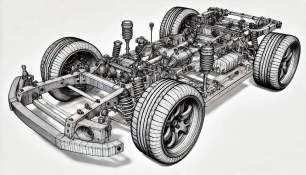
The chassis of a car is an important system of a vehicle that connects the wheels and the body, allowing safe and stable movement. It consists of various mechanisms and components that ensure the vehicle's handling, comfort and roadholding. In this article, we will provide an overview of the chassis structure and introduce in more detail important components such as wishbones, steering arm, pendulum arm, track rod, steering knuckle, hinges, bridge beam and steering rods.
What is a car chassis?
The chassis is a mechanical system that includes all the components that connect the vehicle body to the wheels. Its purpose is to ensure the stability, handling and safety of the vehicle, and to provide a comfortable experience for passengers. The chassis includes suspension, steering and turning components, as well as power transmission mechanisms.

Figure 1 (chassis of an older vehicle)
1. Control arm
2. Steering Arm
3. Idler Arm
5. Tie rod end
6. Ball Joint
7. Axle beam
8. Tie Rod
9. Tie rod end

Figure 2 (front-wheel drive car chassis)
1. Shock absorber dust boot
2. Shock absorber
3. Shock Absorber Mount
4. Spring
5. Steering knuckle
6. Ball joint
7. Lower control arm
8. Lower control arm bushing
9. Stabiliser Bar or Sway bar
10. Stabiliser Bar or Sway bar bushing
11. Drive Shaft
12. Steering Gear
13. Inner tie rod
14. Outer tie rod

Figure 3. Vehicle Axle with Stabilizer Bar
-
1. Stabilizer Bar (Sway Bar / Anti-Roll Bar)
2. Stabilizer Bar End Link (Sway Bar End Link)
3. Stabilizer Bar Bushings (Sway Bar Bushes)

Figure 4. Steering Rod
-
1. Inner Tie Rod (Inner Tie Rod End)
-
2. Outer Tie Rod (Outer Tie Rod End)
-
1 + 2. Tie Rod Assembly (Inner + Outer Tie Rod)


Photo. Vehicle lifted on a car lift – underside view.
Important chassis components
1. Control arm
Control arms are the main components of the chassis that connect the wheels to the vehicle body and allow the wheels to move up and down. They are important for the operation of the suspension and ensuring driving stability.
- Function: Keeps the wheels in the correct position and allows vertical movement.
- Location: The front suspension has upper and lower wishbones, while the rear suspension may only have one, depending on the system.
2. Steering Arm
The steering arm is connected to the steering rod and transfers the movement from the driver to the wheels.
- Function: Directs the rotation of the wheels, following the driver's steering wheel.
- Location: Usually connected to the steering rack or steering gear.
3. Idler Arm
The idler arm (or idler arm bracket) is an important component used to stabilize the chassis, especially in independent suspension systems.
- Function: Stabilizes the chassis and maintains vehicle balance, allowing for smooth movement
4. Tie Rod
The tie rod is the part of the steering mechanism that connects the steering column to the steering tips and ensures the correct steering of the wheels.
- Function: Transmits the movement from the driver accurately to the wheels.
- Special features: Can be adjusted to align the wheels correctly.
5. Tie Rod
A tie rod (steering knuckle) is a part that allows the steering mechanism to move at different angles while maintaining a smooth power transmission.
- Function: Connects and allows movement between the various parts of the steering system.
- Location: Found at the joints of the steering rack and tie rod.
6. Ball Joint
Ball joints are important pivot joints that connect suspension and steering components.
- Function: Allows the wheels to rotate and move vertically, maintaining stability.
- Common problem: Worn joints cause play and can affect the vehicle's handling.
7. Axle beam
A axle beam is a rigid beam that connects the two wheels of a vehicle. This is especially important in dependent suspension systems.
- Function: Provides stability and strength between the wheels.
- Location: Usually on the rear axle in dependent suspension.
8. Tie rod
Tie rods are parts of the steering mechanism that connect the steering rod to the steering tips and transfer the steering force to the wheels.
- Function: Directs the wheels according to the driver's movement of the steering wheel.
9. Tie rod end
Tie rods are located at the ends of the tie rods and connect the tie rods to the wheel assembly. They are one of the main adjustable parts in wheel alignment.
- Function: Ensures the correct direction and smooth movement of the wheels.
- Wear Part: Worn tie rods cause play and uneven tire wear.
 Photo. Unevenly worn tire.
Chassis operating principle
All parts of the chassis work together to ensure:
Stability: Keep the car straight and stable on the road.
Comfort: Absorb road irregularities.
Control: Allow the wheels to turn and move smoothly.
Safety: Help maintain control of the vehicle in various conditions.
Maintenance and problems
The chassis is subjected to a lot of stress, so its components require regular maintenance. Common problems:
- Worn out ball joints and damaged bushings.
- Looseness in the tie rod ends.
- Failure of shock absorbers or springs.
- Looseness in the tie rods or steering arms.
Common Suspension Problems by Car Brand
Different car manufacturers use different engineering solutions to achieve either maximum comfort or a sportier driving experience. However, every solution comes with its own cost and inherent weak points.
Volkswagen Group (VW Passat, Audi A4/A6, Škoda Superb)
Vehicles from the VAG Group are well known for their driving comfort, which is often achieved through the use of multi-link suspension.
- Complex front suspension: Models such as the Audi A4 and VW Passat use a four-link front suspension. While this design provides excellent handling and road stability, it also means that each front wheel has four control arms and four ball joints. Common issue: The upper aluminum control arms tend to wear out relatively quickly. A well-known problem is also the so-called “long bolt” that secures the upper control arms — it often corrodes and seizes inside the steering knuckle.
- Rear suspension bushings: On simpler models (such as the Golf and Octavia), a torsion beam rear axle is used. The large rubber bushings in this setup wear out over time, causing instability or a “floating” feeling at the rear of the vehicle.
 Photo. Worn bushings.
BMW (3 Series, 5 Series, X Series)
BMW achieves its renowned handling through precise but complex suspension geometry.
- Hydraulic bushings: The large front control arms (reaction rods) use oil-filled hydraulic bushings. Common issue: These bushings tend to fail and leak oil, resulting in strong vibrations during braking and vague steering feel.
- Rear subframe (“rear axle carrier”): Older models were known for cracking rear subframe mounting points. On newer models, the rear subframe bushings wear out over time, causing clunking noises during gear changes or throttle transitions.
Toyota and Japanese Vehicles (Avensis, Corolla, Honda Accord, Mazda 6)
Japanese cars are generally considered reliable and often feature simpler suspension designs, such as MacPherson struts.
- Brake caliper slide pins: A common issue on Japanese vehicles is worn brake caliper slide pins, which cause a metallic rattling noise while driving and are often mistaken for a suspension fault.
- Stabilizer bar bushings: These wear out relatively quickly and cause dull knocking noises when driving over bumps.
- Rusting subframes: On Mazda and some older models, severe rust affecting subframes and control arms is a known problem.
Mercedes-Benz (E-Class, S-Class)
- Air suspension (Airmatic): Weak points include air springs that crack and leak, as well as the compressor, which can fail due to constant operation.
- Ball joints: The vehicle’s weight places high loads on the lower suspension joints, and wear is noticeable as loud knocking noises.
Ford and Volvo (Focus, Mondeo, Volvo V50 / S40)
- Rear suspension bushings: On vehicles with the “Control Blade” suspension design, the large rear “butterfly bushings” wear out over time. Symptoms include an unstable rear end and sawtooth tire wear.
- Front coil springs: On certain models, the front coil springs are prone to breaking at the lower coil.
Main Suspension Components: What Is What and Why They Fail
1. Control Arm
The control arm is a metal component that connects the vehicle body to the steering knuckle. The arm itself rarely breaks, but the rubber bushings and ball joints attached to it wear out over time. If these components are integrated into the arm, the entire control arm must be replaced.
2. Ball Joint
A ball joint is a spherical joint that allows the wheel to move and steer. If the rubber dust boot is damaged, sand and dirt can enter the joint, accelerating wear and causing dangerous play in the suspension.
3. Stabilizer Bar (Sway Bar)
The stabilizer bar connects the left and right sides of the suspension to reduce body roll during cornering. Because it absorbs impacts from every bump in the road, it is one of the fastest-wearing suspension components.
4. Shock Absorber and Spring
The spring supports the vehicle’s weight, while the shock absorber dampens oscillations. A worn shock absorber increases braking distance and makes the vehicle unstable, especially during cornering and emergency maneuvers.
How to Extend the Life of Your Suspension and Save Money
1. Avoid Impacts While Braking
One of the biggest mistakes is driving over potholes while keeping the brake pedal pressed. This keeps the suspension under load and transfers the impact directly to the components. Brake before the pothole and release the brake just before hitting the obstacle.
2. Choose Quality Parts
The cheapest suspension parts often last only around 10,000 km. Premium manufacturers such as Lemförder, TRW, Sachs, and SKF offer reinforced components that can last several times longer.
3. Regular Wheel Alignment
After replacing any suspension components, it is recommended to perform a wheel alignment. Incorrect toe or camber settings will quickly wear out tires and put unnecessary stress on new parts.
4. Listen to Your Car
Do not ignore small knocking noises. One worn or loose component will start damaging the next one — for example, a worn ball joint can eventually damage the steering rack.
Summary
The vehicle suspension system is a complex and diverse assembly in which all components — from control arms and steering arms to tie rod ends and ball joints — work together to ensure safety, stability, and driving comfort. Regular maintenance and early detection of issues help prevent more serious failures and significantly extend the vehicle’s lifespan.
If you are carrying out vehicle repairs, here you will find a wide selection of tools for suspension and undercarriage repair.
 The data shown here, especially the complete database of car spare parts, may not be copied. It is strictly prohibited to duplicate the data and database and distribute the same, and/or instruct third parties to engage in such activities, without prior consent from TecAlliance. Any use of content in a manner not expressly authorized constitutes copyright infringement and violators will be prosecuted.